A static risk document is a liability in an era where the SEC requires material incident reporting within four business days. If your strategy doesn't account for the $4.45 million average cost of a data breach or the March 2026 NIS2 compliance deadline, your organization is flying blind. Finding a practical cyber risk appetite statement example is the first step toward moving from reactive defense to proactive command. You need a document that translates technical vulnerabilities into the financial language your Board actually understands.
You're likely feeling the pressure to prove informed risk-taking while managing a supply chain that grows more complex by the hour. It's frustrating to draft boundaries that feel obsolete the moment they're signed. This guide helps you master the art of defining those boundaries using real-world 2026 frameworks. You'll learn how to build a defensible document that prioritizes security investments and aligns business growth with necessary constraints. We'll show you how to move beyond static spreadsheets toward a model of continuous risk intelligence that reflects your true security posture to the outside world.
What is a Cyber Risk Appetite Statement?
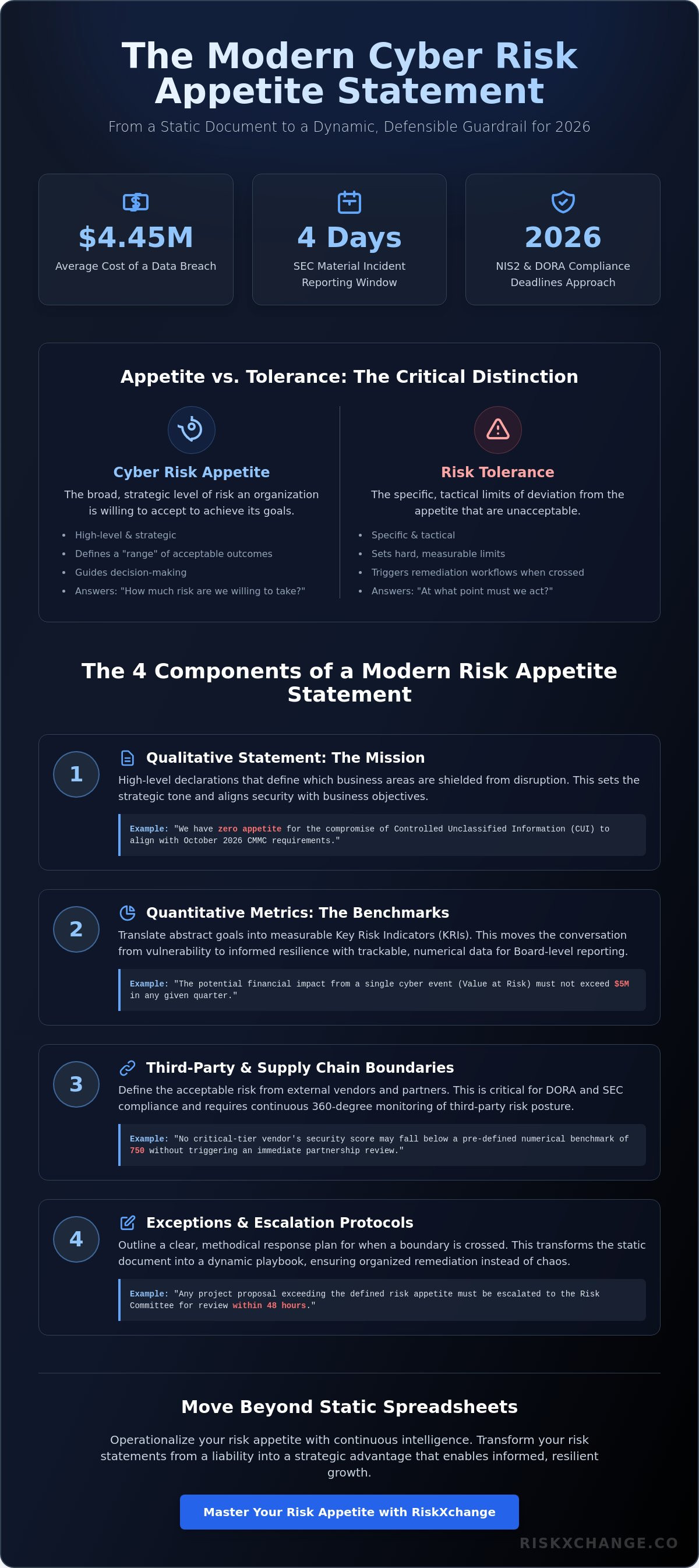
A cyber risk appetite statement is the strategic boundary defining the level of digital loss an organization is prepared to accept while pursuing its business objectives. It serves as the bridge between high-level corporate strategy and technical execution. Risk appetite is not a fixed point. It's a range of acceptable outcomes that allows for innovation without compromising the organization's fundamental viability. By quantifying these boundaries, you move the conversation from a state of vulnerability to one of informed resilience.
In 2026, this document has evolved from a best practice into a regulatory mandate. Under the SEC's enhanced enforcement rules and the EU's DORA framework, boards must demonstrate "informed" risk-taking. It's no longer enough to claim a zero-risk posture; regulators expect a documented, quantifiable approach to managing exposure. A robust cyber risk appetite statement example will specify exactly how much financial impact from a supply chain breach is acceptable before the business model is threatened. This clarity is essential when the average cost of a data breach sits at $4.45 million and incident reporting timelines are as tight as 72 hours under CIRCIA.
Appetite vs. Tolerance: The Critical Distinction
Confusion between these terms often leads to operational friction. Cyber risk appetite is the broad target level of risk a firm is willing to accept to meet its goals. In contrast, risk tolerance represents the hard, tactical limits within that appetite. If appetite is the speed limit, tolerance is the point where the police pull you over.
For those looking for a concise definition: Cyber risk appetite is the strategic threshold of digital uncertainty an organization accepts to achieve its commercial mission. When an organization exceeds its tolerance levels, it triggers specific remediation workflows. For example, if a third-party vendor's risk score drops below a pre-defined numerical benchmark, the system should immediately flag the partnership for review. This moves security from abstract concepts to manageable, trackable data points.
The Role of the Board in Defining Appetite
Setting the "tone at the top" is a non-negotiable Board responsibility. A clear statement provides the CISO with the political capital to say "no" to high-risk projects that fall outside the agreed-upon boundaries. It shifts the perception of security from a cost center to a risk-informed enabler.
We've moved past the zero-risk fallacy. Boards in 2026 recognize that total security is an impossibility. Instead, they focus on informed resilience. By documenting these boundaries, the leadership team ensures that security constraints are aligned with business growth. This creates a world where challenges are visible, measurable, and manageable, allowing the company to navigate the threat landscape with proactive control.
The 4 Components of a Modern Cyber Risk Appetite Statement
A modern risk statement functions as a dynamic guardrail rather than a static policy. To build a document that survives the scrutiny of the 2026 regulatory environment, you must integrate four core components. The first is the qualitative statement, which serves as the "mission" of your risk posture. These are high-level declarations that define which business areas are shielded from any level of disruption. For instance, a cyber risk appetite statement example might state that the organization has zero appetite for the compromise of Controlled Unclassified Information (CUI), aligning with the October 2026 CMMC requirements.
The second component involves quantitative metrics. This is where you move from abstract goals to measurable benchmarks. Utilizing cybersecurity risk appetite statement examples that leverage Value at Risk (VaR) allows you to translate technical debt into specific financial impact. Third, you must address third-party and supply chain boundaries. Given that 2026 regulations like DORA and the SEC amendments focus heavily on external exposure, your statement is incomplete without defining the risk you'll accept from vendors. Finally, the document must outline clear exceptions and escalation protocols. This ensures that when a boundary is crossed, the organization responds with a steady, methodical, and highly organized remediation process.
Quantifying the Qualitative: Setting Real Benchmarks
Translating the Board's strategic intent into trackable data is the hallmark of a sophisticated guardian. You should use financial impact models to set thresholds for "Critical" versus "High" risks. In this framework, "Critical" risks often require immediate cessation of the associated activity, while "High" risks may be accepted temporarily with a documented mitigation plan. Incorporating security ratings as a benchmark allows you to evaluate your true security posture through an externalized lens. This transition from obscurity to clarity ensures that your risk boundaries are visible, measurable, and manageable for all stakeholders.
Incorporating Third-Party Risk (TPRM) Boundaries
Supply chain exposure is often the weakest link in an otherwise robust defense. An effective appetite statement must define acceptable "Security Rating" floors for Tier-1 suppliers to prevent upstream vulnerabilities from becoming internal crises. Aligning vendor onboarding with your overall risk appetite prevents the introduction of "shadow risk" into your ecosystem. To maintain this command, many CISOs are moving toward continuous real-time risk management platforms. This proactive control ensures that your supply chain stays within your defined boundaries, moving the conversation from a state of vulnerability to one of informed resilience.
3 Cyber Risk Appetite Statement Examples for 2026
Transitioning from theoretical frameworks to operational reality requires a cyber risk appetite statement example that mirrors your specific industry pressures. In 2026, a generic template is no longer sufficient. Your statement must reflect the unique intersection of your business objectives and the regulatory environment you inhabit. Whether you're managing a global supply chain or protecting critical infrastructure, these examples provide a benchmark for documenting your boundaries with precision and command.
Example 1: The "Low-Appetite" Financial Institution
For organizations in the financial sector, the priority is absolute data integrity and strict regulatory compliance. With the SEC's enhanced enforcement and DORA's March 2026 compliance deadline, the margin for error is non-existent. This institution prioritizes the protection of Personally Identifiable Information (PII) above all other operational goals. Their statement focuses on immediate remediation and high-floor vendor standards.
- Qualitative Goal: Maintain a zero-tolerance posture toward unauthorized access of customer financial data and PII.
- Key Risk Indicator (KRI): Zero critical vulnerabilities remain unpatched for longer than 24 hours across the production environment.
- Third-Party Boundary: No engagement with vendors or supply chain partners possessing a security rating below 750 on our proprietary numerical benchmark.
Example 2: The "Growth-Focused" Tech Enterprise
A retail or e-commerce giant often adopts a moderate appetite to facilitate rapid innovation and market expansion. They accept a higher level of "calculated" risk to integrate emerging technologies like Generative AI, provided core availability remains intact. This cyber risk appetite statement example balances the need for speed with the necessity of operational resilience.
- Qualitative Goal: Ensure seamless customer experiences by prioritizing platform availability and rapid feature deployment.
- Key Risk Indicator (KRI): Maintain 99.9% system uptime, even during active threat mitigation or peak traffic periods.
- Innovation Boundary: AI-native technologies may be deployed if they undergo a real-time risk assessment and don't introduce vulnerabilities that exceed a $1 million Value at Risk (VaR) threshold.
Example 3: Critical Infrastructure and Zero-Tolerance
For energy, water, or healthcare providers, the focus shifts to operational technology (OT) and physical safety. Under CIRCIA, these entities must report significant incidents within 72 hours. Their appetite for operational downtime is zero. Any disruption to the supply chain that could impact service delivery is treated as a critical breach of boundary.
Customizing these examples for your organization requires an honest assessment of your current maturity. You shouldn't adopt a "low-appetite" stance if your security controls can't support 24-hour patching cycles. Instead, move the conversation from a state of vulnerability to one of informed resilience by setting benchmarks that are challenging yet attainable. As your maturity grows, your appetite statements should tighten, reflecting an increasingly sophisticated security posture.
How to Operationalize Your Risk Appetite Statement
A static document is a liability. To breathe life into your strategy, you must map your high-level targets to specific security controls across your digital infrastructure. This process transforms a cyber risk appetite statement example from a passive policy into an active enforcement mechanism. By establishing Key Risk Indicators (KRIs), you create a trackable, numerical benchmark that alerts leadership when boundaries are threatened. This methodical approach ensures that every security investment serves a documented strategic purpose.
Operationalizing your boundaries requires five distinct steps:
- Map each cyber risk appetite statement example to specific technical security controls.
- Define KRIs for real-time performance tracking against your thresholds.
- Deploy continuous monitoring for both internal and third-party assets.
- Establish a feedback loop for quarterly Board reporting and review.
- Recalibrate appetite levels based on the shifting 2026 threat landscape.
Continuous Monitoring: Moving Beyond the Annual Review
Relying on annual reviews is a strategy rooted in the past. In a world of zero-day exploits, your boundaries must be defended with immediacy and thoroughness. Attack Surface Management (ASM) provides the externalized perspective needed to see your organization as a threat actor does. Integrating a solution like RiskXchange allows you to maintain a 360-degree view of your supply chain. This transparency ensures that vendor risks are visible and manageable before they breach your thresholds. By shifting to a model of persistent oversight, you move the conversation from a state of vulnerability to one of informed resilience.
Reporting Progress to the Board
The Board needs a lens through which they can evaluate the company's true security posture. A Risk Heat Map is an essential tool for this, visually pinpointing where the organization is operating outside its appetite. When reporting, distinguish clearly between remediation, which fixes the root cause, and mitigation, which simply lowers the impact. Translating granular technical data into a language of financial impact empowers the Board to make informed decisions about risk-taking and business growth. This data-driven honesty builds the quiet confidence needed to navigate a volatile technological landscape.
Command your supply chain's security posture by adopting continuous real-time risk management to ensure your partners stay within your defined limits.
Managing Your Risk Appetite with RiskXchange
Establishing a cyber risk appetite statement example is a critical first step, but documenting boundaries is meaningless without the capability to enforce them. RiskXchange provides the 360-degree visibility required to move your strategy from a static document into a living, breathing defense. By utilizing an AI-native TPRM platform, you gain the power to monitor your entire supply chain in real time, ensuring that no vendor or partner inadvertently breaches your established risk thresholds. This transition from reactive defense to proactive command is what distinguishes elite security organizations in 2026.
Manual tracking and annual spreadsheets cannot keep pace with a volatile technological landscape. RiskXchange automates the quantifiable metrics required for your risk appetite statement, providing a trackable, numerical benchmark for every asset in your ecosystem. This data-driven honesty ensures that your security posture is always visible, measurable, and manageable. When you can see your organization from an externalized perspective, you gain the clarity needed to evaluate your true resilience and make informed decisions that align with business growth.
Real-Time Risk Ratings as a Source of Truth
Subjective guesswork has no place in modern risk management. RiskXchange replaces vague assessments with continuous, quantifiable risk ratings that serve as your primary source of truth. Unlike point-in-time audits that become obsolete within weeks, our platform offers persistent oversight of your digital footprint. This immediacy allows you to detect deviations from your risk appetite the moment they occur. We invite you to book a demo to see how these real-time insights can clarify your current risk posture and simplify Board reporting.
Securing the Supply Chain: The Final Frontier
Supply chain vulnerabilities represent the most significant threat to your defined risk boundaries. RiskXchange empowers you to set and enforce appetite levels for thousands of vendors simultaneously, moving the conversation from a state of vulnerability to one of informed resilience. By providing actionable risk intelligence, the platform ensures that your third-party ecosystem remains within the "guardrails" established by your leadership. This level of thoroughness prevents upstream issues from cascading into internal crises.
Ultimately, a well-defined risk appetite is not about restriction; it's about the power to grow safely. When you have total command over your risk landscape, you can pursue innovation with the quiet confidence of a seasoned expert. RiskXchange provides the lens through which you can navigate the modern threat landscape, ensuring that every challenge is visible and every strategic boundary is defended. By integrating continuous real-time risk management, you turn security from a constraint into a competitive advantage.
Secure Your Strategic Boundaries with Measured Confidence
Navigating the 2026 threat landscape requires a precise alignment between your commercial objectives and your digital limits. We've examined how a cyber risk appetite statement example serves as a trackable, numerical benchmark, moving your strategy from abstract fear to informed resilience. By operationalizing these boundaries through continuous monitoring and supply chain oversight, you ensure your organization remains in total command of its security posture.
Enforcing these limits is a persistent task that requires sophisticated tools. RiskXchange provides the AI-native TPRM solution and real-time security ratings trusted by Fortune 500 enterprises to manage complex supply chain exposure. Our platform transforms obscurity into clarity, providing the lens through which you can evaluate your true posture with data-driven honesty. Download our Cyber Risk Management Framework to start building a world where your challenges are visible, measurable, and manageable.
You have the power to turn security from a constraint into a strategic enabler. With the right data and a proactive mindset, you'll lead your organization toward a future of secure, sustainable growth.