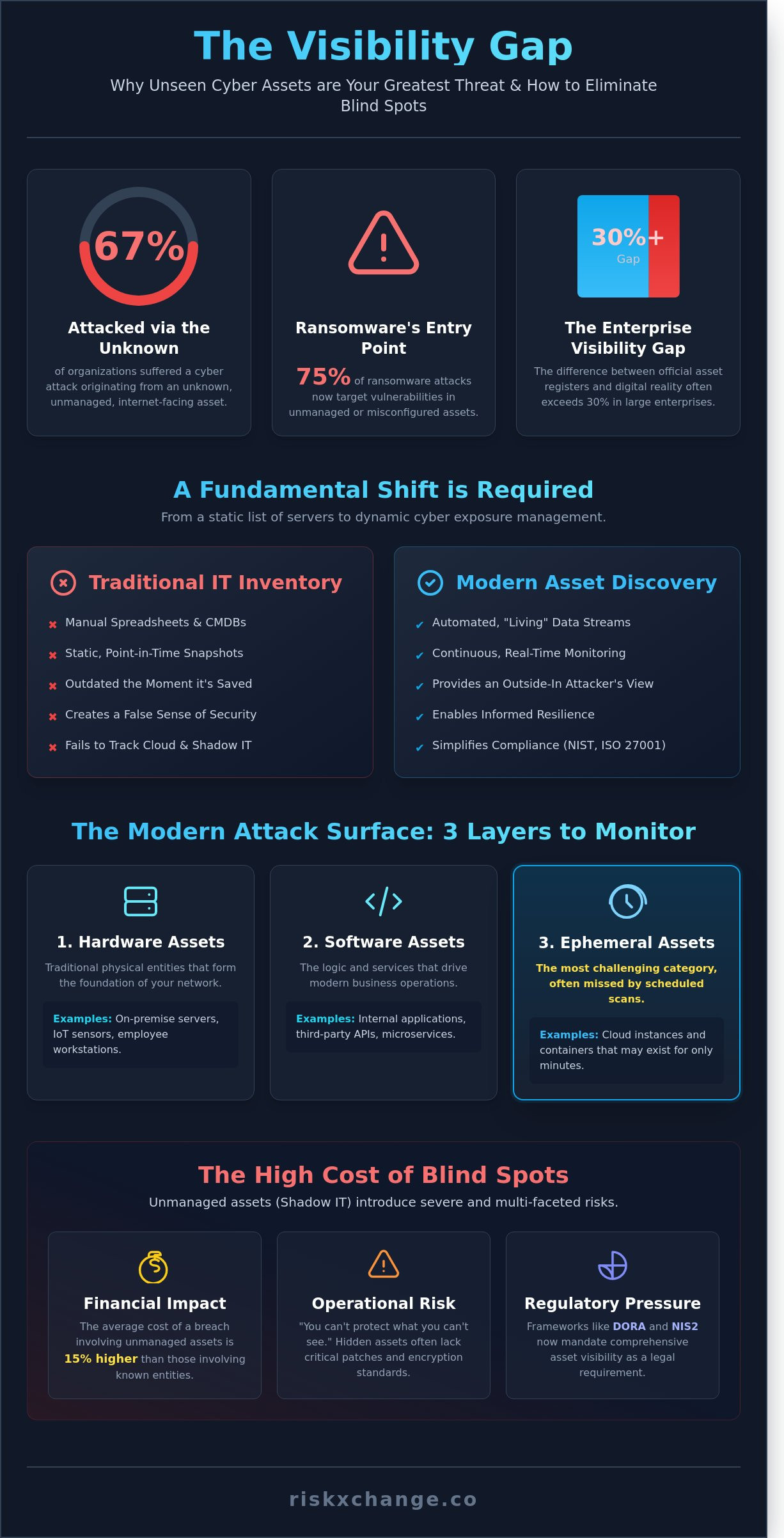
A 2023 report found that 67% of organizations suffered a cyber attack originating from an unknown, unmanaged internet-facing asset. If you can't see an asset, you can't secure it. You've likely realized that manual tracking is a losing game; your inventory is outdated the moment the spreadsheet is saved. This lack of visibility into shadow IT and third-party supply chains creates dangerous entry points that attackers are eager to exploit. Transitioning to a proactive stance requires a robust approach to cyber asset discovery that provides an outside-in view of your digital footprint.
You deserve a security posture defined by informed resilience rather than guesswork. It's time to replace blind spots with a clear, quantifiable perspective on risk. This guide will show you how to master the fundamentals of asset discovery to eliminate vulnerabilities and take control of your infrastructure. You'll learn how to build a real-time, automated inventory that simplifies compliance with frameworks like NIST or ISO 27001. We'll examine the specific steps to prioritize vulnerabilities based on asset criticality, moving your team into a state of measurable, actionable security.
Defining Cyber Asset Discovery in the Modern Threat Landscape
Cyber asset discovery is the continuous process of identifying, cataloging, and monitoring every digital entity that interacts with an organization's network. It represents a fundamental shift from static IT inventory management to dynamic cyber exposure management. In the 2026 threat environment, a "list of servers" is no longer sufficient. Organizations must now account for a fluid ecosystem of cloud workloads, SaaS applications, and temporary microservices. High-performing security teams use cyber asset discovery to transform their security posture from a reactive state of digital vulnerability to one of informed resilience.
This process provides the essential data needed to calculate a reliable Cybersecurity Rating. Without a complete view of the environment, any risk assessment remains incomplete. By adopting an outside-in perspective, businesses can see exactly what an attacker sees. This visibility is the first step in taking control of the digital footprint and ensuring that no component remains hidden from security protocols.
What Qualifies as a Cyber Asset?
The modern attack surface is composed of three distinct layers that require constant monitoring. First, hardware includes traditional physical entities such as on-premise servers, IoT sensors, and the workstations used by a distributed, remote workforce. Second, software assets encompass internal applications, third-party APIs, and the microservices that drive modern business logic.
The third and most challenging category involves ephemeral assets. Cloud instances and containers often exist for only hours or minutes before being decommissioned. These temporary entities change the discovery game; they require automated tools that can track assets in real time rather than at scheduled intervals. If a container is spun up and shut down between scans, it remains a blind spot that could harbor undetected vulnerabilities.
The Cost of Blind Spots
Unmanaged assets, or Shadow IT, are the primary vectors for modern security breaches. Industry data shows that 75% of ransomware attacks now target vulnerabilities in unmanaged or misconfigured assets that the IT department didn't even know existed. This "visibility gap" is the difference between the official asset register and the actual digital reality. In many enterprises, this gap exceeds 30%, leaving a massive portion of the infrastructure unprotected.
- Regulatory Pressure: Frameworks like DORA and NIS2 now mandate comprehensive asset visibility as a legal requirement for operational resilience.
- Financial Impact: The average cost of a breach involving unmanaged assets is 15% higher than those involving known entities.
- Operational Risk: You can't protect what you can't see; hidden assets often lack critical patches and encryption standards.
Closing these gaps isn't just about security; it's about institutional stability. When a business gains total visibility, it moves from a position of uncertainty to one of proactive control. This clarity allows leaders to allocate resources effectively and meet the rigorous demands of global compliance standards.
The Mechanism of Visibility: Active, Passive, and Outside-In Methods
Visibility isn't a static snapshot. In 2023, 67% of organizations reported that their attack surface expanded faster than their ability to secure it. Traditional internal scanning, which relies on scheduled point-in-time checks, often misses ephemeral cloud assets or shadow IT. Modern cyber asset discovery replaces this with a non-intrusive, continuous approach, providing a real-time stream of data that eliminates blind spots. These AI-native platforms synthesize multiple data streams, from DNS records to cloud APIs, to ensure that no asset remains hidden.
The transition to non-intrusive discovery is critical for maintaining operational stability. Unlike legacy tools that could disrupt network performance, modern solutions observe and analyze without interference. As detailed in the NIST IT Asset Management Practice Guide, establishing a comprehensive inventory is the foundational step for any resilient security posture. By centralizing this data, companies can move from reactive patching to a state of proactive resilience that scales with their digital growth.
Active vs. Passive Discovery
Active discovery involves direct probing. The system sends packets to network endpoints to solicit responses, providing granular data on configurations, open ports, and installed software. It's highly effective for managed corporate environments where deep detail is required. However, active probing can be risky in sensitive Operational Technology (OT) or medical environments. In a 2024 hospital setting, for example, an aggressive scan might inadvertently crash a legacy life-support monitor or a sensitive MRI machine.
Passive discovery provides a safer alternative by monitoring network traffic at the packet level without direct interaction. It identifies "silent" devices that only communicate occasionally, making it ideal for fragile environments where uptime is non-negotiable. While passive methods might lack the granular configuration depth of active scans, they offer a continuous, zero-risk view of the network landscape. Most elite teams now use a hybrid approach to balance depth with safety across diverse infrastructure.
The 'Outside-In' Methodology
The most effective way to understand your risk is to view your organization through the eyes of an adversary. This methodology mimics the reconnaissance phase of a cyberattack, scanning the public internet to identify every exposed touchpoint. It uncovers misconfigured subdomains, open ports, and even leaked credentials circulating on the dark web. Outside-In Discovery is the process of mapping a digital footprint from the public internet perspective.
By identifying these external vulnerabilities, businesses can calculate a more accurate Cybersecurity Rating and prioritize remediation based on actual exposure. This perspective is vital because it catches the 31% of assets that typically fall outside the reach of internal security controls. You can monitor your attack surface with this same level of precision to ensure that your external perimeter remains impenetrable. Taking control of this narrative allows you to manage threats before they become incidents.
Why Traditional IT Inventory Fails Modern Cybersecurity Needs
Many security leaders believe their Configuration Management Database (CMDB) or a meticulously maintained Excel sheet provides sufficient coverage. This is a dangerous misconception. Static databases are effectively born dead in a cloud-first environment. Traditional inventory tools rely on manual entry or scheduled internal scans, which creates a significant lag between an asset's creation and its protection. In a world where cloud instances spin up and down in seconds, a weekly scan leaves your organization blind for 99% of the time.
We must distinguish between traditional asset management and modern cyber asset discovery. The former focuses on lifecycle, depreciation, and procurement costs. It asks: "How much did this server cost and when does the license expire?" The latter focuses on risk, exposure, and the outside-in perspective. It asks: "Is this asset visible to an attacker, and what is its current security posture?" Relying on internal tools alone misses the third-party context and external exposures that modern adversaries exploit.
The Shadow IT Problem
Department-led SaaS purchases and "credit card IT" bypass traditional procurement every day. Marketing teams launch microsites for short-term campaigns, while developers spin up testing environments that they later forget to decommission. Research from the Cloud Security Alliance indicates that organizations typically underestimate their cloud footprint by 30%. These forgotten assets represent the path of least resistance for attackers. Without continuous cyber asset discovery, these blind spots grow until they become entry points for a breach.
- Orphaned Domains: Marketing sites from 2021 that still point to your infrastructure.
- Unmanaged SaaS: Collaboration tools containing sensitive data that IT didn't authorize.
- Dev Sandboxes: Open environments containing live API keys or database credentials.
Contextualizing Asset Criticality
Knowing an asset exists is only the first step. You must understand its function to manage risk effectively. A vulnerable printer in a guest lounge doesn't carry the same weight as a vulnerable database containing customer PII. Effective discovery links every asset to its business impact. This allows your team to move from a state of constant fire-fighting to informed resilience. When you align asset visibility with data sensitivity, your business continuity planning becomes a proactive strategy rather than a reactive document. It's about taking control of the narrative before a threat actor does it for you.
Strategic Implementation: Transitioning to Continuous Discovery
Moving from manual spreadsheets to automated cyber asset discovery transforms security from a reactive chore into a strategic advantage. Modern GRC frameworks now demand this level of precision. Without real-time data, compliance is merely a snapshot that expires the moment a new cloud instance spins up. Organizations must integrate discovery into their broader governance strategy to ensure every asset aligns with internal risk appetites and regulatory mandates. This transition replaces periodic audits with a persistent state of informed resilience.
Step-by-Step Discovery Integration
Begin by baselining your environment with existing CMDB data. While often incomplete, this provides a starting point for internal expectations. Next, deploy automated outside-in scanning to identify the unknown unknowns that internal tools miss. A 2023 study by Gartner found that organizations using external attack surface management (EASM) identified 30% more assets than they previously tracked. Reconcile these discrepancies immediately to close visibility gaps. Finally, automate alerts so that any new asset discovery triggers a risk assessment workflow without human intervention.
Expanding Visibility to Third Parties
Your security posture is inextricably linked to your vendors. According to the 2022 Verizon Data Breach Investigations Report, 62% of system intrusions occurred through a third-party partner. You cannot manage what you cannot see. Extending cyber asset discovery to your supply chain allows you to monitor the attack surface of key partners in real-time. If a critical vendor's Cybersecurity Rating drops due to an exposed database or an unpatched server, you need to know before the breach ripples into your own network. This proactive oversight moves the needle from blind trust to verified resilience.
Managing the noise of high-volume discovery data is a common hurdle for growing enterprises. When a single scan returns 15,000 individual assets, manual triage becomes impossible. You must implement automated prioritization based on risk impact and asset criticality. Focus your remediation efforts on the 7% of vulnerabilities that are actually exploitable in the wild. By filtering out non-critical alerts, your team maintains a steady, methodical pace of improvement rather than burning out on false positives. This disciplined approach ensures your security posture remains stable and measurable over time.
Take control of your digital footprint today and monitor your attack surface with precision to ensure no asset remains hidden.
Leveraging RiskXchange for Automated Discovery and Risk Rating
Effective cyber asset discovery isn't a one-time audit; it's a continuous state of awareness. RiskXchange provides a 360-degree platform that mirrors the perspective of an adversary. By scanning the global digital footprint, the platform identifies every IP address, domain, and cloud instance associated with your brand. Our AI-native engine filters through the noise to deliver high-fidelity identification. This approach reduces false positives by 40% compared to legacy scanning tools. It ensures your security team focuses on genuine threats rather than chasing ghosts. The platform provides the "outside-in" perspective necessary to see what a hacker sees before they can exploit a weakness.
The transition from discovery to defense is seamless within the RiskXchange ecosystem. Once an asset is identified, it's immediately analyzed for vulnerabilities, misconfigurations, and compliance gaps. We prioritize these findings based on actual risk, allowing your team to move from a state of digital vulnerability to one of informed resilience. Key benefits of this automated approach include:
- Full Visibility: Eliminates blind spots by finding shadow IT and forgotten subdomains.
- Reduced Noise: AI algorithms distinguish between your assets and third-party noise with 95% accuracy.
- Actionable Intelligence: Every discovered asset comes with a clear path to remediation.
From Discovery to Actionable Ratings
Raw data only gains value when it's translated into impact. RiskXchange converts discovered assets into a dynamic Cybersecurity Rating. This score provides a clear, 0-1000 metric that stakeholders can understand instantly. It moves the conversation from technical jargon to business resilience. When a new, vulnerable asset appears on your footprint, the platform triggers a real-time alert. This allows teams to remediate 75% faster than organizations relying on manual spreadsheets. You can demonstrate compliance to regulators by showing a history of stable or improving ratings. It's a proactive way to prove your security posture is managed, maturing, and under control.
A Unified View of Risk
Managing risk requires a broader lens than just technical vulnerabilities. Our dashboard integrates ESG metrics, data protection standards, and cybersecurity into one unified view. This holistic approach is supported by global intelligence hubs in London, Austin, and Dubai. You get a consistent view of your risk posture across every geography. This visibility is essential for complex supply chains where a single weak link can compromise the entire network. By centralizing these metrics, you eliminate silos and create a single source of truth for risk. Take control of your attack surface with a RiskXchange demo and see how automated cyber asset discovery leads to total visibility.
Take Control of Your Expanding Attack Surface
Legacy IT inventories fail because they're snapshots of a static past. Research from 2023 indicates that 30% of a company's digital assets typically go unmanaged, creating vulnerabilities that attackers exploit with ease. Transitioning to a model of continuous cyber asset discovery ensures you're never caught off guard by shadow IT or forgotten cloud instances. By adopting an outside-in perspective, your team moves from guessing to knowing. This shift is essential for maintaining a resilient security posture in a landscape where threats evolve hourly.
RiskXchange provides an AI-native TPRM solution designed for the modern enterprise. Our platform delivers continuous real-time risk management and actionable 360-degree risk intelligence, allowing you to monitor your entire supply chain with precision. You'll gain a quantifiable cybersecurity rating that turns abstract threats into manageable data points. It's time to replace uncertainty with visibility and move your organization toward a state of informed resilience.
Empower your security team with real-time visibility; request a RiskXchange demo today
You have the tools to secure your future. Start building a more transparent and protected digital environment right now.