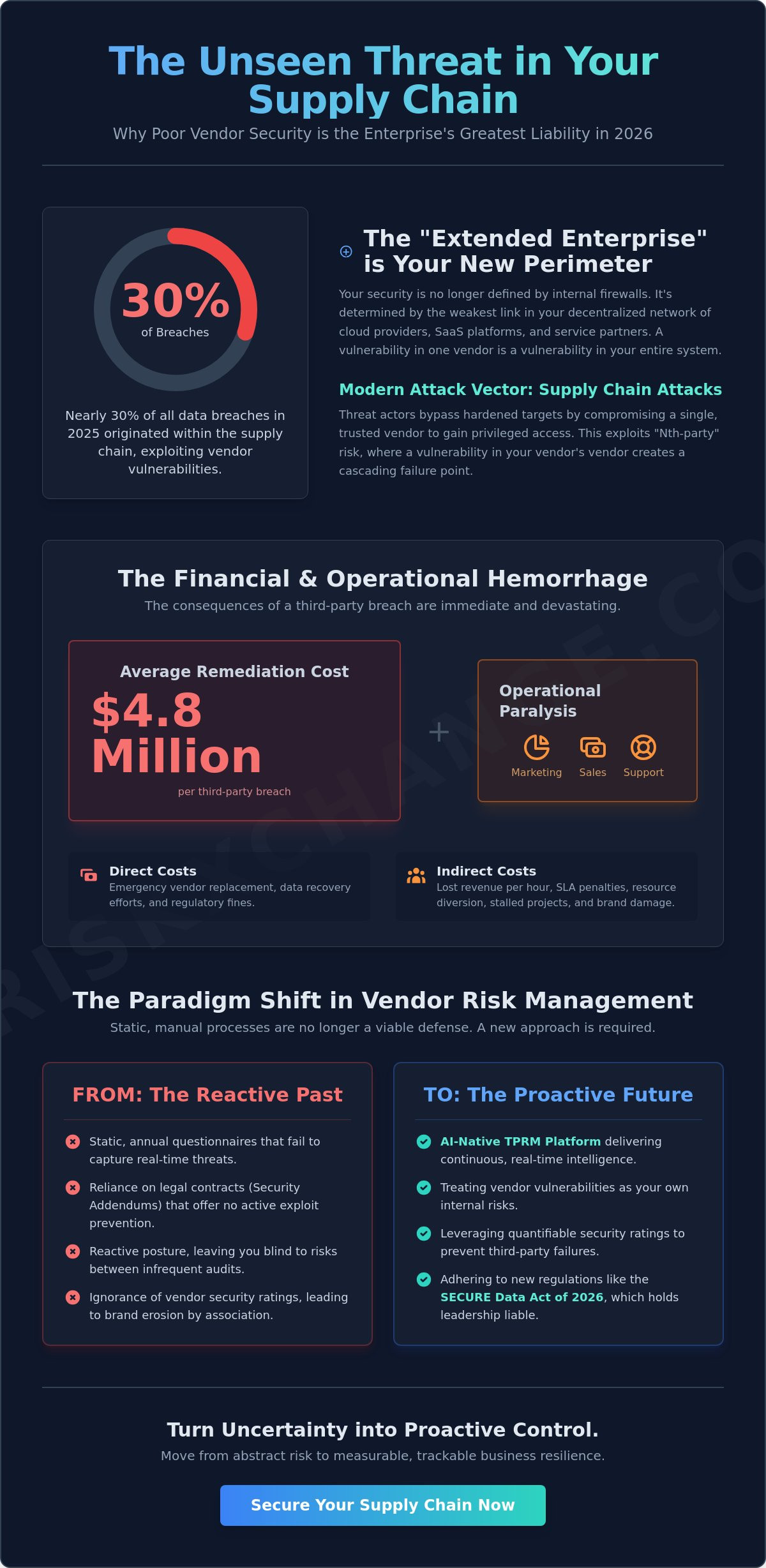
Nearly 30% of all data breaches in 2025 originated within the supply chain, highlighting the severe consequences of poor vendor security for the modern enterprise. While you likely recognize that your digital ecosystem is expanding, the difficulty of quantifying "invisible" vulnerabilities often leads to a reactive posture. Relying on the static, manual questionnaires of the past is no longer a viable defense when the average cost to remediate a third-party breach has reached nearly $4.8 million. You're right to feel anxious about the gaps in your visibility, especially as new regulations like the SECURE Data Act of 2026 demand more rigorous, documented oversight.
This guide provides the strategic framework you need to move from uncertainty to proactive control. You'll learn how to identify the multi-dimensional risks that threaten your brand and discover why real-time monitoring is the only way to protect your enterprise value. We'll explore the specific financial and regulatory impacts of third-party failures and outline the transition to a continuous, AI-driven risk management model. By the end, you'll have a clear roadmap to present to stakeholders that turns security from an abstract concept into a measurable, trackable business enabler.
The Expanding Attack Surface: Why Vendor Security is Your Responsibility in 2026
In 2026, the concept of a "perimeter" has largely vanished. Your enterprise is now a decentralized network of cloud providers, SaaS platforms, and specialized service partners. This "Extended Enterprise" model means your security posture isn't defined by your internal firewalls, but by the weakest link in your digital supply chain. The consequences of poor vendor security are no longer isolated incidents. They're systemic events that can compromise your entire network in minutes.
Modern threat actors have changed their strategy. Instead of launching a direct assault on a hardened enterprise, they target a single vendor "node" to gain entry into hundreds of downstream organizations. This method, known as a supply chain attack, exploits the privileged access you grant to third parties. If a vendor has access to your API, your customer database, or your internal communications, their vulnerability is yours. Traditional defenses are obsolete when the threat enters through a trusted, authenticated channel.
The Evolution of Supply Chain Vulnerabilities
Attackers now use AI-driven automated scanning to map your entire ecosystem in seconds. They don't just look at your direct partners. They analyze "Nth-party" risk, which involves identifying vulnerabilities in the vendors of your vendors. This creates a cascading failure point where a breach three levels deep can lead to total operational paralysis for your business. Security is no longer about preventing simple data theft. It's about maintaining systemic resilience in a world where your dependencies are your greatest liabilities.
The Myth of the Security Addendum
Many organizations rely on legal contracts to mitigate risk. While a security addendum provides a legal safety net, it's a post-mortem tool that does nothing to stop an active exploit. There's a dangerous gap between contractual compliance and real-time security posture. Static audits and annual questionnaires are snapshots of the past. They fail to capture the dynamic, hour-by-hour threats of 2026. The consequences of poor vendor security often manifest between these audits, leaving you blind to risks until the damage is already done. You can't manage a high-velocity threat landscape with low-velocity paperwork.
Immediate Impact: Operational Paralysis and Financial Hemorrhage
When a critical vendor goes offline, the crisis doesn't wait for your next board meeting. It hits on "Day Zero" with a force that can flatten your operational throughput. Threat actors frequently exploit weak vendor security practices to trigger these shutdowns. The consequences of poor vendor security are often felt as a "Bullwhip Effect" across your digital supply chain. A single failure in a logistics partner or a cloud service provider doesn't just stop one department; it creates a cascade that halts marketing, sales, and customer support simultaneously. You aren't just losing access to a tool; you're losing the ability to conduct business.
Distinguishing between direct and indirect losses is crucial for accurate risk quantification. While direct financial theft is a clear drain, the indirect hemorrhage of downtime often proves more lethal. Emergency vendor replacement and data recovery efforts aren't just expensive, they're chaotic. You're forced to pay a premium for speed while your internal teams abandon strategic initiatives to manage the fallout. Implementing a continuous risk monitoring platform helps you identify these friction points before they escalate into total paralysis.
Calculating the Real Cost of Downtime
Quantifying the impact requires looking beyond the immediate service outage. You must factor in lost revenue per hour, service level agreement (SLA) penalties, and the inevitable surge in overtime pay for incident response teams. A significant hidden cost is "resource diversion." When your best engineers spend weeks remediating a third-party crisis, your own product roadmap stalls. These events also trigger business interruption insurance claims, which can lead to increased premiums and more rigorous future audits. In 2025, breaches originating from a third-party system cost an average of nearly $4.8 million to remediate, a figure that reflects these deep operational scars.
Ransomware Cascades: When Their Breach Becomes Your Ransom
In 2026, ransomware is rarely a localized event. Attackers use compromised vendor credentials to move laterally into your environment, turning a partner's oversight into your catastrophe. They employ double-extortion tactics, threatening to leak your sensitive data while keeping your systems encrypted. To manage this, you must understand your operational dependencies. High-risk areas include identity and access management (IAM) providers, managed service providers (MSPs), and cloud infrastructure layers. The consequences of poor vendor security in these sectors can increase your breach lifecycle significantly. In 2025, the global average data breach lifecycle reached 241 days, highlighting how long these "cascades" can haunt an organization.
The Compliance Trap: Legal and Regulatory Repercussions
The regulatory environment in 2026 has reached a tipping point where your liability is inextricably linked to your third-party ecosystem. Regulators no longer accept the "it was our vendor's fault" defense as a valid shield. Instead, they view a failure in your supply chain as a direct failure of your corporate governance. The consequences of poor vendor security now include aggressive enforcement actions from agencies that demand proof of active, continuous oversight rather than passive, contractual promises.
Recent shifts demonstrate this increased scrutiny. As of January 1, 2026, comprehensive data privacy laws took effect in Indiana, Kentucky, and Rhode Island. Simultaneously, updated CCPA/CPRA regulations now mandate specific cybersecurity audits and documented risk assessments for high-risk data processing. If your vendor handles sensitive data without these verified controls, you're the one facing the penalty. We've already seen the financial weight of these failures; in early 2026, France's CNIL issued a €42 million penalty to Iliad SA following a breach that compromised millions of customers. Even if your internal systems are pristine, a "lack of due diligence" in your vendor selection and monitoring can trigger massive fines and mandatory forensic audits under mandates like DORA, HIPAA, or the proposed SECURE Data Act of 2026.
Regulatory Liability and Board Accountability
The legal "duty of care" has expanded significantly. Boards of directors are now being held personally accountable for supply chain oversight. Regulators increasingly dismiss annual questionnaires as insufficient "security theater," favoring real-time risk intelligence instead. In this landscape, the legal distinction between being a "victim" of a breach and a "negligent partner" rests entirely on your ability to prove continuous monitoring. You must demonstrate that you didn't just ask about security once a year, but that you maintained visibility into their posture every day.
The Long Tail of Litigation
The fallout from third-party vulnerabilities often results in a decade of legal battles. Class-action lawsuits are now the standard response to any significant data exposure, and these suits frequently name the enterprise client as the primary defendant. Attempting to claw back damages from a bankrupt or under-insured vendor is often a futile exercise. Maintaining an auditable trail of real-time risk assessments is your only reliable defense. It transforms your legal position from one of vulnerability to one of documented, proactive control. The consequences of poor vendor security extend far beyond the initial breach, often impacting your valuation during future audits or M&A activity.
The Invisible Cost: Reputation Damage and Security Rating Erosion
Reputation is often treated as an abstract concept, but in 2026, it is a quantifiable asset tied directly to your digital posture. When a third-party failure exposes sensitive data, the market rarely focuses on the vendor. Instead, the narrative centers on your perceived failure to maintain rigorous oversight. This "Guilt by Association" effect can trigger immediate brand equity erosion and long-term customer churn. The consequences of poor vendor security manifest as a loss of confidence from stakeholders who expect you to be the ultimate guardian of their information. This perception is difficult to reverse once a "trust deficit" has been established.
Beyond the immediate public reaction, there is the technical reality of Security Rating Erosion. A vendor breach often lowers your own cyber score in automated risk assessment systems. These scores are no longer private metrics; they are the benchmarks used by partners, insurers, and investors to evaluate your stability. A drop in your rating can lead to higher insurance premiums or even the collapse of potential mergers and acquisitions. Maintaining a resilient brand requires more than just internal defense. Protect your reputation with real-time risk intelligence that allows you to address vulnerabilities before they become public scandals.
The External Perspective: How the World Sees Your Risk
Insurers and investors use external security ratings as a primary lens through which they judge your enterprise value. When a breach occurs in your supply chain, it creates a "contagion effect." Automated systems flag your organization as high risk because your data is now circulating in insecure environments. This externalized perspective is why RiskXchange’s 360-degree view is so critical. It provides the same lens that outsiders use to evaluate you, giving you the agency to command your security narrative. If you don't manage your external posture, the market will define it for you.
Customer Churn and the "Trust Deficit"
The financial impact of losing customer trust is staggering. While acquiring a new customer is expensive, the cost of losing an existing one due to a third-party leak is often permanent. In B2B sectors, security has become a primary competitive differentiator. If your security posture is perceived as weak because of your partners, you'll lose out on major contracts. However, real-time transparency can actually strengthen your reputation. By showing that you have immediate visibility and control over your vendor risks, you demonstrate a level of sophistication that reassures clients. The consequences of poor vendor security don't have to be terminal if you can prove that your governance is proactive and data-driven.
Strategic Resilience: Mitigating Vendor Risk with AI-Native TPRM
Legacy Third-Party Risk Management (TPRM) relied on trust and periodic verification. In 2026, trust without continuous verification is a liability. The consequences of poor vendor security are too severe to leave to an annual spreadsheet or a manual questionnaire. We're seeing a fundamental shift from static risk assessment to active, real-time risk management. This means moving away from point-in-time snapshots toward a 360-degree posture that reflects the current reality of your digital ecosystem. You need a strategy that doesn't just identify problems after they occur but prevents them from escalating into enterprise-wide crises.
Transitioning to an AI-native approach allows you to replace guesswork with data-driven honesty. In a landscape where the average cost of a third-party breach exceeds $4 million, the ability to see and manage risk in real-time is a strategic imperative. By adopting a platform that prioritizes external visibility and command, you move from a state of vulnerability to one of informed resilience. This shift ensures that your security posture is always visible, measurable, and manageable.
Moving to Continuous Real-Time Monitoring
AI-native platforms redefine monitoring by providing an objective, quantifiable metric for every vendor in your ecosystem. Unlike legacy tools that merely flag known issues, AI identifies emerging threats across the global attack surface before they're exploited. This technology scans for anomalies in real-time, allowing you to see your vendors exactly as an attacker does. Modern resilience also requires a unified view that integrates ESG data with cybersecurity benchmarks. This comprehensive visibility ensures that your governance matches the speed of the 2026 threat environment, providing the clarity needed for both technical leaders and business executives.
Building a Proactive TPRM Roadmap
Transformation begins with a methodical approach to your supply chain. You can't monitor everything with the same intensity, so start by tiering your vendors based on data access and operational criticality. Once tiered, automate your assessment workflows to eliminate the manual bottlenecks that plague traditional security teams. Setting up real-time alerts ensures that a drop in a vendor's security rating triggers an immediate response rather than waiting for a breach notification. This proactive cadence reflects a stable, permanent solution to an ongoing challenge.
Effective risk management is a collaborative effort. Use the intelligence provided by your platform to work with vendors on remediation. This moves the conversation from a punitive audit to a strategic partnership focused on shared resilience. By addressing the consequences of poor vendor security through proactive command, you protect your bottom line and your brand's future. Protect your enterprise with RiskXchange’s AI-native TPRM platform and turn supply chain complexity into a measurable competitive advantage.
Command Your Security Narrative in 2026
The transition from a reactive to a proactive security posture isn't just a technical upgrade; it's a strategic necessity. The consequences of poor vendor security reach far beyond a single data breach, impacting your operational continuity, regulatory standing, and market valuation. By acknowledging that your vendors are an extension of your own infrastructure, you gain the clarity needed to manage these risks with precision. Moving toward a model of continuous, real-time oversight ensures that your organization remains resilient in an increasingly volatile digital landscape.
Strategic resilience is built on quantifiable data and external visibility. Fortune 500 enterprises now rely on 360-degree real-time risk intelligence to maintain a clear view of their entire supply chain. Our AI-native attack surface management provides the actionable security ratings you need to move from uncertainty to total command. You can transform your third-party risk management into a business enabler that fosters trust with partners and customers alike.
Book a demo to see how RiskXchange quantifies your third-party risk and start building your roadmap to informed resilience today. You have the tools to turn complexity into a measurable advantage, and we're here to help you lead the way with confidence.