By early 2026, 72% of CISOs report that a lack of verified technical credentials is the primary barrier to securing their expanding attack surfaces. You've likely felt the weight of this shift as the market floods with hundreds of different computer security certifications, each promising to be the definitive answer to your career growth. It's frustrating to spend thousands on exam fees and maintenance CPEs only to find that your chosen path doesn't align with what top-tier employers actually demand. We understand that your professional development time is a finite resource that requires strategic allocation.
You want a clear roadmap that validates your technical expertise and increases your salary potential without the guesswork. This guide cuts through the noise to highlight the most respected credentials for an AI-driven environment. We'll examine the specific credentials that provide visibility into your digital footprint and empower you to take control of organizational risk. From foundational technical skills to high-level strategic oversight, here is the definitive path to professional resilience in 2026.
What are Computer Security Certifications and Why Do They Matter in 2026?
Computer security certifications are professional credentials that validate a practitioner's expertise in protecting digital assets, managing risk, and ensuring regulatory compliance. In 2026, these certifications have moved beyond simple technical validation. They now serve as a critical benchmark for Governance, Risk, and Compliance (GRC). While automated systems and AI handle 90% of routine data processing, the human element remains the essential layer for strategic oversight. These credentials prove that a professional can manage the complex risk profiles generated by autonomous security tools.
Establishing a baseline of trust is vital for third-party partnerships. Organizations no longer take security claims at face value. They require verified proof of competence. Referencing a comprehensive list of computer security certifications reveals how the industry has branched into specialized domains like cloud sovereignty and supply chain integrity. For a modern enterprise, employing a certified team is a proactive step toward building a resilient digital footprint that partners and insurers can quantify.
The Evolution of Cybersecurity Credentials
The journey of security credentials started with internal network defense but has shifted toward "outside-in" visibility. Early certifications focused on perimeter firewalls; today's modules prioritize cloud-native security and the mitigation of supply chain vulnerabilities. This shift reflects a reality where 75% of breaches originate from third-party ecosystems. The "Certified Trust" era of 2026 defines a period where professional credentials serve as the primary currency for digital reputation and inter-organisational reliability.
Individual vs. Organisational Benefits
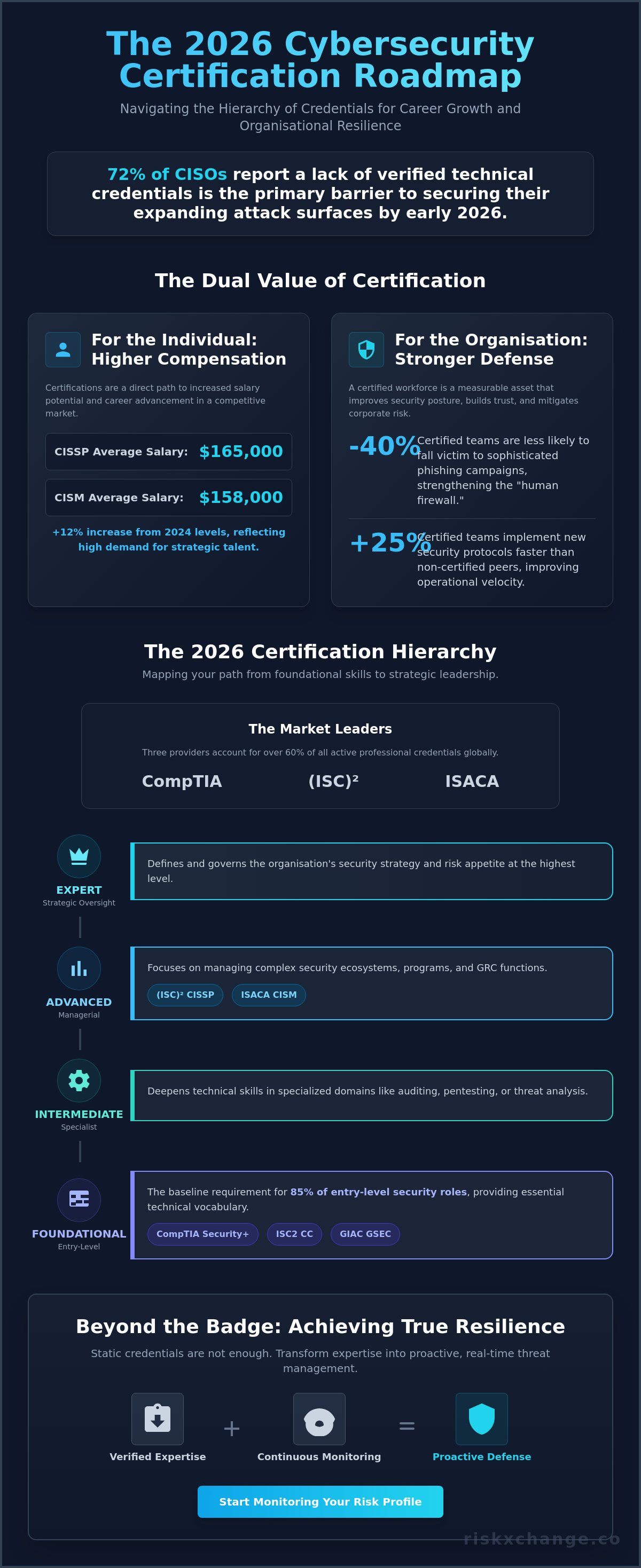
For the individual, computer security certifications are a direct path to higher compensation. Based on 2026 industry benchmarks, professionals holding a CISSP earn an average of $165,000, while CISM holders command salaries near $158,000. These figures represent a 12% increase from 2024 levels, reflecting the scarcity of high-level strategic talent.
Organisations gain a different set of advantages. A certified workforce is a measurable asset that directly improves a company’s cybersecurity rating. This rating acts as a real-time indicator of a firm's risk posture. By investing in staff certification, companies strengthen their "human firewall." This concept remains the primary defense mechanism against social engineering and configuration errors. A team that understands the "why" behind compliance is 40% less likely to fall victim to sophisticated phishing campaigns than an uncertified cohort.
- Validation: Certifications provide an objective measure of skill in a volatile threat landscape.
- Visibility: They allow organizations to project a secure image to external stakeholders.
- Velocity: Certified teams implement security protocols 25% faster than non-certified peers.
The Hierarchy of Cybersecurity Credentials for 2026
Navigating the professional landscape requires a clear map. In 2026, the value of computer security certifications isn't just in the acronym; it's in the specific risk-mitigation capability they represent. Organizations now prioritize candidates who can demonstrate a quantifiable impact on their security posture. This shift has led to a more structured hierarchy where credentials are evaluated based on their ability to provide visibility and control over an expanding attack surface.
CompTIA, (ISC)², and ISACA remain the primary architects of this professional framework. These three providers account for over 60% of all active professional credentials globally this year. While CompTIA focuses on vendor-neutral technical skills, (ISC)² emphasizes the management of complex security ecosystems. ISACA prioritizes the governance and audit functions that keep organizations compliant and resilient against external threats.
Foundational Certifications for Entry-Level Roles
CompTIA Security+ remains the baseline requirement for 85% of entry-level security roles. It provides the technical vocabulary needed to discuss the attack surface with confidence. For those seeking a lower barrier to entry, the ISC2 Certified in Cybersecurity (CC) offers a streamlined path into the industry. Meanwhile, the GIAC Security Essentials (GSEC) provides deeper technical rigor, ensuring practitioners can handle real-time incident responses. Consulting the CompTIA certification roadmap helps professionals align these early steps with their long-term career trajectory.
Advanced and Strategic Certifications
The CISSP remains the gold standard for security leadership, demanding five years of experience across eight critical domains. It shifts the focus from managing tools to managing strategic risk. CISM targets professionals who bridge the gap between technical security and business goals, while CISA focuses on the audit and control of information systems. These credentials are vital for maintaining a high cybersecurity rating by ensuring governance structures are robust and measurable. They empower leaders to move from a state of digital vulnerability to one of informed resilience.
Niche Specialisations: Cloud, AI, and TPRM
Cloud security is no longer a specialty; it's the standard. The CCSP validates expertise in securing complex, multi-tenant environments. However, 2026 has seen a 40% surge in demand for AI-specific security credentials. These certifications focus on the unique risks of Large Language Models (LLMs) and the expanded attack surfaces created by automated agents. They empower teams to secure the outside-in view of their AI deployments. Finally, the CGRC (Governance, Risk and Compliance) has become the essential link for managing third-party risk, ensuring your supply chain visibility remains clear and actionable.
- CCSP: Focused on cloud data protection and infrastructure security.
- AI Security Certs: Managing prompt injection risks and automated attack surfaces.
- CGRC: Integrating internal controls with external risk management frameworks.
Selecting the right computer security certifications depends on your specific role in the risk lifecycle. Whether you're building defenses or auditing them, your credentials should serve as a lens through which you can finally see and manage your true security posture.
Strategic Value: Using Certifications to Mitigate Corporate Risk
Modern CISOs in 2026 don't view computer security certifications as mere HR checkboxes. They treat them as strategic assets that harden the corporate attack surface. A workforce backed by verified credentials directly elevates an organization’s Cybersecurity Rating, transforming security from a subjective concept into a trackable metric. This outside-in perspective is vital. It allows stakeholders to see your company as a resilient entity rather than a digital liability. When 74% of breaches involve human error, a certified team serves as a proactive firewall against sophisticated social engineering and technical misconfigurations. By investing in these credentials, leadership moves from a state of reactive panic to one of informed resilience.
The presence of certified experts changes how the world perceives your risk posture. Insurance providers and investors now utilize these metrics to determine premiums and valuations. A company that mandates high-level computer security certifications for its core technical staff often sees a 15% to 20% improvement in its overall security score. This isn't just about prestige; it's about establishing a baseline of technical competence that scales with the business. It ensures that every team member speaks the same language of risk, reducing the internal friction that often leads to security gaps during rapid digital transformation.
Certifications as a Component of TPRM
Supply chain resilience depends on the competence of your partners. Organizations now integrate staff certification requirements into their Third-Party Risk Management (TPRM) workflows to ensure end-to-end visibility. While automated platforms flag vulnerabilities, it takes a certified professional to interpret real-time risk data and prioritize remediation. By 2026, over 50% of enterprise-level service level agreements (SLAs) specifically mandate that vendor security teams hold industry-standard credentials. This combination of human expertise and automated monitoring creates a comprehensive defense that identifies blind spots before attackers can exploit them. It allows for a more nuanced understanding of vendor risk that software alone cannot provide.
Compliance and Regulatory Alignment
Global regulations have reached a point of unprecedented stringency. Aligning your team's expertise with frameworks like NIST, ISO 27001, and GDPR is no longer optional. Certifications such as CISM and CISA provide the "defensible security" posture required during rigorous regulatory audits. They demonstrate to authorities that your leadership understands risk management at a granular level. In the current 24/7 threat landscape, the concept of a one-time qualification is obsolete. Organizations must prioritize continuous certification to ensure their defensive strategies remain effective against modern AI-driven threats. This commitment to ongoing education turns compliance from a yearly hurdle into a permanent competitive advantage that protects both data and brand reputation.
The Certification Roadmap: Planning, Training, and Maintenance
Achieving computer security certifications requires a tactical approach rather than a scattergun method. You must treat your professional development as a risk management strategy, ensuring every hour spent studying translates into actionable expertise. In 2026, the landscape demands more than just a passing score; it requires a demonstrated ability to manage a company’s attack surface with precision and calm confidence.
Step 1: Assessing Your Career Path
Identify your destination before you invest in a voucher. A security architect requires a different knowledge base than a compliance auditor or a SOC manager. You should align your choices with the NICE Framework to ensure your skills match industry-standard job roles precisely. High-level strategic roles often favor the CISSP or CISM, while technical guardians might prioritize hands-on credentials. Use self-assessment platforms to identify gaps in your current knowledge; this data-driven approach prevents you from wasting resources on exams you aren't prepared to tackle. Mapping your journey this way provides the visibility needed to move from digital vulnerability to professional resilience.
Step 2: Effective Study Strategies for 2026
The 2026 learning environment relies heavily on AI-driven tutors and virtual reality (VR) labs. Theory is only the foundation. By 2026, 85% of major certification providers have integrated performance-based testing that simulates live environments. You can't just memorize definitions; you must demonstrate control. Build a 90-day study plan to guarantee retention. Dedicate the first 30 days to core concepts, the next 45 to VR labs, and the final 15 to practice exams. While self-study remains a cost-effective route for disciplined learners, intensive bootcamps now offer a 40% higher pass rate for complex computer security certifications. These immersive programs provide the granular technical expertise necessary to handle real-time threats.
Step 3: Maintaining Your Edge
Earning the badge is only the beginning of your journey. You must prevent certification decay by staying current with emerging threats and evolving compliance standards. The Continuing Professional Education (CPE) system requires you to earn credits through webinars, whitepapers, and professional service. This system ensures your expertise doesn't stagnate while the threat landscape shifts. Engaging in regular IT Security Assessments helps you apply theoretical knowledge to real-world infrastructure, keeping your skills sharp. This continuous monitoring of your own capabilities mirrors the way a business monitors its external digital footprint. By treating your credentials as a trackable metric, you maintain a superior professional posture.
Take control of your organization’s security posture with a proactive strategy. See your cybersecurity rating here.
Beyond the Badge: Validating Expertise with Continuous Risk Monitoring
Computer security certifications provide the essential theoretical framework required to navigate the industry, but they represent a static snapshot of a professional's knowledge. In a 2026 threat environment where 60% of vulnerabilities are exploited within 12 days of discovery, point-in-time validation is no longer sufficient. Real-world defense requires a transition from the classroom to the command center. While computer security certifications establish a standard of excellence, they don't replace the need for active, 24/7 oversight of your digital footprint.
The gap between earning a credential and stopping a breach is bridged by execution. Certified professionals understand the "why" of security, but they need the "how" of real-time data to be effective. RiskXchange empowers these experts by moving security from a periodic audit to a continuous stream of actionable intelligence. This approach ensures that your team’s skills are applied to the most critical risks at the exact moment they emerge.
Empowering the CISO with 360-Degree Visibility
RiskXchange’s AI-native platform fundamentally simplifies the workload for certified managers. Instead of wasting hours on manual assessments that are outdated before they're even finished, the platform provides automated, real-time supply chain monitoring. This shifts the focus from reactive patching to proactive management. By adopting an "outside-in" perspective, your team sees exactly what a malicious actor sees. It doesn't matter how many credentials your staff holds if they can't see the exposed port or the misconfigured cloud bucket that appeared ten minutes ago. The platform identifies these blind spots instantly, allowing your team to act with precision.
Building a Culture of Informed Resilience
Security isn't a project with a finish line; it’s a state of being. By combining human intelligence with machine-speed analytics, organizations move past the compliance check-box mentality. You can use the RiskXchange Cybersecurity Rating to provide the board with a quantifiable metric of success. This turns abstract technical improvements into a clear, trackable score. It allows your experts to demonstrate their direct impact on the company’s risk posture through tangible data rather than jargon-heavy reports. The evolving nature of threats in 2026 means that even the most prestigious computer security certifications require the support of live telemetry to remain effective.
Elite expertise deserves an elite platform. Don't let your team’s hard-earned skills be consumed by manual data entry or obsolete processes. Combine your staff's deep knowledge with the world’s leading risk platform to ensure your defenses are as dynamic as the threats you face. Take control of your attack surface with RiskXchange and move your organization from a state of vulnerability to one of informed resilience.
Secure Your Competitive Edge in the 2026 Threat Landscape
In 2026, the strategic value of computer security certifications has shifted from individual achievement to a critical component of corporate resilience. With the global cybersecurity workforce gap projected to reach 3.5 million positions by 2026 according to Cybersecurity Ventures, these credentials are vital for mitigating operational risk. However, static badges alone can't protect a complex supply chain. You must translate human expertise into measurable, real-time outcomes. Fortune 500 companies globally now use quantifiable metrics to bridge the gap between professional training and active defense.
True security posture requires visibility into how skills perform against live threats. By adopting an outside-in perspective, you gain the clarity needed to manage risk with precision rather than guesswork. It's about moving from a state of vulnerability to one of informed, proactive control. Empower your certified team with RiskXchange’s AI-native TPRM platform to access real-time security ratings and continuous monitoring across your entire supply chain. It's time to take control of your digital footprint and build a future defined by resilience.