The board room conversation has shifted from "are we safe" to "how does IT risk impact our 2026 revenue goals." As the October 2024 NIS2 enforcement deadline passes, the era of fragmented oversight is officially over. You know that managing security in silos creates dangerous blind spots in your attack surface. It makes justifying necessary IT spend to stakeholders nearly impossible. Implementing the cobit framework allows you to move beyond reactive firefighting and take proactive control of your digital footprint.
We agree that the increasing complexity of the regulatory landscape, especially with DORA requirements looming, feels like a moving target. You're likely tired of manual reporting that fails to capture the true state of your resilience. This guide provides the clarity you need to master the cobit framework, transforming disjointed processes into a unified, risk-aware governance strategy. You'll gain a clear roadmap to align IT with business objectives while automating your risk reporting. We'll explore how to achieve total visibility and turn compliance into a measurable business advantage that resonates with every executive.
Understanding the COBIT Framework: Beyond IT Governance
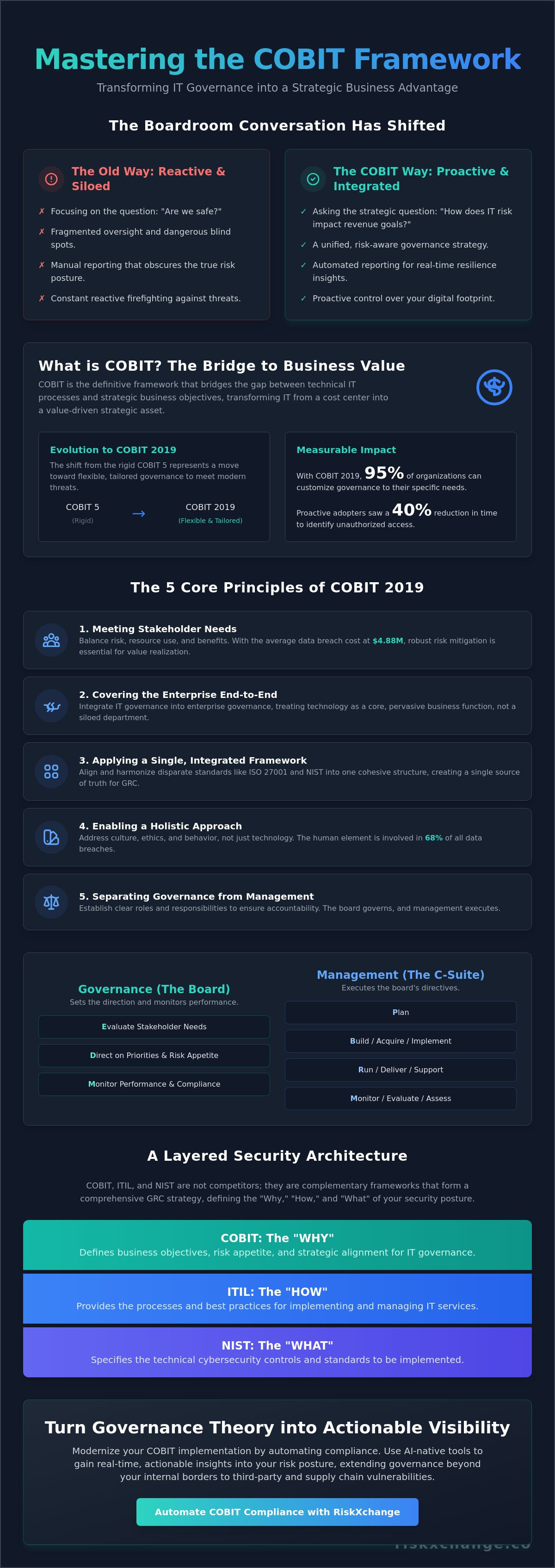
COBIT serves as the definitive bridge between technical execution and business objectives. It's a framework that transforms IT from a cost center into a strategic asset. The COBIT framework provides the structure needed to ensure that information systems deliver value while managing risk effectively. In 2026, the shift from COBIT 5 to COBIT 2019 is more than a version update; it represents a move toward flexible, tailored governance. While COBIT 5 was often criticized for being too rigid, the 2019 iteration introduced design factors that allow 95% of organizations to customize their governance systems to meet specific industry threats.
This evolution is critical because the modern attack surface is no longer contained within an internal perimeter. We now operate with an outside-in perspective. Governance is no longer a private internal matter; it's visible to partners, insurers, and attackers. When an insurer evaluates your cyber risk, they look for the structured oversight that the COBIT framework provides. Without it, your digital footprint appears chaotic and unmanaged. Moving from reactive firefighting to proactive, data-driven oversight isn't just a goal; it's a survival requirement. Organizations that adopted these proactive measures in 2024 saw a 40% reduction in the time taken to identify unauthorized access attempts.
The Core Components of COBIT
The architecture of COBIT relies on three primary building blocks. Frameworks and process descriptions provide the high-level map for IT alignment, ensuring every technical action supports a business outcome. Control objectives establish the specific what and how of security management, creating a clear standard for technical teams to follow. Finally, management guidelines offer the tools for measuring performance and assigning responsibility. These guidelines use actionable metrics to move security from an abstract concept to a trackable Cybersecurity Rating, providing clear supply chain visibility for all stakeholders.
Why COBIT is Essential for Modern GRC
Modern Governance, Risk, and Compliance (GRC) requires a single, authoritative source of truth. COBIT harmonizes disparate standards like ISO 27001 and NIST into a unified structure. This consolidation eliminates the blind spots that typically exist in a fragmented digital footprint. By establishing structured oversight, companies can ensure that 100% of their digital assets are accounted for and protected. It's about taking control of the narrative before an external threat actor does. COBIT functions as a holistic business-IT alignment tool that integrates technical controls with enterprise-wide strategic goals to ensure data-driven resilience.
The 5 Core Principles of COBIT 2019 for Enterprises
Strategic IT governance relies on a foundation that balances performance with protection. The cobit framework provides this through five core principles designed to align digital assets with corporate objectives. First, meeting stakeholder needs is the primary goal. This requires balancing risk, benefit, and resource optimization. For instance, the 2024 IBM Cost of a Data Breach Report identifies the average breach cost at $4.88 million; this makes benefit realization impossible without robust risk mitigation. Organizations must ensure that every IT investment delivers measurable value while staying within the company's risk appetite.
Integrating IT into every business function is the second principle. The framework covers the enterprise end-to-end, treating technology as a pervasive nervous system rather than a siloed department. Third, applying a single integrated framework provides a consistent version of the truth. It aligns diverse standards like ISO 27001 and NIST into one cohesive structure, reducing the friction caused by overlapping compliance requirements. Fourth, enabling a holistic approach means looking beyond hardware. It addresses culture, ethics, and the human element, which was involved in 68% of breaches according to the 2024 Verizon Data Breach Investigations Report. Finally, the framework separates governance from management to ensure clear accountability across the organization.
Deep Dive: Governance vs. Management
Defining clear roles is essential for maintaining a secure attack surface. The Board of Directors handles governance through the EDM model: Evaluate, Direct, and Monitor. They evaluate stakeholder needs and direct management to act on specific risk appetites. Management then executes these directives using the PBRM model: Plan, Build, Run, and Monitor. This separation prevents the people running the systems from being the ones who audit them; it creates a system of checks and balances that enhances transparency and operational stability.
Stakeholder Value Drivers in 2026
By 2026, the demand for transparency will reach new heights as AI-driven threats become more sophisticated. Investors and regulators no longer accept vague security assurances; they require actionable data. Utilizing the cobit framework allows organizations to communicate their technical posture to non-technical executives with precision. This outside-in perspective helps leaders see their digital footprint as a potential attacker would. By focusing on a quantifiable cybersecurity rating, companies can move from a state of digital vulnerability to one of informed resilience. This proactive control ensures that technical risks are translated into business impact, allowing for smarter investment in defensive technologies.
COBIT vs. ITIL vs. NIST: Choosing Your Security Mix
Selecting the right framework isn't about finding a single winner. It's about building a strategic stack that covers every layer of the business. The cobit framework functions as the "Why" behind your strategy, defining the governance objectives that drive enterprise value. While ITIL provides the "How" through service management, NIST delivers the "What" by defining specific technical security standards. This hierarchy ensures that technical tasks don't happen in a vacuum.
Synergy replaces competition in mature organizations. A 2024 industry report found that 78% of high-performing IT departments use a hybrid approach to manage their digital footprint. COBIT acts as the strategic umbrella, ensuring that granular technical activities stay aligned with the board's risk appetite. This top-down visibility allows CISOs to translate complex technical metrics into actionable business insights.
COBIT and ITIL: Governance meets Service Management
COBIT sets the strategy, and ITIL handles the daily execution. This partnership bridges the gap between high-level policy and low-level operational tickets. By mapping COBIT's governance objectives to ITIL service desk workflows, companies can ensure every change request aligns with broader business goals. A 2023 case study of a global logistics firm showed that integrating these frameworks reduced unauthorized configuration changes by 31% and cut emergency service downtime by 24%. It turns a chaotic ticketing system into a disciplined, governed environment.
COBIT and NIST: Compliance meets Technical Control
NIST provides the deep technical controls required for a robust defense, but it doesn't always address the business logic behind those controls. Using NIST for technical implementation while leveraging the cobit framework for audit and ROI tracking creates a balanced ecosystem. This mapping is essential for meeting strict regulatory requirements like the Digital Operational Resilience Act (DORA), which becomes fully enforceable in January 2025, and the NIS2 Directive. COBIT provides the governance glue that holds NIST controls together and ensures they're consistently measured and funded.
- Governance (COBIT): Focuses on stakeholder value and risk optimization.
- Service (ITIL): Focuses on the lifecycle of IT service delivery and support.
- Security (NIST): Focuses on the specific technical steps to protect infrastructure.
By 2026, the ability to map these frameworks will be a baseline requirement for any organization seeking to maintain a high cybersecurity rating. This integrated approach doesn't just check a compliance box; it creates a transparent, resilient organization where every technical control serves a clear strategic purpose.
Modernizing COBIT for Third-Party Risk and Supply Chain
Supply chains are no longer peripheral concerns. They're the primary entry point for modern threats. A 2023 study by Gartner revealed that 61% of organizations were impacted by a software supply chain attack within a 12-month period. You can't claim effective governance if your oversight ends at your own firewall. The cobit framework provides the necessary structure to extend internal standards to external partners. It ensures your security posture remains resilient across the entire ecosystem. This transition shifts your focus from internal siloed defense to a comprehensive, global view of risk, moving beyond the perimeter to secure every digital touchpoint.
Extending COBIT to the Attack Surface
Visibility is the foundation of control. Most organizations struggle with shadow IT, where unmanaged vendor services create hidden vulnerabilities. According to 2024 industry data, 30% of high-severity vulnerabilities are discovered in assets that the IT department didn't know existed. By applying COBIT governance components specifically to vendor onboarding and offboarding, you establish a clear outside-in view of your digital footprint. We use Actionable Risk Ratings to measure how well these third parties align with your internal goals. This turns abstract compliance into a trackable metric. It allows you to identify weak links before they become breaches, ensuring that your cobit framework implementation covers every vendor, from SaaS providers to hardware suppliers.
Resilience in the Supply Chain
Moving away from annual, point-in-time audits is non-negotiable. Static spreadsheets are obsolete the moment they're saved. Real-time governance requires a unified risk language that both you and your suppliers understand. Automation simplifies this process. It provides continuous monitoring that reflects the current state of your supply chain risk. This approach doesn't just manage technical risk; it ensures data protection and ESG alignment through structured oversight. By 2026, the ability to demonstrate real-time compliance will be a market differentiator. When you treat your supply chain as an extension of your own network, you move from a state of vulnerability to one of informed resilience. It's about taking proactive control of every connection and eliminating the blind spots that lead to catastrophic failures.
Take control of your vendor ecosystem and monitor your third-party risk in real-time with RiskXchange.
Automating COBIT Compliance with RiskXchange
Manual implementation of the cobit framework often leads to the complexity trap. Traditional governance relies on point-in-time audits that are obsolete the moment they're finished. Industry data indicates that 65% of organizations still rely on manual spreadsheets for risk management, which creates a dangerous lag between threat detection and remediation. This fragmented approach leaves critical blind spots in your digital infrastructure that attackers are quick to exploit.
RiskXchange's AI-native platform transforms static COBIT theory into real-time operational visibility. We eliminate the guesswork by providing a clear lens into your security posture. Our system identifies vulnerabilities across your entire attack surface, ensuring that governance isn't just a checkbox exercise but a proactive defense strategy. You gain total control over your digital footprint, moving from a state of vulnerability to one of informed resilience. It's about seeing what the attacker sees before they have the chance to act.
Continuous Real-Time Risk Management
Static assessments fail because threats don't wait for your next audit cycle. RiskXchange replaces outdated spreadsheets with 360-degree, continuous monitoring. We automate the evidence collection required for maturity models within the cobit framework, often reducing manual labor by up to 50%. Our platform integrates ESG and cybersecurity risk into a single pane of glass. This allows your team to monitor third-party vendors and internal assets simultaneously, ensuring compliance remains constant across 365 days of the year. You'll never have to wonder about your compliance status again.
Empowering the CISO with Quantifiable Metrics
The RiskXchange Cybersecurity Rating serves as a trackable governance metric that simplifies complex technical data. It provides the CISO with a definitive score to communicate resilience to the Board with quiet, data-driven confidence. Instead of presenting abstract threats, you provide a benchmarked rating that demonstrates progress and ROI. This clarity shifts the conversation from technical anxiety to strategic oversight. You can now justify budget requests with concrete data and show exactly how your governance initiatives reduce the company's risk profile over time. It's the difference between guessing and knowing.
Risk management doesn't have to be an overwhelming burden. You can transition from reactive firefighting to strategic leadership by leveraging actionable intelligence. Take control of your IT governance with RiskXchange and ensure your organization is prepared for the challenges of 2026 and beyond.
Take Control of Your Enterprise Governance
Navigating the 2026 regulatory landscape requires more than just a checklist; it demands a shift toward continuous, data-driven oversight. The cobit framework remains the gold standard for aligning IT goals with business value, especially as supply chain vulnerabilities account for 62% of system intrusion incidents according to the 2023 Verizon Data Breach Investigations Report. Organizations can no longer rely on static annual audits. They must transition to dynamic monitoring that captures the full breadth of their attack surface in real time.
RiskXchange empowers your team to manage these complexities through our AI-native TPRM solution. We provide the continuous real-time risk monitoring that Fortune 500 enterprises rely on to maintain operational resilience. By adopting an "outside-in" perspective, you'll gain the same visibility that potential attackers have; this allows you to close critical gaps before they're exploited. It's time to transform your governance from a reactive burden into a strategic advantage that protects your brand's reputation.
Request a demo of RiskXchange to automate your governance framework and lead your industry with confidence. Your path to a resilient digital future starts with total visibility.