With the average cost of a U.S. data breach hitting $10.22 million in 2026, the stakes for your next presentation have never been higher. You've likely noticed that traditional board reporting on cybersecurity risk often fails because it focuses on internal alerts rather than how the outside world sees your attack surface. When directors are overwhelmed by jargon, they can't effectively evaluate materiality or justify the necessary security investments. It's a disconnect that leaves the organization vulnerable and puts leadership under the microscope of the SEC's latest disclosure mandates.
We understand the challenge of turning granular data into a clear, actionable narrative. This article provides a strategic framework to help you translate technical vulnerabilities into business intelligence that aligns with the board's risk appetite. You'll learn how to use objective cybersecurity ratings to quantify your posture and gain a clear reporting template for 2026. By the end of this guide, you'll have the data-driven confidence needed to move the conversation from a state of digital vulnerability to one of informed, proactive control.
Bridging the Communication Gap: Why Traditional Board Reporting Fails
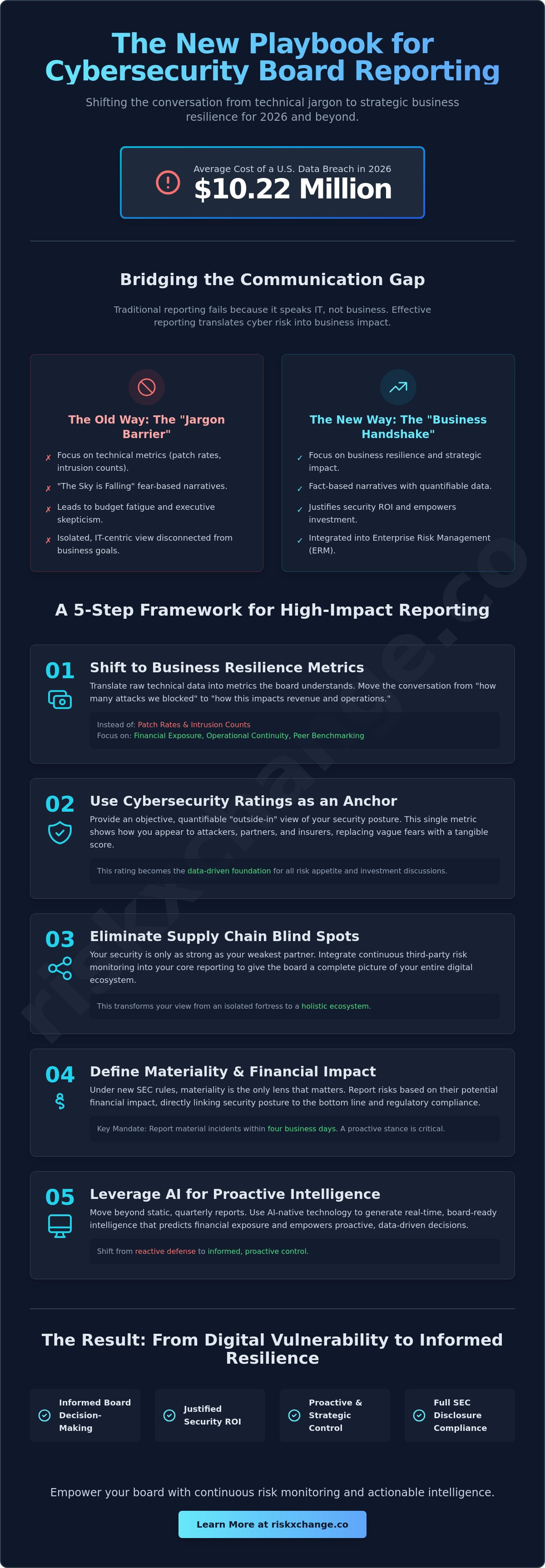
Effective board reporting on cybersecurity risk isn't about listing every blocked attempt or server update. It's the process of translating technical vulnerabilities into business resilience. Many CISOs fall into the trap of the "Jargon Barrier." They present metrics like patch rates or intrusion counts that lack context for a director. These numbers don't tell a board member if the company's revenue is safe or if a supply chain disruption is imminent. Without that bridge, data remains noise, and decision-makers remain in the dark.
To bridge this gap, organizations must move away from an isolated IT-centric view. Cyber threats need to be woven into the broader Enterprise Risk Management (ERM) strategy. This creates a "Handshake" between security teams and corporate leadership. It ensures every dollar spent on defense directly supports strategic goals like market expansion or digital transformation. When security is treated as a business enabler rather than a cost center, the board can make decisions based on real-world utility.
The Evolution of Board Oversight in 2026
By mid-2026, the regulatory landscape has shifted dramatically. The SEC's disclosure rules are fully enforced, requiring material incidents to be reported within four business days. Directors no longer view cyber as a "compliance-check" item. Under the "Caremark" standard of fiduciary duty, they face potential personal liability for failing to implement adequate reporting systems. Materiality has become the only lens that matters. If a risk doesn't impact the bottom line or operational continuity, it's secondary to the board's strategic focus.
From Fear-Based to Fact-Based Narratives
For years, security professionals relied on alarmist rhetoric to secure funding. This "The Sky is Falling" approach has led to widespread budget fatigue and executive skepticism among leadership teams. Effective board reporting on cybersecurity risk now demands a professional, reassuring tone that emphasizes proactive control. It moves the needle by providing a "Cybersecurity Rating" as a quantifiable anchor for every discussion. This metric offers a critical "outside-in" perspective, showing exactly how the organization’s digital footprint appears to potential attackers and partners alike. It replaces vague fears with measurable visibility. This allows the board to finally see their true security posture through a lens of data-driven honesty, transforming abstract threats into manageable business risks.
Translating Technical Data into Strategic Business Metrics
Data alone is silent. For it to speak to a board of directors, it must be contextualized within the framework of business value and operational continuity. Effective board reporting on cybersecurity risk avoids the trap of presenting raw technical logs. Instead, it prioritizes five core metrics: financial exposure, peer benchmarking, supply chain health, time to remediation, and the overall Cybersecurity Rating. These indicators move the needle because they describe resilience, not just defense.
Quantifying "Cyber Risk Appetite" is perhaps the most critical step in this translation. It's not enough to say a risk is "high." You must define what that risk costs in dollars. By translating technical data for the board into potential loss scenarios, you empower directors to make informed decisions about where to allocate capital. This financial clarity transforms cybersecurity from a technical hurdle into a strategic pillar of the organization.
Adopting an "outside-in" perspective is essential for a complete picture. This narrative device allows leadership to see their company as an attacker does, identifying exposed assets and blind spots across the digital footprint. This visibility is the foundation of continuous risk monitoring solutions that provide real-time updates rather than static, quarterly snapshots. When you take control of this external view, you move from reactive defense to proactive resilience.
Defining Materiality and Financial Impact
Materiality is the primary lens for 2026. With the average cost of a U.S. data breach reaching $10.22 million, boards need to know the specific financial impact of downtime or data theft. AI-native platforms now predict financial exposure by analyzing emerging threat vectors across the entire supply chain. This allows the CISO to present cyber risk as a strategic risk, directly linked to the company's fiduciary responsibilities and market valuation.
Benchmarking and Peer Performance
Directors naturally want to know how they stack up against the competition. Objective Cybersecurity Ratings provide this context, offering a standardized benchmark to compare performance against industry peers. Continuous monitoring trends allow you to visualize progress over time, showing the board exactly how strategic investments have improved the company’s posture. This data-driven honesty builds trust and ensures that security remains a proactive, manageable part of the business strategy.
The Supply Chain Blind Spot: Reporting on Third-Party Risk
Supply chain visibility has transitioned from a logistical concern to a non-negotiable board-level priority. Between 2024 and 2025, breaches involving third parties doubled from 15% to 30%. This trend highlights a harsh reality: your organization's risk is only as low as your weakest vendor's security. In 2026, the "Extended Enterprise" model means your attack surface includes every SaaS provider, cloud host, and digital partner in your ecosystem. If you aren't accounting for these external links, your board reporting on cybersecurity risk is incomplete.
Directors now require clarity on "Concentration Risk." This involves identifying if a single vendor failure could paralyze your entire operation. A robust Third-Party Risk Management (TPRM) strategy serves as a core pillar of your report. It provides the board with a clear map of where critical data resides and which partners pose the greatest threat to business continuity. By quantifying these risks, you move from a reactive posture to one of proactive resilience. It's about taking control of the narrative before a vendor's blind spot becomes your material incident.
Continuous Monitoring vs. Annual Audits
Static vendor assessments are officially obsolete. In a landscape where 2,090 cyberattacks occur every week, an annual questionnaire provides zero protection against a breach happening tomorrow. Modern board reporting on cybersecurity risk relies on automated platform data to offer real-time health checks of your vendors. This "outside-in" perspective allows you to see a partner's vulnerabilities before they're exploited. Continuous visibility significantly reduces time-to-detection, ensuring that supply chain incidents are managed before they become material disasters.
Automating Supply Chain Compliance
Manual compliance tracking is a significant drain on resources and increases the likelihood of human error. Streamlining Governance, Risk, and Compliance (GRC) reports through AI-native solutions allows you to present evidence of continuous compliance. Instead of point-in-time snapshots, you show the board a persistent state of security. AI identifies high-risk vendors by analyzing patterns across the supply chain, flagging potential liabilities before they impact your Cybersecurity Rating. This automation ensures that your reporting is both comprehensive and actionable, giving the board the data-driven honesty they need to oversee the extended enterprise effectively.
A 5-Step Framework for High-Impact Board Presentations
Effective board reporting on cybersecurity risk requires a steady, methodical progression from visibility to action. Directors don't need a list of every firewall block; they need a narrative that mirrors a professional risk assessment. By following a structured 5-step framework, you can move the conversation away from technical noise and toward strategic business intelligence. This approach ensures that every slide contributes to a sense of informed resilience and proactive control.
The foundation of this framework is the "outside-in" perspective. This narrative device creates immediate engagement by showing the board exactly how potential attackers see the organization’s attack surface. It replaces internal assumptions with external reality. When you anchor this discussion with an objective Cybersecurity Rating, you provide a tangible, trackable metric that simplifies the complexity of the digital threat landscape. This score serves as the quantifiable anchor for the entire presentation, allowing directors to see the company's true security posture at a glance.
Step 1 & 2: Setting the Scene and Defining Impact
Start with a high-level strategic oversight of the current environment. AI-powered phishing is forecasted to be involved in over 42% of global intrusions by the end of 2026, making it our most significant threat to operational continuity this quarter. Under current SEC rules, materiality is defined as any incident that has a substantial likelihood of influencing a reasonable investor's decision. By framing the threat in this context, you align your report with the board’s fiduciary duties and the "Caremark" standard of oversight.
Step 3, 4, & 5: Actionable Intelligence and The Ask
Visualizing the attack surface allows you to show exactly where security investments are going. It's essential to differentiate between remediation, which involves fixing a specific vulnerability, and mitigation, which focuses on reducing the potential impact of a threat. A comprehensive report highlights progress against peer benchmarks to show where the company stands in the industry. This data-driven honesty builds trust and justifies the final "Ask."
Your conclusion must be direct and tied to financial resilience. Whether you're requesting a budget increase for real-time monitoring or seeking policy approval, the request should be framed as a way to reduce the $10.22 million average cost of a potential breach. To streamline this process, you can automate your board-level reporting using AI-native platforms that generate instant, actionable intelligence. This ensures your "Ask" isn't just a number; it's a strategic move to take control of the organization's digital future.
Empowering the Board with Actionable Intelligence via RiskXchange
RiskXchange serves as the definitive lens through which leadership can finally see their true security posture. By providing a 360-degree view of both enterprise and third-party risk, the platform eliminates the fragmentation that typically plagues board reporting on cybersecurity risk. It moves the conversation from static, point-in-time assessments to a dynamic model of continuous monitoring. This ensures that every stakeholder, from the technical CISO to the business-focused director, operates from a single source of truth that integrates cyber risk with broader data protection and ESG goals.
The heart of this capability lies in our AI-native TPRM solution. It doesn't just collect data; it synthesizes complex signals into a clear, quantifiable Cybersecurity Rating. This rating acts as an anchor for all discussions, allowing the board to track resilience as a tangible metric over time. Instead of spending weeks preparing for a quarterly meeting, CISOs can leverage automated workflows to generate instant, board-ready reports. These documents are designed to highlight material risks and peer benchmarks, ensuring the board has the actionable intelligence needed to fulfill their fiduciary duties with calm confidence.
Seamless Integration into Board Governance
RiskXchange automates the collection of attack surface data, providing a zero-effort reporting cycle that keeps pace with the high-velocity threat landscape of 2026. This automation allows the CISO to inhabit the role of a sophisticated guardian rather than a data collector. By adopting an outside-in perspective, the platform identifies vulnerabilities exactly as an attacker would see them. This transition from blind spots to visibility is what empowers directors to make proactive decisions about risk appetite and strategic investments. It's a methodical approach that ensures the core message of risk mitigation is never lost in technical jargon.
Taking Control of Your Risk Narrative
Moving from a defensive posture to one of proactive resilience requires more than just tools; it requires a shift in the narrative. Fortune 500 enterprises trust RiskXchange to manage supply chain resilience because we provide the transparency needed to navigate a volatile digital world. We don't promise a world without threats, but we provide the visibility to make those threats measurable and manageable. By taking control of your security data, you ensure that your organization remains stable and secure regardless of the external environment. To see how these features can transform your executive presentations, Request a demo of RiskXchange’s Board Reporting features.
Mastering the Next Era of Board Governance
Effective board reporting on cybersecurity risk is no longer a luxury; it's a fundamental requirement for business resilience. You've seen how shifting from technical jargon to financial materiality transforms a confusing presentation into a strategic dialogue. By adopting an outside-in perspective and utilizing objective Cybersecurity Ratings, you provide directors with the clarity they need to oversee the extended enterprise effectively. This transition ensures that your security efforts aren't just seen as a cost, but as a direct contributor to corporate stability and shareholder trust.
Taking control of your risk narrative requires the right technology. RiskXchange provides an AI-native TPRM platform that delivers continuous, real-time visibility across your entire supply chain. With a global presence in London, Austin, and Dubai, we help organizations move from digital vulnerability to proactive control. You don't have to navigate the volatile threat landscape alone. Our tools provide the data-driven honesty needed to turn complex risks into manageable business assets. Start building a future where your security posture is visible, measurable, and always under your control.
Empower your Board with real-time risk intelligence—Explore RiskXchange