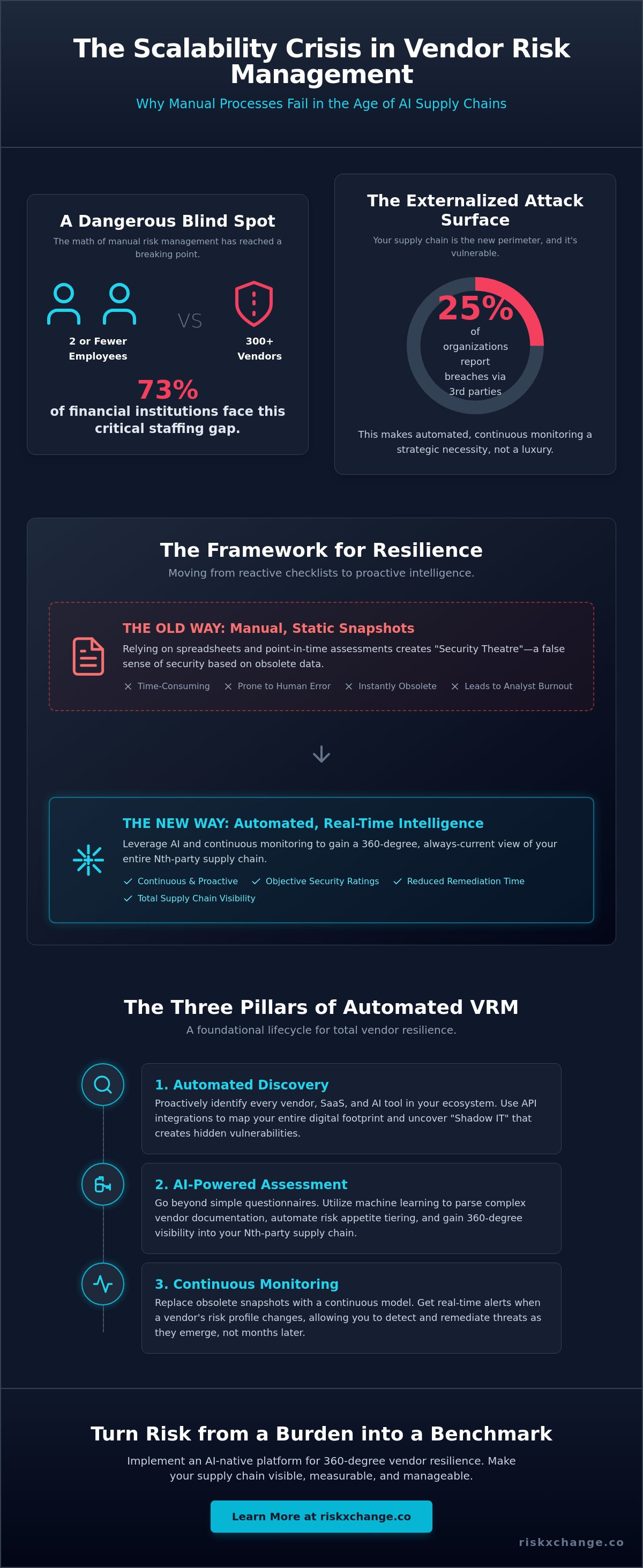
73% of financial institutions are currently attempting to manage more than 300 vendors with two or fewer full-time employees. This staffing gap, highlighted by 360Factors in 2026, creates a dangerous blind spot as nearly a quarter of organizations report security incidents caused by third parties. In this high-stakes environment, manual spreadsheets can't keep pace with the speed of digital threats. Implementing automated vendor risk management is no longer a luxury for efficiency; it's a strategic necessity to secure the externalized attack surface created by modern SaaS and AI supply chains.
You're likely familiar with the friction of assessment bottlenecks and the looming pressure of regulatory deadlines like the March 2026 DORA Register of Information submissions. We understand that managing these complex ecosystems feels overwhelming when you're caught between manual workflows and inconsistent risk reporting. This guide will show you how to master the transition to AI-driven, continuous supply chain intelligence for total vendor resilience. We'll examine how to leverage quantifiable security ratings and automated remediation to ensure your organization remains visible, measurable, and manageable in a volatile landscape.
The Scalability Crisis: Why Manual Vendor Risk Management Fails in 2026
The math of manual risk management has reached a breaking point. With 44% of organizations now assessing more than 100 third parties annually, the traditional reliance on human-led third-party management has become a liability. When two or fewer employees are tasked with overseeing hundreds of vendors, the result isn't oversight; it's a gamble. Manual assessments provide a static snapshot of a vendor's security posture that is often obsolete before the ink dries. In a hyper-connected ecosystem, a vendor's risk profile can shift in seconds due to a misconfigured cloud bucket or a new zero-day exploit. Relying on point-in-time data leaves your organization blind to the reality of your current risk exposure.
We're also seeing the rise of Shadow AI as a primary threat vector. Employees are integrating AI tools into their workflows without formal vetting, creating invisible entry points into your data environment. Most legacy systems fail to account for this exponential growth in the AI supply chain. Relying on compliance checklists often creates "Security Theatre," where an organization feels protected because a spreadsheet was completed, even while actual breaches loom. True resilience requires moving beyond these performative measures toward a state of informed command.
The Hidden Costs of Manual Data Entry
Manual data entry is a silent drain on corporate resources. GRC departments lose hundreds of hours each year to the tedious cycle of chasing questionnaire responses and clarifying vague answers. This inefficiency leads to analyst burnout, driving high turnover in critical security roles. Even worse, human error in risk scoring can lead to catastrophic vulnerabilities. A single mischaracterized vendor rating can leave a high-risk portal wide open to exploitation, simply because an analyst missed a detail in a 50-page PDF. These errors are not just administrative; they're structural weaknesses in your defense.
The 2026 Threat Landscape: Speed is the New Security
Security is no longer a matter of checking boxes once a year. The 2026 threat landscape is defined by speed. When a zero-day vulnerability hits a common supply chain component, you don't have weeks to wait for a manual survey. You need to know your exposure immediately. This shift from annual reviews to continuous monitoring is why automated vendor risk management has become essential. By moving to a proactive defensive posture, you gain the ability to detect and remediate threats as they emerge. High-performing teams use automated vendor risk management to turn risk from a static reporting burden into a dynamic, quantifiable benchmark of organizational resilience.
Defining Automated Vendor Risk Management: Beyond Simple Questionnaires
True automated vendor risk management isn't merely a digital version of a legacy process. It's a fundamental shift from reactive, point-in-time checks to a 360-degree, AI-driven intelligence lifecycle. While many organizations still rely on subjective "gut feel" during procurement, modern leaders are adopting quantifiable security ratings as a tangible anchor for their decisions. This doesn't just move the conversation from vague uncertainty to informed resilience. By treating security as a trackable, numerical benchmark, you can evaluate your true security posture through a lens of data-driven honesty.
Research from McKinsey on risk management suggests that organizations successfully transforming their third-party oversight focus on integrated, technology-enabled processes. This involves identifying the vendors your procurement team might have missed through automated discovery. These systems use API integrations to map your entire digital footprint, uncovering shadow IT and unmanaged AI tools that create hidden vulnerabilities. Understanding how your organization is perceived from an outside vantage point is the first step in gaining command over your supply chain.
The Three Pillars of Automation: Discovery, Assessment, Monitoring
The foundation of a resilient program rests on three specific pillars. First, automated discovery proactively identifies every entity in your ecosystem. Second, AI-powered assessment tools parse unstructured documentation like SOC2 and ISO reports to extract critical risk indicators. Finally, continuous monitoring provides 24/7 scanning of the external attack surface. This steady, methodical approach ensures that no change in a vendor's posture goes unnoticed. Integrating these pillars into a single AI-native TPRM platform allows you to manage complexity with quiet confidence.
The Role of AI in Risk Extraction
Machine learning and Natural Language Processing (NLP) are the engines behind this transformation. These technologies identify high-stakes SLAs and security terms within thousands of pages of documentation, highlighting potential contradictions that a human analyst might overlook. AI-driven platforms reduce total assessment time by 60% and simultaneously improve the depth of every analysis. By filtering out the noise of irrelevant alerts through intelligent risk scoring, your team can focus on the specific threats that matter. This level of precision ensures that risk mitigation is never lost in jargon or administrative fatigue.
Static vs. Automated VRM: Measuring the ROI of Real-Time Intelligence
Traditional vendor risk management often relies on self-reported data, which is essentially a pinky-promise of security. In 2026, this level of trust is insufficient for any organization aiming for true resilience. According to the 2024 Cyber Risk Report from Resilience, 40% of breach claims now involve a third party. This statistic underscores why shifting to automated vendor risk management is a fiscal and strategic imperative. By moving from manual questionnaires to objective external scanning, you gain an accurate, real-time view of your actual risk profile rather than a curated version of the truth.
One of the most critical metrics for modern GRC teams is 'Time-to-Remediation.' In a manual setup, identifying a vendor vulnerability often takes weeks of back-and-forth emails, leaving a window of exposure open for far too long. Automation slashes this window from weeks to hours. This efficiency allows a lean team to manage 1,000 or more vendors without increasing headcount. You're no longer paying a 'Compliance Tax' in the form of wasted labor and administrative friction. Instead, you're investing in an intelligence lifecycle that protects your bottom line and your brand reputation.
Questionnaires vs. Security Ratings
Manual questionnaires are limited by 'Yes/No' answers that lack nuance and context. They simply can't capture the complexity of a modern cloud environment or the rapid changes in a vendor's infrastructure. Real-time security ratings provide a common, numerical language that simplifies board-level reporting. This moves the conversation from abstract fears to trackable, quantifiable benchmarks. Using an externalized perspective ensures you see your supply chain exactly how an attacker does. This clarity allows you to prioritize the most critical threats first, moving your organization from a state of vulnerability to one of informed resilience.
Efficiency Gains and Resource Allocation
When you automate the onboarding process, business velocity increases. Procurement shouldn't be a bottleneck for innovation. By shifting high-value analysts from tedious data collection to strategic risk mitigation, you maximize the human intelligence in your department. High-growth organizations use automated vendor risk management to stay agile, onboarding new SaaS and AI tools with confidence rather than caution. The ROI becomes clear when you compare the cost of an automated platform against the potential multi-million dollar fallout of a supply chain breach. It's about maintaining agency and command in an increasingly volatile technological landscape.
Implementing an Automated Vendor Risk Management Program
Transitioning from manual oversight to a mature automated vendor risk management framework requires a methodical, four-phase approach. It's a journey from obscurity to clarity, where you move from reacting to individual vendor failures to commanding an entire ecosystem. By establishing a structured roadmap, you ensure that security remains a trackable, numerical benchmark rather than an abstract goal. This process moves your organization into a state of informed resilience, where every third-party relationship is visible and manageable.
Phase 1 begins with Inventory and Discovery. You cannot manage what you haven't mapped. This phase involves using automated tools to uncover every vendor in your supply chain, including the "Shadow AI" and SaaS tools that often bypass formal procurement. Phase 2 focuses on Tiering and Categorization. Here, you apply automated logic to group vendors based on their access to sensitive data and their criticality to your operations. Phase 3 moves into Integration, connecting your risk data directly into your procurement, legal, and IT stacks. Finally, Phase 4 establishes Remediation Loops, ensuring that when a risk is detected, the path to a fix is immediate and documented. Phase 5 provides the Governance and Oversight needed to report your progress to the board using a single quantifiable metric.
Setting Your Risk Appetite Rules
A successful vendor risk management program relies on clearly defined risk appetite rules. You must define custom risk tiers that trigger specific actions based on the sensitivity of the data involved. For low-risk vendors, you can automate "Go/No-Go" decisions, allowing your team to focus their expertise on high-stakes partnerships. This automation speeds up business velocity without sacrificing your security posture. It creates a streamlined flow where risk mitigation is built into the very first step of the vendor lifecycle.
Closing the Remediation Loop
Detection is only half the battle; the true value of automated vendor risk management lies in closing the gap between finding a vulnerability and fixing it. Automated notifications drive vendor accountability by sending immediate alerts when a security rating drops below your threshold. You can track the entire lifecycle of a vulnerability from the moment of discovery to verified remediation. Automation ensures contractual compliance by continuously verifying that vendor security performance aligns with agreed-upon service levels. This proactive control allows you to maintain agency over your externalized attack surface. To see how this looks in practice, you can scale your program with an AI-native TPRM platform designed for the 2026 threat landscape.
RiskXchange: The AI-Native Platform for 360-Degree Vendor Resilience
RiskXchange serves as the lens through which your company can evaluate its true security posture. While many competitors offer fragmented tools for monitoring, our AI-native platform provides a unified workflow that integrates ESG, Data Protection, and Cyber Risk. This consolidation eliminates the obscurity of siloed data, replacing it with a single source of truth for your entire supply chain. By moving the conversation from a state of vulnerability to one of informed resilience, we empower decision-makers to manage complexity with absolute confidence. This isn't just about internal defense; it's about gaining an externalized perspective on your entire ecosystem.
Our solution is built for global scalability, supporting Fortune 500 supply chains across Austin, London, and Dubai. We don't just answer the question "What is the risk?" instead, we provide the actionable intelligence needed to answer "How do we fix it?" This proactive control is essential for maintaining a persistent defensive posture in a landscape where threats evolve in seconds. Automated vendor risk management through our platform ensures that your security efforts are always visible, measurable, and manageable.
Why Real-Time Security Ratings Matter
The core of our platform is a proprietary cybersecurity risk rating platform that provides a quantifiable, numerical benchmark for vendor trust. These ratings aren't static; they're dynamic signals that reflect the current state of a vendor's infrastructure. By leveraging AI to provide an externalized perspective, we show you exactly how your organization is perceived by outside threats. This transparency moves security from an abstract concept to a trackable business metric, allowing for clear and effective board-level communication. It's the tangible anchor needed for every strategic discussion regarding third-party relationships.
Streamlining Compliance and Beyond
Meeting the requirements of global regulations requires more than manual effort. RiskXchange automates compliance with frameworks like NIST and ISO, alongside stringent data protection laws. This automation ensures that your vendor relationships remain compliant without the burden of manual oversight or administrative fatigue. Looking ahead, the future of TPRM lies in predictive risk modeling. We're moving beyond simple detection toward a model of supply chain resilience that anticipates disruptions before they occur. Automated vendor risk management is the foundation of this future, providing the steady and methodical rhythm required for long-term stability. Request a demo of the RiskXchange automated vendor risk management platform today to take command of your digital ecosystem.
Commanding Your Supply Chain Future
The transition from manual assessments to automated vendor risk management is a move from vulnerability to informed resilience. You've seen how point-in-time snapshots fail to capture the speed of modern supply chain threats. By adopting a methodical approach to discovery, assessment, and continuous monitoring, you regain agency over your digital footprint. This shift ensures that compliance is no longer a reactive burden but a strategic advantage that protects your organization's reputation and bottom line.
Secure the future of your operations with a partner that delivers clarity in a volatile landscape. RiskXchange offers AI-powered 360-degree risk intelligence and real-time security ratings that serve as a tangible anchor for all your strategic decisions. Trusted by Fortune 500 enterprises globally, our platform provides the quantifiable benchmarks you need to lead with confidence. Secure your supply chain with the RiskXchange AI-native TPRM platform and transform your vendor oversight from a state of obscurity into one of persistent command. You have the tools to manage the modern threat landscape; it's time to put them to work.