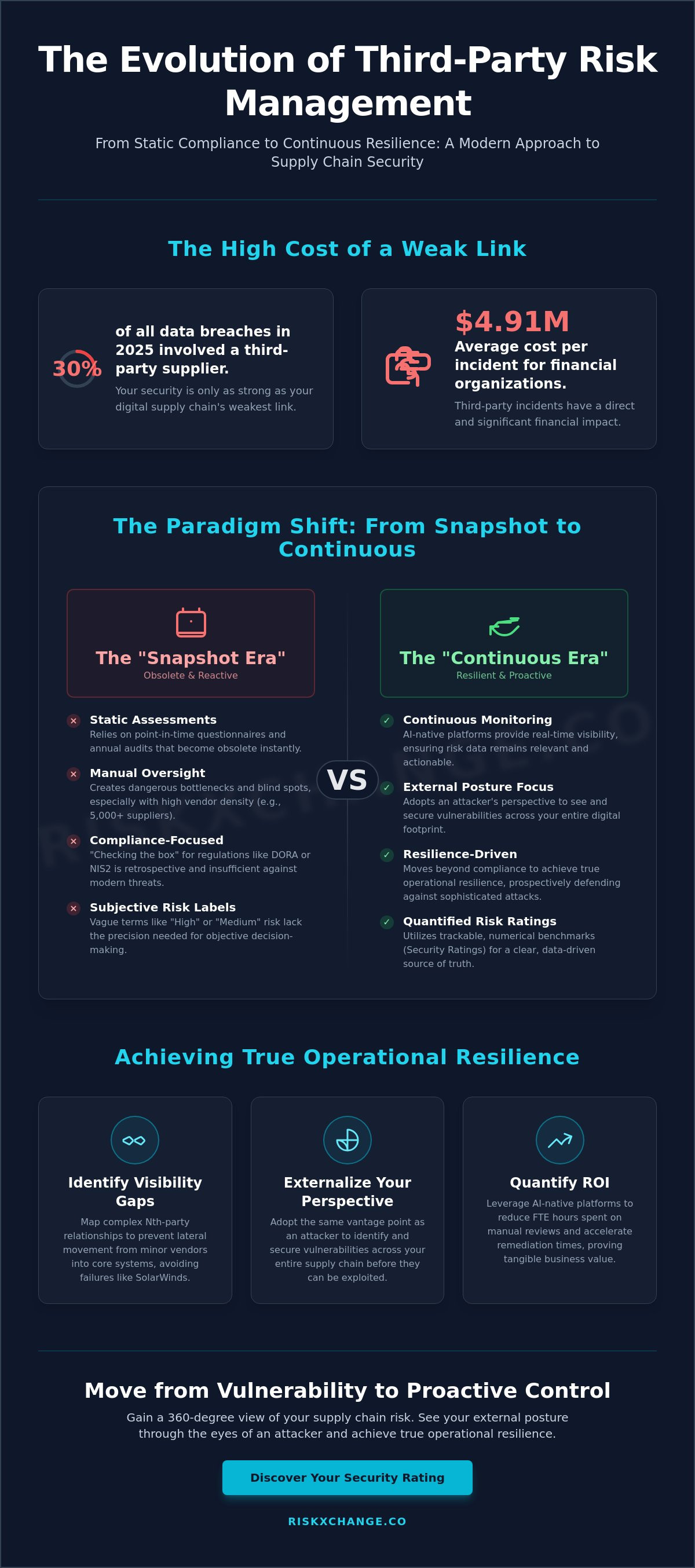
In 2025, nearly 30% of all data breaches involved a third-party supplier, costing financial organizations an average of $4.91 million per incident. This reality proves that your security posture is only as strong as the weakest link in your digital supply chain. You likely feel the pressure of monitoring an overwhelming volume of vendors while static, point-in-time assessments become obsolete the moment they're completed. Analyzing third-party risk management case studies from the past year reveals a stark divide between organizations trapped in manual compliance cycles and those achieving true operational resilience through quantified external visibility.
It's understandable to feel overwhelmed by the shifting requirements of DORA and the SEC when your current tools lack the immediacy needed for modern threats. This article provides the roadmap to master the practical application of TPRM through real-world breach post-mortems and enterprise success stories that define supply chain stability. We'll explore how AI-native platforms move the conversation from vulnerability to proactive control, helping you reduce incident response times and automate compliance reporting. You'll gain a clear business case for a system that treats security as a trackable, numerical benchmark rather than an abstract goal.
The Evolution of TPRM: Why Traditional Case Studies No Longer Apply
In the 2026 digital ecosystem, Third-Party Risk Management (TPRM) is no longer a peripheral compliance exercise. It's the core of operational resilience. Modern enterprises are connected to thousands of vendors, each representing a potential entry point for attackers. Traditional third-party risk management case studies often highlight a "Snapshot Era" approach, where manual questionnaires and point-in-time assessments were the standard. This method is now a liability. In an era of automated exploits, a static assessment is obsolete before the ink dries. We've moved into the "Continuous Era," where AI-native monitoring provides the real-time visibility required to defend complex supply chains.
High vendor density has transformed manual oversight into a dangerous bottleneck. When an organization manages 5,000 suppliers, relying on human-led reviews creates blind spots that hackers are eager to exploit. The primary metric for 2026 resilience has shifted to "External Posture." This perspective allows you to see exactly what an attacker sees, identifying vulnerabilities across your entire ecosystem before they can be weaponized. It's about moving the conversation from a state of vulnerability to one of informed resilience and proactive control.
The Shift from Compliance to Resilience
Meeting a regulatory standard like NIS2 or DORA is necessary, but it's no longer enough to prevent a sophisticated supply chain attack. Compliance is often retrospective, while resilience is prospective. Proactive risk management requires real-time data to identify shifts in a vendor's security environment as they happen. Corporate boards in 2026 are held to higher standards of accountability by the SEC, making it essential to move beyond "checking the box." You need a system that offers agency and command over your data, ensuring that your organization isn't just compliant, but genuinely secure against lateral movement.
Quantifying Risk in the Modern Enterprise
Vague labels like "High" or "Medium" risk are too subjective for the high-stakes environment of 2026. Enterprises now require a single source of truth for vendor risk data that uses trackable, numerical benchmarks. A Security Rating is a dynamic, quantifiable benchmark of an organization’s external posture, providing a clear lens through which to evaluate true security health. This numerical approach turns security into a measurable business asset. By using these ratings, you can compare vendors objectively and track improvements over time, moving your strategy from obscurity to total clarity. This data-driven honesty helps you manage the overwhelming number of vendors without losing technical precision. Successful third-party risk management case studies today focus on these metrics to prove tangible business benefits.
Learning from Failure: High-Profile Third-Party Breach Post-Mortems
Analyzing failure is the first step toward resilience. A NIST Case Study on Supply Chain Risk highlights that even mature organizations struggle with visibility beyond their immediate contracts. When we examine third-party risk management case studies, a recurring pattern emerges: a total reliance on trust rather than continuous verification. This lack of external visibility creates an environment where vulnerabilities persist unnoticed until an incident occurs. It's no longer enough to assume a vendor is secure because they passed an annual audit.
The SolarWinds incident serves as the definitive example of the Nth-party problem. It wasn't just a compromise of a single vendor; it was an attack on the integrity of the software update mechanism itself. This breach demonstrated that your security posture is inextricably linked to your vendor's vendors. Without a way to map these complex Nth-party relationships, you're essentially blind to risks deep within your ecosystem. The common thread here is a lack of immediacy. By the time a vulnerability is discovered through traditional methods, the damage is often already done.
Similarly, the Target breach remains a masterclass in lateral movement. Attackers didn't target the retailer's main network first. They exploited a small HVAC contractor with weak security controls to gain a foothold. Once inside, they moved laterally to access point-of-sale systems. This failure wasn't just about the vendor's internal defense, it was about a lack of visibility into how that vendor was perceived from the outside. To prevent these scenarios, organizations are turning to AI-native monitoring solutions that provide an immediate, externalized view of risk.
The Hidden Danger of Nth-Party Vulnerabilities
The Nth-party problem refers to the risks introduced by your vendor’s own suppliers. A single point of failure deep in the supply chain can cause a cascading effect that eventually reaches your organization. Visibility must extend beyond the primary contract because your data often travels through multiple layers of sub-processors. Modern third-party risk management case studies prove that mapping these dependencies is the only way to achieve true resilience. You must understand the security posture of the entire ecosystem, not just your direct partners.
Lateral Movement and Access Control Failures
Attackers frequently use low-risk vendors as a gateway to high-value internal networks. Network segmentation and least-privilege access are critical, but they only address the internal side of the equation. External attack surface management identifies these entry points before they are exploited by providing a hacker’s eye view of your vendor’s infrastructure. By quantifying these risks as numerical benchmarks, you gain the command necessary to remediate vulnerabilities before they lead to a breach. This proactive approach moves your organization from a state of vulnerability to one of informed resilience.
The Anatomy of Success: How Enterprises Achieve TPRM Maturity
Success in 2026 isn't defined by the speed of a single assessment. It's defined by the ability to maintain informed resilience across a shifting vendor ecosystem. Mature organizations follow a rigorous framework that moves from automated discovery to verified remediation. By moving away from manual spreadsheets, these leaders gain a clear, externalized perspective of their entire supply chain. This approach ensures no vendor remains in the shadows, regardless of their size or location. It's about achieving a state of proactive control where risks are visible, measurable, and manageable.
Consider the example of a Fortune 500 financial firm that faced the stringent requirements of the Digital Operational Resilience Act (DORA). By the time the regulation became fully applicable on January 17, 2025, they had already shifted to an AI-native TPRM platform. Instead of relying on static reports, they maintained a trackable, numerical benchmark for every critical ICT provider. They didn't just meet the deadline; they improved their security posture by identifying vulnerabilities in their Nth-party ecosystem months before their competitors. This case shows that a single source of truth for vendor risk data is a prerequisite for modern compliance.
Another success story involves a global manufacturer securing an increasingly complex IoT supply chain. They realized that traditional third-party risk management case studies often ignored the risks posed by unmanaged hardware components. By implementing automated remediation workflows, they could instantly flag unauthorized changes in a vendor's infrastructure. This proactive stance saved their internal teams thousands of hours, moving their focus from administrative data entry to strategic risk mitigation. It demonstrates how elite capabilities can be made accessible through the right technological partnership.
Automating the Vendor Assessment Lifecycle
AI-native platforms have effectively ended the era of "questionnaire fatigue." Instead of sending hundreds of manual emails, enterprises now use automated digital footprint analysis to gather evidence. This shift has a tangible impact on the bottom line. Many organizations report reducing vendor onboarding time from several months to just a few days. It's a transition from obscurity to clarity that empowers decision-makers to move at the speed of business without compromising their security posture.
Continuous Monitoring as a Competitive Advantage
Real-time alerts provide a critical window of opportunity to respond to vendor breaches before data exfiltration occurs. This isn't just about defense; it's a competitive advantage. Using security ratings as a negotiation lever during procurement allows you to demand higher standards from your partners. Integrating ESG and data protection into a unified risk score provides a holistic view of organizational health. This ensures your supply chain resilience is visible and manageable from an outside vantage point, distinguishing your firm as a sophisticated, tech-forward leader.
Measuring ROI: The Business Case for Modern TPRM Software
The financial impact of supply chain vulnerabilities has never been more transparent. With third-party compromises costing financial organizations an average of $4.91 million per incident, the business case for a robust platform moves from "optional" to "essential." 96% of organizations now report that their programs deliver a measurable ROI, yet the true value lies in preventing the 30% of data breaches that originate within the vendor ecosystem. Analyzing modern third-party risk management case studies demonstrates that the transition from manual labor to AI-native automation isn't just about security; it's about preserving capital and operational continuity.
Compliance with regulations like DORA, which became fully enforceable on January 17, 2025, has further solidified the ROI of automated oversight. Organizations that fail to maintain stringent oversight of critical ICT providers face significant regulatory fines and reputational damage. By automating compliance reporting, enterprises avoid the staggering costs of non-compliance while simultaneously lowering their cyber insurance premiums. Insurers in 2026 increasingly reward "continuous era" monitoring with an "Insurance Dividend," recognizing that real-time visibility significantly reduces the likelihood of a catastrophic claim. This transition from obscurity to clarity ensures that your organization is perceived as a resilient partner by both regulators and insurers.
Operational Efficiency Metrics
The shift to AI-native TPRM delivers immediate efficiency gains by eliminating the labor-intensive cycles of manual evidence collection. Organizations often see a drastic reduction in the FTE hours required to manage thousands of vendors. By focusing on "Mean Time to Detect" (MTTD) and "Mean Time to Remediate" (MTTR), businesses can quantify their operational success in ways that traditional spreadsheets cannot match. This rhythmic consistency in data collection allows for a streamlined flow of information across the enterprise.
- Onboarding Speed: Reducing the time to vet new vendors from months to days by utilizing automated digital footprint analysis.
- Incident Response: Lowering overhead by using attack surface analysis to prioritize high-impact vulnerabilities before they are exploited.
- Resource Allocation: Allowing internal teams to focus on strategic remediation rather than administrative data entry and questionnaire follow-ups.
Strategic Risk Reduction
Informed resilience is the new standard for board-level reporting. Leaders no longer present abstract threats; they use trackable, numerical benchmarks to prove a decreasing risk trend over time. This data-driven honesty builds confidence with stakeholders and positions the security team as a business enabler. While point-in-time audits offer a historical snapshot of security, continuous intelligence provides the real-time visibility necessary to cover risks as they emerge in a volatile threat landscape. To see how these metrics apply to your organization, you can quantify your supply chain risk through our AI-native platform.
RiskXchange in Action: A 360-Degree Approach to Supply Chain Risk
The transition from vulnerability to informed resilience requires more than just better data; it requires a fundamental shift in perspective. RiskXchange provides this shift by offering an externalized perspective of your entire digital footprint. Unlike legacy tools that focus on internal defenses, our AI-native platform identifies exactly what a hacker sees when evaluating your supply chain. This visibility is anchored by our proprietary security rating, a trackable, numerical benchmark that turns abstract risk into a measurable business asset. By centralizing cybersecurity, ESG, and compliance metrics into a single actionable dashboard, we eliminate the obscurity that often plagues large-scale vendor ecosystems.
Mapping complex Nth-party relationships is a core capability of our platform. It's no longer enough to monitor your direct partners while their own subcontractors remain invisible. Our AI-driven engine continuously analyzes the connections between your third parties and their own suppliers, surfacing hidden vulnerabilities before they can cascade into your network. This level of thoroughness is what distinguishes elite programs from those that are merely "established." When you look at modern third-party risk management case studies, the common denominator in success is the move toward this type of comprehensive, real-time oversight.
Visibility Beyond the Perimeter
Our 360-degree platform monitors the entire digital ecosystem in real-time, providing immediacy that manual assessments simply cannot match. Attack Surface Management plays a pivotal role here, allowing you to preemptively close vulnerabilities before they are weaponized. For instance, a global enterprise recently used RiskXchange to secure a network of over 1,000 vendors. By implementing our continuous monitoring, they moved from reactive firefighting to a state of proactive control. They achieved a significant reduction in their mean time to remediate critical vulnerabilities by focusing on the external entry points that mattered most.
Empowering Proactive Control
Actionable intelligence is the lens through which you can evaluate your true security posture. We move the conversation beyond simple vulnerability alerts to a state of informed resilience. With a global presence in London, Austin, and Dubai, RiskXchange provides localized risk insights that are essential for managing a volatile technological landscape. We don't promise a world without challenges, but we provide the command necessary to make those challenges manageable. It's time to move your organization from a state of uncertainty to one of quiet confidence. You can request a demo to see your organization’s real-time security rating and begin your journey toward total supply chain clarity.
Achieve Informed Resilience in a Volatile Landscape
The transition from periodic assessments to a continuous, real-time approach is no longer just a strategic choice; it's a regulatory and operational necessity. By analyzing recent third-party risk management case studies, it's clear that success belongs to organizations that prioritize external visibility and quantifiable benchmarks over static checklists. You've seen how high-profile failures often stem from a lack of Nth-party oversight, while mature enterprises leverage automation to reduce incident response overhead and secure complex supply chains.
RiskXchange provides the elite capabilities needed to navigate this complexity with calm confidence. Our AI-native platform delivers real-time monitoring and quantifiable security ratings that Fortune 500 enterprises rely on to maintain proactive control. With global intelligence hubs in London, Austin, and Dubai, we ensure your digital footprint is managed with technical precision and strategic clarity. Secure your supply chain with the RiskXchange 360-degree risk platform and move your organization from a state of vulnerability to informed resilience today. You have the tools to make the modern threat landscape visible, measurable, and manageable.