Open-source malware detections surged by 73% in 2025, yet many CISOs still rely on manual vendor audits that are obsolete before the ink is dry. If you're struggling to gain visibility into fourth-party risks or meet the mandates of the March 2026 National Cybersecurity Strategy, you aren't alone. You understand that static spreadsheets can't protect a complex ecosystem against modern threats. Adopting a proactive supply chain cybersecurity framework is no longer just a compliance exercise. It's the only way to gain an outside-in view of your digital footprint and preempt vulnerabilities before they become breaches.
This guide moves you from a state of digital vulnerability to one of informed resilience. You'll learn how to implement a dynamic, AI-driven supply chain cybersecurity framework that replaces manual assessments with continuous, real-time monitoring. We'll provide a roadmap for selecting the right standards, including the new ISO/IEC TS 27103:2026, and show you how to leverage quantifiable security ratings. By the end of this article, you'll have a clear strategy to satisfy regulators like DORA and CMMC 2.0 while demonstrating measurable risk reduction to your Board.
Why Modern Supply Chains Need a Unified Cybersecurity Framework
A supply chain cybersecurity framework is the essential blueprint for managing the complex web of third-party digital dependencies that define modern business. It's a transition from the narrow focus of "vendor management" to the broader goal of ecosystem resilience. In 2026, this shift is driven by necessity. Governments have moved from suggestions to mandates. The U.S. National Cybersecurity Strategy, updated in March 2026, places heavy emphasis on cloud and supply chain transparency. Similarly, the EU’s NIS2 and DORA regulations require financial and critical infrastructure entities to maintain rigorous oversight of their ICT providers. You don't just need a list of vendors; you need a strategy to survive their vulnerabilities.
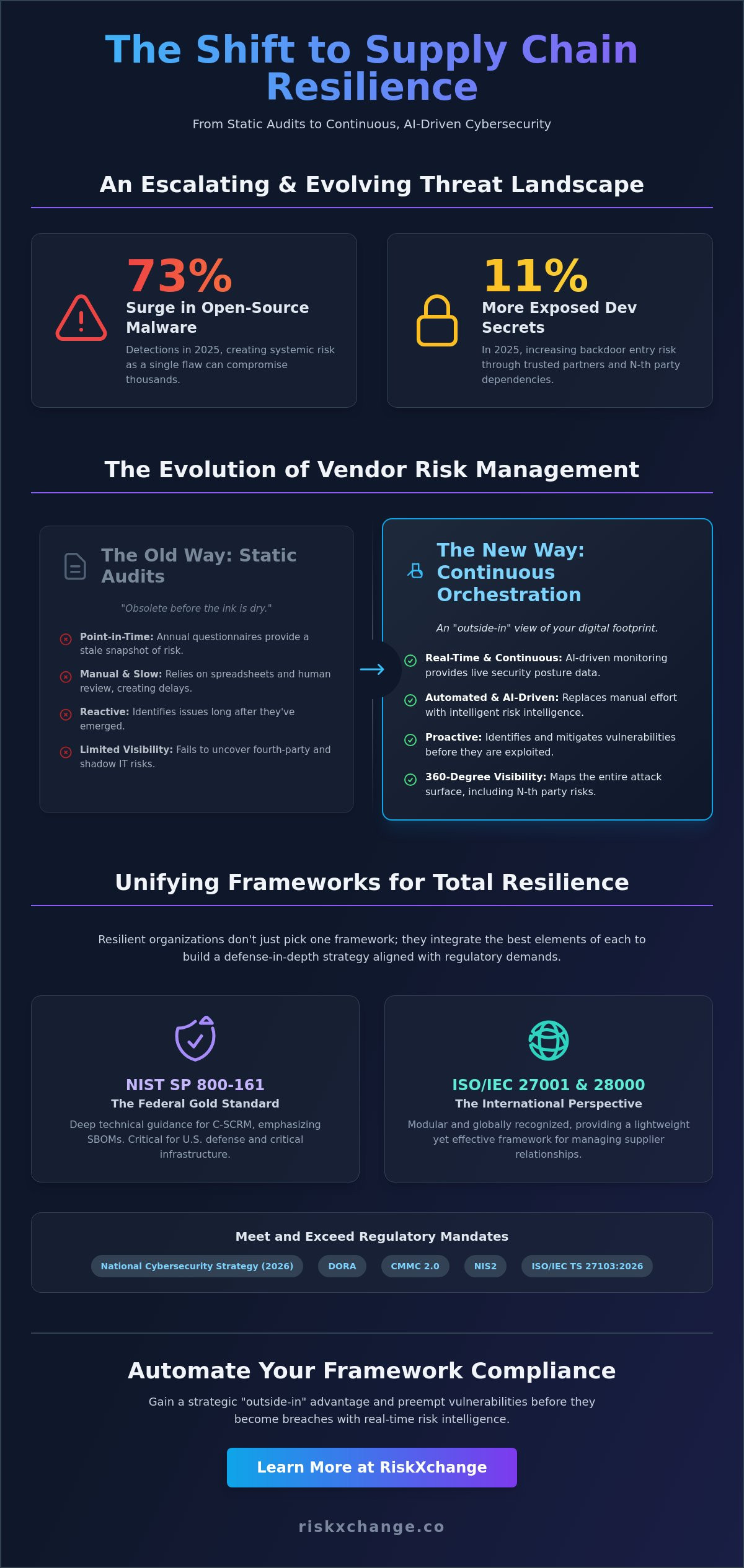
The cost of failure has never been higher. While the 2013 Target breach remains a cautionary tale, the threats have evolved into systemic contagions. With open-source malware detections increasing by 73% in 2025, a single vulnerability in a shared library can compromise thousands of downstream organizations simultaneously. A unified Digital Supply Chain Security approach ensures that your organization isn't the weakest link in this chain. It moves the conversation from reactive crisis management to proactive, informed control.
The Shift from Static Audits to Real-Time Visibility
Traditional annual questionnaires are a fundamental failure of "point-in-time" logic. They provide a snapshot of a vendor's posture that's often obsolete by the time the assessment is reviewed. You can't manage 2026 risks with 2010 methods. Modern frameworks demand 360-degree risk management. This requires moving away from manual spreadsheets toward AI-native solutions that bridge the visibility gap. These platforms allow you to monitor security postures continuously, ensuring that a vendor’s Cybersecurity Rating reflects their current status, not their status from six months ago.
Identifying Your Supply Chain Attack Surface
You can't protect what you can't see. Effective risk management requires an "outside-in" perspective; you must understand how potential attackers view your vendors' digital footprints. Your supply chain attack surface isn't just limited to your direct partners. It includes the shadow IT and N-th party dependencies they bring into your environment. When 11% more development secrets were exposed in major repositories in 2025, the risk of a backdoor entry through a trusted partner became a primary concern. A robust supply chain cybersecurity framework links attack surface management directly to your overall security posture, turning blind spots into actionable data.
Comparing the Core Supply Chain Cybersecurity Frameworks (NIST, ISO, and C-SCRM)
Selecting a supply chain cybersecurity framework isn't about finding a one-size-fits-all solution. It's a matter of strategic alignment with your regulatory obligations and risk appetite. While NIST provides the technical depth required for federal compliance, ISO offers the modularity needed for global operations. In 2026, the most resilient organizations don't just pick one; they integrate the best elements of each to build a defense-in-depth strategy. This hybridization allows CISOs to meet the rigorous demands of the March 2026 National Cybersecurity Strategy while maintaining the agility needed for international trade.
NIST SP 800-161: The Federal Gold Standard
As the definitive guide for Cybersecurity Supply Chain Risk Management (C-SCRM), NIST SP 800-161 Revision 1 organizes security into five core tiers: Identify, Protect, Detect, Respond, and Recover. The 2026 updates place a heavy emphasis on Software Bills of Materials (SBOMs), requiring vendors to provide granular transparency into their codebases. This level of detail is critical for organizations operating within the U.S. defense industrial base or critical infrastructure. NIST 800-161 stands as the most comprehensive, albeit complex, framework available for organizations requiring deep technical integration.
ISO/IEC 27001 and 28000: The International Perspective
If your operations are global, ISO/IEC 27001 remains the preferred entry point. Annex A.15 specifically addresses supplier relationships, providing a lightweight alternative to NIST's exhaustive controls. For companies managing the convergence of physical and digital logistics, ISO 28000 offers a broader view of security across the entire supply chain. Choosing ISO over NIST often makes sense for organizations that need a flexible, internationally recognized certification to facilitate cross-border partnerships. This is particularly relevant given the publication of ISO/IEC TS 27103:2026 in February 2026, which provides updated guidance on using these standards within a modern framework.
Beyond these, the Department of Energy’s Supply Chain Principles provide a focused lens for critical infrastructure, emphasizing the integrity of hardware and firmware. Navigating these options requires a clear understanding of your current maturity. You can benchmark your current posture against these standards to identify where your visibility gaps reside. By blending the technical rigor of NIST with the operational flexibility of ISO, you create a robust supply chain cybersecurity framework that scales with your business. This approach ensures you meet the November 2026 CMMC 2.0 deadlines while staying ahead of emerging threats.
Moving Beyond Compliance: The Shift to Continuous Framework Orchestration
Static compliance is a relic of a slower era. If your supply chain cybersecurity framework exists only as a spreadsheet or a quarterly PDF, it's effectively dead. In 2026, the speed of exploitation is often measured in hours from the moment a vulnerability is disclosed. This reality makes manual reviews a liability rather than a defense. True resilience requires Continuous Framework Orchestration (CFO). This approach moves you from "reviewing" risk to "orchestrating" it, integrating real-time data directly into your Governance, Risk, and Compliance (GRC) workflows so your security posture evolves as fast as the threats do.
Central to this orchestration is the use of quantifiable Cybersecurity Ratings. Instead of interpreting vague, subjective audit responses, these ratings provide a trackable metric that reflects the "outside-in" reality of your vendors. This visibility must extend beyond your primary partners. Since 70% of organizations reported being extremely concerned about supply chain risks in 2025, ignoring N-th party (fourth-party and beyond) dependencies is no longer an option. You need to see the vulnerabilities in your vendors' vendors to truly secure your perimeter. Integrating a dynamic supply chain cybersecurity framework into your daily operations ensures these hidden risks are surfaced and mitigated automatically.
The Role of AI and Machine Learning in Risk Mitigation
AI-native solutions do more than aggregate data; they identify behavioral patterns that human analysts often miss. By 2026, machine learning models can predict vendor risk by analyzing historical breach data and current configuration drifts. These tools also solve the "cross-mapping" challenge, automatically translating a single piece of vendor evidence across multiple standards like NIST and ISO. This automation significantly reduces questionnaire fatigue, allowing your security team to focus on remediation rather than administrative data entry. It turns a manual, grueling process into a seamless, high-speed operation.
Actionable Intelligence vs. Raw Data
A list of ten thousand vulnerabilities isn't a strategy; it's a distraction. A modern framework filters this noise into actionable intelligence. By converting raw technical data into business-level Cybersecurity Ratings, you empower non-technical stakeholders across the organization. Procurement teams can now use clear "go/no-go" metrics during the onboarding process. This shift ensures that security isn't a bottleneck at the end of a deal, but a foundational requirement from the very first touchpoint. You aren't just checking boxes; you're building a culture of proactive control.
How to Implement a Supply Chain Cybersecurity Framework in 5 Steps
Execution is where many CISOs stall. A supply chain cybersecurity framework is only as good as its implementation, and moving from a theoretical model to a functional defense requires a steady, methodical approach. To meet the rigorous demands of the March 2026 National Cybersecurity Strategy, you must move beyond the "checkbox" mentality and build a system that prioritizes visibility and action. By following these five steps, you can transform your supply chain from a source of vulnerability into a pillar of organizational resilience.
- Step 1: Discover and Categorize. You can't protect what you can't see. Start by identifying every third-party touchpoint, including the shadow IT and N-th party dependencies that often hide in the background.
- Step 2: Baseline and Benchmark. Assign an initial Cybersecurity Rating to every vendor in your network. This provides a quantifiable starting point to measure future progress or decline.
- Step 3: Framework Mapping. Align your vendor requirements with established standards like NIST SP 800-161 or ISO/IEC 27001. This ensures your expectations are rooted in global best practices.
- Step 4: Continuous Monitoring. Replace outdated annual audits with real-time risk intelligence. This allows you to respond to threats as they emerge, rather than months after the fact.
- Step 5: Collaborative Remediation. Work directly with your partners to close identified gaps. High-speed dev cycles in 2026 require a partnership model where security is a shared responsibility.
Categorizing Vendors by Criticality
Not all vendors represent the same level of risk. You must separate "commodity" suppliers from "critical" partners who have direct access to your sensitive data or core infrastructure. Define criticality based on the potential operational impact of a breach. For a high-tier vendor, your supply chain cybersecurity framework should demand more granular evidence, such as real-time SBOM updates. Lower-tier vendors might only require basic hygiene monitoring. This tiered approach ensures your resources are focused where they matter most, preventing security bottlenecks in your procurement process.
Establishing a Remediation Workflow
Identifying a problem is only the first half of the battle; the second half is fixing it. You need a structured remediation workflow that moves issues from detection to resolution without manual friction. Use automated platforms to track vendor improvements over time and set clear deadlines for closing critical vulnerabilities. Learning how to conduct a third-party risk assessment effectively is the foundation of this process. It turns raw data into a punch list of actionable tasks for your vendors. When you treat security as a trackable metric, you move the conversation from "finding faults" to "improving posture."
Ready to see how your vendors measure up? Get your free Cybersecurity Rating today and start building your roadmap to resilience.
RiskXchange: Automating Framework Compliance with Real-Time Risk Intelligence
RiskXchange acts as the AI-native orchestration layer that brings your supply chain cybersecurity framework to life. While frameworks like NIST or ISO provide the necessary structure, they often remain static without a continuous stream of data. Our platform bridges this gap by providing the real-time risk intelligence required to move from passive compliance to active resilience. We offer a distinct "outside-in" advantage, allowing you to see your entire vendor ecosystem exactly as a potential attacker does. This perspective is critical for identifying exposed credentials or misconfigured assets before they can be exploited.
Managing a modern supply chain requires more than just technical oversight. RiskXchange provides a comprehensive 360-degree monitoring capability that encompasses cyber risk, ESG factors, and regulatory compliance. This holistic view ensures that your organization remains protected against a wide array of third-party disruptions. Because our platform is designed for seamless integration, it plugs directly into your existing GRC and Procurement stacks. This ensures that security data is available to every stakeholder, from the technical analyst to the procurement officer, without requiring them to learn a new, siloed system.
Continuous Monitoring for the 2026 Threat Landscape
The threat landscape in 2026 moves too fast for human-led intervention alone. RiskXchange utilizes a real-time alert system that triggers the moment a vendor experiences a breach or a significant drop in their security posture. This proactive capability is essential for meeting the transparency requirements of the March 2026 National Cybersecurity Strategy. Beyond simple alerts, the platform automates the evidence collection process for NIST and ISO audits, mapping real-time performance data to specific framework controls. RiskXchange is the only platform providing a 360-degree view of supply chain resilience.
From Vulnerability to Resilience
Translating complex technical risks into business-level insights is a core requirement for the modern CISO. We treat the Cybersecurity Rating as a quantifiable anchor for all executive and Board-level reporting. This metric provides a clear, trackable history of your security posture, demonstrating measurable improvement over time. For organizations facing the November 2026 CMMC 2.0 deadlines, our professional services offer an elite, managed approach to the vendor assessment lifecycle. This ensures that your team isn't overwhelmed by the administrative burden of compliance, allowing you to focus on strategic risk reduction. It's time to move beyond blind spots and take definitive control of your digital footprint.
Request a demo of the RiskXchange platform to see how we can automate your path to a more resilient supply chain.
Take Command of Your Digital Resilience
The 2026 threat landscape doesn't wait for annual audits or manual reviews. Success now depends on your ability to move from static compliance to a dynamic, orchestrated defense. By implementing a modern supply chain cybersecurity framework, you ensure your organization is prepared for the rigorous mandates of the March 2026 National Cybersecurity Strategy and the final phases of CMMC 2.0. You've learned that true visibility requires an outside-in perspective and the ability to monitor N-th party risks in real time. This shift from reactive snapshots to continuous oversight is the only way to protect your ecosystem against the 73% surge in open-source malware detections recorded in 2025.
RiskXchange simplifies this overwhelming complexity. As an AI-native TPRM platform, we provide real-time security ratings and 360-degree supply chain visibility that traditional methods simply can't match. You can finally replace guesswork with quantifiable metrics that speak the language of the Board. Take control of your supply chain risk with RiskXchange. It's time to transform your digital footprint from a source of vulnerability into a pillar of informed, proactive strength.