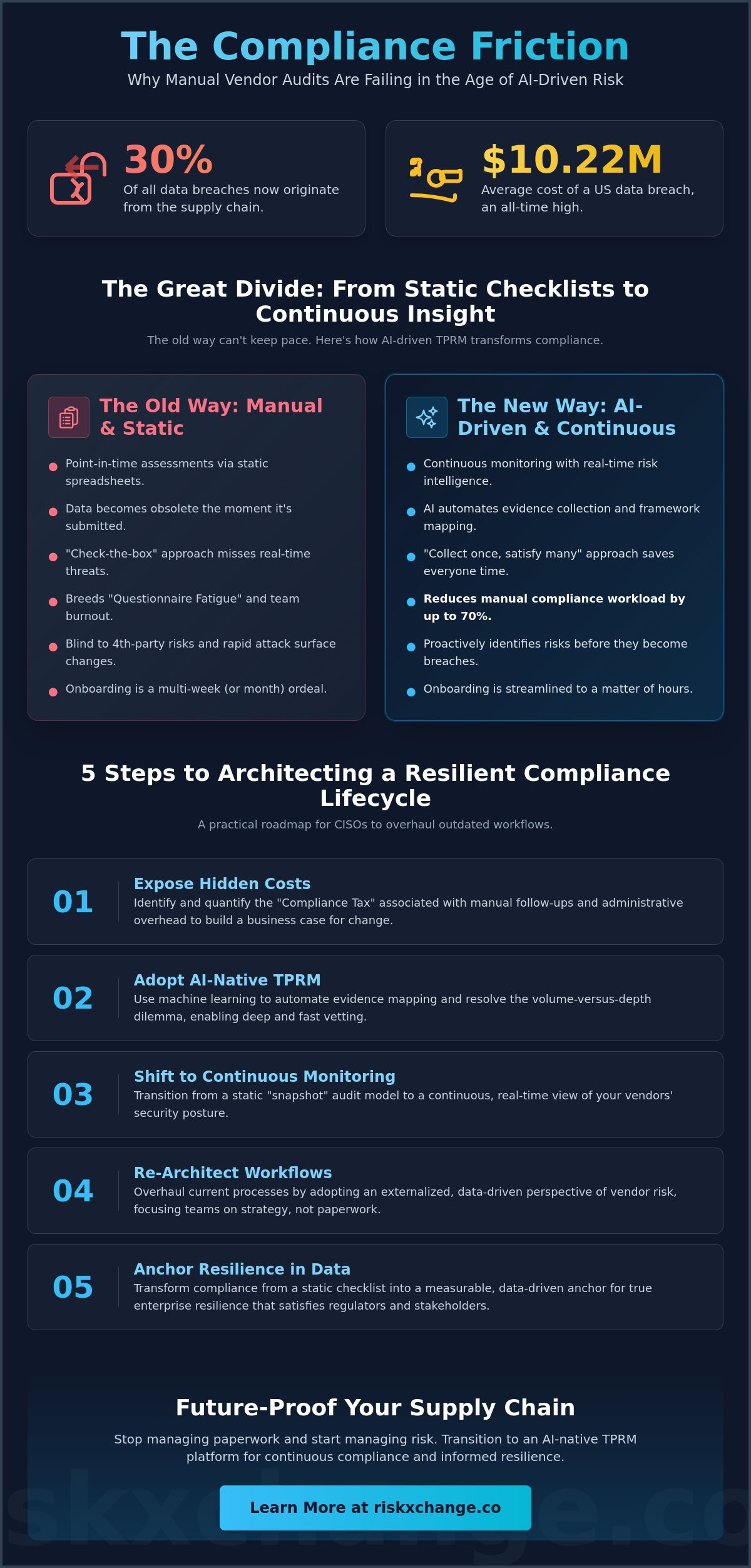
If 30% of all data breaches now originate from your supply chain, why is your compliance strategy still stuck in a cycle of static, point-in-time spreadsheets? You likely already feel the strain of manual questionnaire fatigue, knowing that these assessments often become obsolete the moment they're submitted. As DORA audits intensify and the average cost of a US data breach reaches an all-time high of $10.22 million, the old ways of streamlining third-party compliance management simply can't keep pace with the velocity of modern risk.
You're right to be concerned about the lack of visibility into deep supply chain layers. This guide demonstrates how to transform overwhelming vendor audits into a streamlined, AI-driven engine that reduces manual workload by up to 70%. We'll examine the transition from reactive assessments to real-time compliance visibility, allowing your team to allocate resources where they matter most. By the end of this guide, you'll understand how to achieve a state of informed resilience that satisfies both regulators and stakeholders with quantifiable clarity.
The Compliance Friction: Why Manual Third-Party Management Fails in 2026
Third-party compliance management serves as the operational backbone of modern supply chain integrity. It ensures that every vendor, partner, and service provider adheres to the same rigorous security standards as your own organization. However, many enterprises still treat this as a bureaucratic hurdle rather than a strategic asset. This creates a "Compliance Tax," which represents the massive, hidden costs associated with manual questionnaire follow-ups and administrative overhead. When GRC teams spend hundreds of hours chasing signatures, they aren't managing risk; they're managing paperwork.
The traditional reliance on point-in-time assessments is a significant vulnerability. These snapshots provide a false sense of security that expires the moment the document is signed. With third-party related breaches now accounting for 30% of all data breaches, according to 2026 data, relying on annual reviews is no longer a viable defense. Transitioning toward streamlining third-party compliance management allows leaders to move from a defensive posture to one of operational excellence. It turns compliance into a competitive advantage by ensuring business continuity and building trust with stakeholders who demand transparency.
The Questionnaire Fatigue and Data Obsolescence
The 60-page spreadsheet is the primary bottleneck in modern procurement. These massive documents are often outdated before a reviewer even opens them. This "stale data" problem means you're making critical business decisions based on how a vendor looked six months ago, not how they look today. Beyond the technical risk, there's a significant emotional toll on GRC teams. High-performing professionals are often relegated to repetitive manual tasks, leading to burnout and a lack of focus on high-priority strategic risks. Effective Third-party risk management (TPRM) requires moving away from these manual cycles.
The Hidden Risks of "Check-the-Box" Compliance
Manual processes are fundamentally blind to rapid shifts in a vendor's attack surface. A vendor might pass an audit in March but misconfigure a cloud bucket in April; a "check-the-box" approach won't catch that until next year. Traditional models also fail to account for 4th-party visibility, leaving you exposed to the risks of your vendor's vendors. Regulators have noticed this gap. With the full application of the Digital Operational Resilience Act (DORA) in early 2025 and new EU AI Act obligations, the mandate has shifted. Authorities now require continuous oversight and operational effectiveness rather than simple annual reviews. Streamlining third-party compliance management is the only way to meet these rigorous, real-time expectations.
The Mechanics of Streamlining: AI-Native TPRM and Automation
Enterprises face a fundamental dilemma: they can either vet every vendor deeply or they can vet them quickly. They rarely do both. AI-native TPRM dissolves this conflict by automating the heavy lifting of data ingestion and analysis. By 2024, 41% of organizations had already begun deploying AI for third-party risk management. This shift isn't just about speed; it's about accuracy. Machine learning algorithms can parse thousands of external security signals in seconds, providing a level of depth that a manual review of a spreadsheet simply cannot match. This approach to streamlining third-party compliance management moves the needle from reactive to proactive. It allows your team to focus on high-risk exceptions rather than routine data entry.
Automated Evidence Collection and Framework Mapping
The "collect once, satisfy many" philosophy is the heart of a modern compliance engine. Instead of asking a vendor for the same SOC2 or ISO 27001 certification multiple times, AI-native systems ingest a single piece of evidence and automatically map it across various regulatory frameworks. This eliminates redundant requests and significantly reduces the friction in the vendor relationship. It's a method that transforms the onboarding process from a multi-week ordeal into a matter of hours. When you use an AI-native TPRM platform, you're not just saving time; you're ensuring that the evidence is verified against the latest regulatory requirements without human error. This systematic approach ensures that infrastructure oversight remains thorough and constant.
Integrating ESG and Privacy into the Compliance Engine
Modern risk is multi-dimensional. Cybersecurity no longer exists in a vacuum. It's now inextricably linked with data protection mandates like GDPR and CCPA, as well as emerging ESG (Environmental, Social, and Governance) requirements. Understanding the potential risks external parties may pose requires a unified workflow that breaks down these traditional silos. By integrating these disparate data points into a single lens, decision-makers gain a 360-degree view of their supply chain health. This integration is critical because organizations that extensively use AI and automation in these processes save an average of $1.9 million per breach, according to 2026 industry data. It's about moving from obscurity to total clarity. You'll ensure that every link in your chain is as resilient as the core organization, transforming compliance from a burden into a measurable benchmark of success.
Static vs. Continuous Compliance: A Strategic Comparison
The traditional "Snapshot" model of compliance is essentially a rearview mirror. It captures a vendor's security posture at a single point in time, leaving your organization blind to any vulnerabilities that emerge in the following 364 days. In contrast, the "Live Stream" approach offered by RiskXchange provides an uninterrupted view of vendor health. This shift is fundamental to streamlining third-party compliance management. It moves the conversation from a state of vulnerability to one of informed resilience. When you maintain a continuous stream of data, you're no longer guessing about your security posture; you're measuring it in real-time.
This transition yields tangible business benefits, particularly regarding cyber insurance. Insurers in 2026 increasingly reward organizations that demonstrate continuous oversight with lower premiums. They recognize that static audits are insufficient for predicting risk in a volatile landscape. By adopting a continuous model, your GRC team undergoes a critical resource shift. They stop acting as manual data gatherers and start functioning as strategic risk remediators. This empowerment allows them to address threats before they escalate into breaches, moving from a reactive scramble to proactive command.
The Power of Real-Time Security Ratings
Security ratings provide a proprietary quantifiable metric that acts as a tangible anchor for all vendor discussions. These ratings aren't just abstract numbers; they correlate directly with the likelihood of a compliance failure. For a deeper look at these dynamics, consult this comprehensive guide to third-party risk management. High-performing organizations use these ratings to trigger automated re-assessments. If a vendor's score drops below a specific benchmark, the system immediately flags the issue for review. This proactive control ensures that you're never caught off guard by a vendor's declining security standards or infrastructure oversight.
Moving from Periodic Audits to Continuous Monitoring
Transitioning to a 24/7 monitoring posture requires a methodical approach. It begins with integrating APIs that pull live data directly from vendor environments. This removes the reliance on self-reported questionnaires, which are often prone to human error or bias. The result is an "always-ready" audit trail that reflects the true state of your supply chain. When external regulators arrive for an inspection, you won't need to scramble for documents. You'll present a chronological, data-driven history of your oversight efforts. This transparency positions your brand as a sophisticated guardian of its supply chain, moving beyond "check-the-box" habits into true operational excellence.
5 Steps to Architecting a Streamlined Compliance Lifecycle
Overhauling a legacy compliance program requires more than just new software; it requires a shift in philosophy. CISOs must adopt an externalized perspective, viewing their vendor ecosystem through the eyes of a potential attacker. This approach is central to streamlining third-party compliance management in a high-velocity environment. It moves the team from a defensive crouch to a position of command and agency. By following these steps, you'll replace manual friction with automated precision, ensuring your risk posture is visible, measurable, and manageable.
Step 1: Discover and Categorize the Digital Footprint
You can't secure what you can't see. Most organizations have unknown third-party connections that bypass official procurement channels, creating blind spots in your security perimeter. Attack surface management tools identify these shadow connections, allowing you to tier vendors based on their criticality and data access levels. A Digital Footprint is the totality of an organization's internet-facing assets and the third-party connections that define its compliance scope. By mapping this footprint, you establish a clear boundary for your audit efforts. This ensures you aren't wasting resources on low-risk vendors while critical pathways remain unmonitored.
Step 2: Automate the Onboarding and Vetting Process
Onboarding is often where streamlining third-party compliance management faces its greatest hurdles. Rather than starting from scratch with every new partner, use pre-populated assessments based on existing security ratings. This proactive control allows you to set firm compliance thresholds. If a vendor doesn't meet your baseline security score, the system pauses the process automatically. You can learn more about vendor onboarding software to see how this reduces manual review time. This step ensures only resilient partners enter your ecosystem, protecting your organization from the first day of the partnership.
Step 3: Implement Continuous Risk Signaling
Once a vendor is onboarded, the work of monitoring begins. Move away from the cycle of manual "check-in" emails that drain GRC resources and offer little real-time value. Instead, set up automated alerts that trigger when a vendor’s security rating fluctuates or when a data leak is detected. Integrating external threat intelligence into your compliance dashboard provides the immediacy required in 2026. This system moves your team from obscurity to clarity. They'll only intervene when the data indicates a genuine threat, allowing for better resource allocation across the supply chain. To achieve this level of oversight, consider how an AI-native TPRM platform can serve as your primary risk engine.
Future-Proofing with RiskXchange: The AI-Native Advantage
RiskXchange serves as the 360-degree lens through which Fortune 500 enterprises evaluate their true security posture. In a landscape where third-party related breaches have doubled year-over-year, having a fragmented view of your supply chain is a liability you can't afford. By streamlining third-party compliance management through our AI-native platform, you move beyond the limitations of legacy tools that rely on manual input and static data. We provide the actionable risk intelligence required to manage thousands of vendors with the same precision you apply to your internal infrastructure. This level of oversight doesn't just protect your perimeter; it builds a foundation of resilience that enables your organization to pursue aggressive growth without fear of hidden vulnerabilities.
The global reach of our solution ensures that even the most complex, multi-layered supply chains remain transparent. Whether you're navigating the direct supervision of the EU Anti-Money Laundering Authority or the rigorous audit cycles of DORA, our platform provides the stability and permanence your leadership demands. It's about moving the conversation from a state of constant vulnerability to one of informed, proactive control. You'll have the quiet confidence of a seasoned expert who knows exactly where the risks lie and how to remediate them before they impact your bottom line.
Quantifiable Metrics: The Anchor of Your Security Posture
RiskXchange transforms abstract compliance concepts into a trackable, numerical benchmark. Our proprietary quantifiable metric acts as a tangible anchor, allowing you to measure security as a live performance indicator rather than a yearly checklist. This is the core differentiator of an AI-native architecture. While legacy tools identify problems and leave the heavy lifting to your team, we provide the tools for immediate remediation. You'll see exactly how your organization is perceived from an outside vantage point, giving you the command needed to enforce high standards across every vendor tier. This data-driven honesty ensures that your security posture is always visible, measurable, and manageable.
Achieving Command and Agency Over Your Supply Chain
The user experience of our platform is designed to instill calm confidence in decision-makers. Our dashboard simplifies the overwhelming complexity of the global threat landscape, presenting a clear path from obscurity to clarity. You won't find cluttered interfaces or alarmist rhetoric here. Instead, you'll find a methodical, highly organized progression of data that mirrors a professional assessment. This clarity allows your GRC team to act with agency, focusing their expertise on strategic risk mitigation rather than administrative chasing. It's time to stop feeling rushed by regulatory deadlines and start leading with a steady, proactive cadence. You can streamline your compliance management with a RiskXchange demo and begin your transition to a more resilient future today.
Secure Your Supply Chain with Data-Driven Command
The transition from periodic, manual assessments to a continuous, AI-driven model is no longer optional for the modern enterprise. By 2026, the complexity of global regulations and the rising cost of third-party breaches demand a more sophisticated approach. You've seen how streamlining third-party compliance management turns overwhelming administrative burdens into a strategic asset. By leveraging quantifiable security ratings and real-time risk signaling, your team gains the agency to manage global supply chains with absolute clarity.
RiskXchange offers an AI-native TPRM platform trusted by Fortune 500 enterprises to monitor infrastructure oversight across every vendor tier. Our solution moves you from a state of vulnerability to one of informed resilience through continuous real-time risk management and trackable numerical benchmarks. It's time to replace guesswork with data-driven honesty and proactive control.
Request a 360-Degree Risk Assessment Demo to take command of your digital ecosystem and build a future where growth is anchored in measurable security.