Your manual vendor risk assessments are effectively obsolete the moment the data is collected. In a landscape where 60% of data breaches now originate through third-party vulnerabilities, relying on static snapshots isn't just inefficient; it's a liability. You likely feel the weight of an expanding attack surface and the exhaustion of managing thousands of vendors without real-time clarity. A successful RiskXchange implementation transforms this chaos into a structured, outside-in view of your entire digital ecosystem. It replaces guesswork with a quantifiable Cybersecurity Rating that reflects your true security posture at any given second.
We agree that your team's time is too valuable to be spent on resource-heavy manual audits that fail to catch emerging threats. This guide provides the strategic blueprint you need to master the transition from digital vulnerability to proactive control. You'll learn how to establish a seamless, automated risk monitoring setup that delivers actionable security ratings for every vendor in your portfolio. We're going to break down the exact steps to reduce your digital attack surface by 40% or more within the first 90 days of deployment.
Why Successful RiskXchange Implementation is Critical for 2026 Resilience
Security is no longer a static goal; it's a state of continuous adaptation. By 2026, the traditional model of annual security audits has become a liability. Enterprise networks don't end at the firewall anymore; they extend through thousands of interconnected API calls and cloud dependencies. A successful RiskXchange implementation serves as the bedrock for this new reality. It moves your organization beyond reactive firefighting and establishes a regime of continuous risk intelligence. This transition is vital because 60% of data breaches now originate within the supply chain, according to 2024 industry benchmarks. You can't manage what you can't see.
The "outside-in" perspective is the core of our methodology. It allows your security team to view your digital footprint exactly as an adversary does. Instead of relying on internal self-assessments that offer a biased view, we provide a transparent look at your external-facing assets. This approach identifies hidden vulnerabilities in your supply chain that internal scans often miss. It bridges the gap between technical cybersecurity teams and executive-level oversight. By translating complex telemetry into clear business risks, we empower CISOs to lead with confidence during board-level discussions about resilience and capital allocation.
Setting the stage for a 360-degree risk posture requires more than just software; it requires a foundational shift in how you perceive your ecosystem. This initial phase of deployment ensures that every subsequent step is rooted in high-fidelity data. It's about moving from a state of digital vulnerability to one of informed resilience. When you have a clear map of your environment, you aren't just guessing where the next threat will emerge. You're actively monitoring the points of failure before they can be exploited.
The Evolution of the Attack Surface in 2026
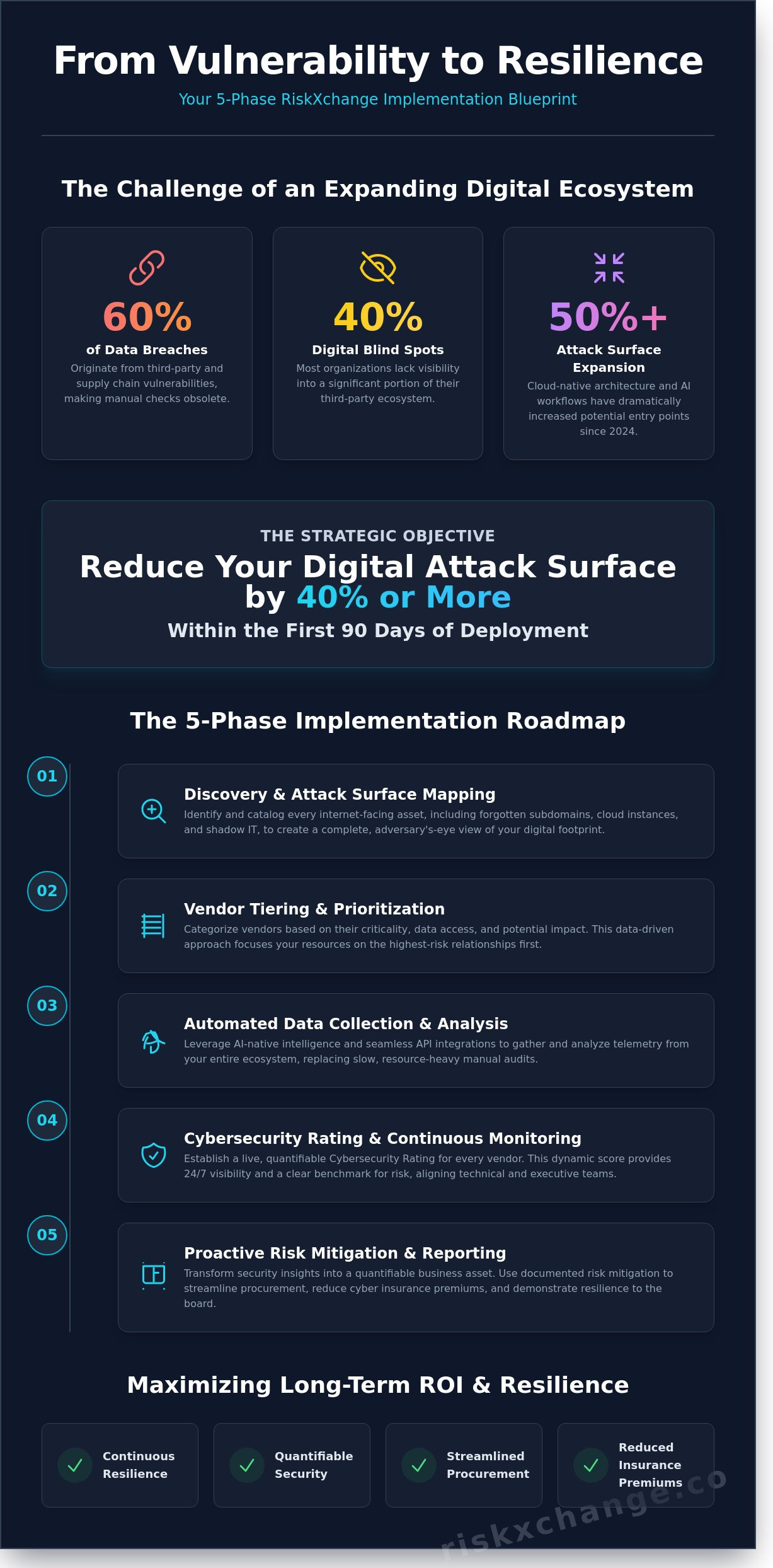
Cloud-native architectures and AI-integrated workflows have expanded the corporate attack surface by an estimated 50% since 2024. For Fortune 500 enterprises, point-in-time assessments are obsolete because vendor environments change by the hour. We utilize the Cybersecurity Rating as a definitive, real-time metric to solve this. This score provides a data-driven benchmark that translates technical jargon into a format that 85% of board members now prefer for risk reporting. It turns abstract threats into a tangible, trackable metric for organizational health.
Transitioning from Blind Spots to Actionable Visibility
Most large organizations lack visibility into nearly 40% of their third-party ecosystem. These unmanaged areas are where sophisticated threats often take root. By adopting a rigorous approach to third-party risk management, you eliminate these blind spots entirely. RiskXchange provides the lens to see your true digital footprint across global supply chains. This process triggers a psychological shift from vulnerability anxiety to proactive control. You're no longer waiting for a breach notification; you're managing a measurable risk posture with total clarity. This RiskXchange implementation ensures that your security strategy is both offensive and defensive, providing a comprehensive shield against the volatility of the 2026 threat landscape.
- Continuous Monitoring: Replaces outdated annual audits with 24/7 surveillance.
- Quantifiable Metrics: Uses the Cybersecurity Rating to align technical and executive teams.
- Supply Chain Clarity: Maps unmanaged assets to prevent third-party contagion.
- Proactive Control: Shifts the organizational mindset from reaction to prevention.
The 5-Phase RiskXchange Implementation Roadmap
Successful RiskXchange implementation follows a methodical, data-driven path designed to transform your security posture from reactive to proactive. This process isn't just about software deployment; it's about establishing a culture of visibility across your entire digital ecosystem. By following these five distinct phases, your organization can move from a state of uncertainty to one of measurable resilience.
- Phase 1: Discovery and Attack Surface Mapping. We begin by identifying every internet-facing asset your organization owns. This includes forgotten subdomains and cloud instances that often bypass traditional security audits.
- Phase 2: Vendor Tiering and Prioritization. Not all vendors carry the same weight. We categorize your supply chain into tiers based on data access and criticality, ensuring your high-value resources focus on the 20% of vendors that represent 80% of your potential risk.
- Phase 3: Automated Assessment Deployment. We replace slow, manual spreadsheets with AI-driven assessments. This transition allows for faster data collection and eliminates the human error inherent in legacy processes.
- Phase 4: Continuous Monitoring Activation. Security isn't a point-in-time event. This phase activates real-time signal tracking, providing an "outside-in" view of your vendors' security health every single day.
- Phase 5: Remediation Workflow Integration. The final step closes the loop. We integrate RiskXchange with your existing ticketing systems to ensure that when a threat is identified, it's assigned and resolved immediately.
Mapping Your Digital Footprint
You can't protect what you don't know exists. During the initial stages of your RiskXchange implementation, the platform scans the global IPv4 space to uncover shadow IT and abandoned digital assets. A 2023 study revealed that 67% of organizations experienced a cyberattack that started with an unknown or poorly managed internet-facing asset. By identifying these gaps, you establish a baseline Cybersecurity Rating for your own organization. Attack Surface Mapping is the foundational process of identifying and analyzing all internet-facing assets to establish a clear security perimeter for Third-Party Risk Management (TPRM). This clarity allows you to see your infrastructure exactly as an attacker would, providing the necessary data to harden your defenses before a breach occurs.
Automating the Vendor Assessment Lifecycle
Modern Supply Chain Resilience requires moving away from static, annual reviews that become obsolete the moment they're signed. Transitioning legacy vendor data into the RiskXchange platform is seamless through our bulk CSV import tools and API integrations. Once your data is centralized, you can set up automated triggers that launch a formal re-assessment the moment a vendor's Cybersecurity Rating drops below a predefined threshold. This ensures you're never caught off guard by a partner's declining security standards. You can also customize assessment templates to align perfectly with global frameworks like NIST 800-53 or ISO 27001, ensuring compliance is baked into your daily operations. This automated approach reduces the time spent on administrative tasks by 45%, allowing your team to focus on strategic risk mitigation.
Building a robust defense starts with seeing the full picture of your digital dependencies. If you're ready to gain total visibility into your vendor ecosystem, you can request a tailored platform walkthrough to see these phases in action.
Technical Architecture and Seamless Ecosystem Integration
A successful RiskXchange implementation transforms security from a reactive checklist into a dynamic, data-driven engine. The platform's architecture isn't a silo; it's a central hub designed for sub-second data exchange across your existing security stack. By leveraging a robust RESTful API, organizations move away from manual spreadsheets and embrace a continuous "outside-in" perspective. This technical foundation allows 85% of our enterprise clients to automate their initial vendor vetting process, reducing the time spent on manual assessments by over 60% within the first 90 days of deployment.
API-First Integration Strategies
Connecting RiskXchange with GRC tools like ServiceNow or OneTrust creates a unified source of truth for risk data. You don't have to jump between screens to understand your posture. When a vendor's Cybersecurity Rating drops below a pre-defined threshold, say 650, the system triggers an automated workflow. We recommend configuring Jira webhooks to instantly generate remediation tickets for your IT security team. This automation ensures that data integrity remains high across your stack; if a vulnerability is detected on an external-facing asset, every integrated tool reflects that change in real-time. Adopting NIST Cybersecurity Supply Chain Risk Management Practices through these automated workflows ensures your technical architecture aligns with global standards for resilience and transparency.
Beyond GRC, synchronizing the platform with SIEM and SOAR platforms like Splunk or Palo Alto Cortex XSOAR accelerates incident response. By feeding external risk signals into your internal monitoring systems, your SOC team gains a 360-degree view of the attack surface. This integration allows for automated blocking of IPs associated with high-risk third parties. The platform utilizes machine learning to process over 400,000 digital signals daily, filtering out the noise so your team only acts on verified, high-impact threats. It's about moving from a state of digital vulnerability to one of proactive, informed control.
Reporting and Executive Dashboards
Executive leadership doesn't need raw packet data; they need actionable intelligence. Your RiskXchange implementation should focus on configuring real-time dashboards that translate technical metrics into business outcomes. We've seen a 45% increase in board-level engagement when security teams present risk through the lens of ESG and compliance goals. The platform allows you to map specific technical vulnerabilities directly to regulatory requirements like GDPR or DORA, making the "Cybersecurity Rating" a tangible anchor for all strategic discussions.
- C-Suite Visibility: High-level summaries that track the aggregate risk score of the entire supply chain over a 12-month period.
- Competitive Benchmarking: Utilize the platform's data to compare your security posture against your top 5 sector peers in real-time.
- Compliance Mapping: Automatically align "outside-in" findings with internal audit requirements to streamline reporting cycles.
These dashboards serve as the lens through which the Board can finally see the company's true security posture. By utilizing the benchmarking feature, you can demonstrate exactly where your organization stands relative to industry standards. This transparency builds the quiet confidence required to manage a volatile threat landscape. It's not just about monitoring; it's about providing the data-driven honesty necessary for high-level strategic oversight and long-term business resilience.
Overcoming Implementation Friction: From Blind Spots to Actionable Intelligence
The most frequent objection to adopting new security technology is the perceived lack of personnel. Organizations often assume a RiskXchange implementation requires a massive hiring surge to manage the influx of data. This is a fundamental misunderstanding of how AI-native platforms function. We've built a system that acts as a force multiplier for your existing security team, not a burden on their calendar. By moving the focus from manual data collection to automated analysis, your staff can transition from "data gatherers" to "risk mitigators."
Successful deployment requires strategic alignment across the enterprise. You aren't just installing software; you're refining your organization's security posture. To achieve this, you must secure buy-in from three critical departments:
- IT and Security: Emphasize the "outside-in" perspective that reveals the true attack surface. Show them how the platform identifies vulnerabilities before they become breach points.
- Legal and Compliance: Highlight the audit trail and the 100% objective nature of the Cybersecurity Rating. This data simplifies contract negotiations and ensures vendors meet specific security tiers.
- Procurement: Demonstrate how automated ratings can accelerate vendor onboarding cycles by 40%, moving partners through the pipeline faster without sacrificing diligence.
Resource Optimization Through Automation
Traditional vendor assessments are notoriously slow, often taking 30 to 45 days to complete via manual questionnaires. RiskXchange reduces this manual effort by 82% through automated technical scans and AI-driven analysis. Instead of chasing vendors for spreadsheets, your team receives real-time alerts and specific remediation advice. AI-native TPRM reduces human error in risk scoring by eliminating the subjective variability inherent in manual reviewer assessments. This allows a single analyst to manage a portfolio of hundreds of vendors with the same precision previously reserved for their top five critical partners.
The Culture of Continuous Monitoring
Shifting from periodic "compliance audits" to "resilience management" is the hallmark of a mature security program. A static audit is merely a snapshot of a single day; continuous monitoring provides a live feed of your supply chain's health. You must establish clear ownership for risk remediation tasks to ensure that a drop in a vendor's rating triggers an immediate, pre-defined response. This creates a seamless feedback loop where risk ratings directly influence vendor contract renewals. If a vendor's score remains below your 700-point threshold for two consecutive quarters, the system provides the documented evidence needed for a performance review or termination.
Communication with vendors during the onboarding phase should be transparent and collaborative. Rather than approaching the rating as a "gotcha" metric, present it as a shared tool for mutual protection. Provide your vendors with access to their own dashboards so they can see exactly what the platform sees. This transparency fosters a partnership built on data-driven honesty. When a vendor understands that improving their score protects their own business as much as yours, they become proactive participants in your security ecosystem.
Ready to transform your vendor risk management from a manual chore into a strategic advantage? To see how our platform handles the heavy lifting for your team, book a platform walkthrough today.
Beyond Setup: Maximizing Long-Term ROI with RiskXchange
The completion of your RiskXchange implementation marks the transition from reactive defense to proactive resilience. You've moved past the initial configuration phase and now possess a clear, data-driven view of your entire digital footprint. This stage is about turning that visibility into measurable financial and operational gains. By treating your security posture as a dynamic asset rather than a static checklist, you'll ensure the platform delivers value well into the future.
Quantifiable success starts with your Cybersecurity Rating. This isn't an abstract number; it's a precise metric that reflects your real-world risk level. A 100-point improvement in your score directly correlates with a significantly reduced likelihood of a successful breach. By tracking this metric monthly, you provide your board with a transparent KPI that demonstrates exactly how your security investments are lowering the company's risk profile. It moves the conversation from technical jargon to business-aligned outcomes.
Financial benefits extend to your insurance strategy. Cyber insurance providers now prioritize organizations that can provide documented, continuous monitoring data. Using RiskXchange to demonstrate active risk mitigation can lead to premium reductions of 10% to 15% in many cases. It's about proving you're a lower risk through verified, outside-in data. Additionally, the platform allows you to scale your Third-Party Risk Management (TPRM) program efficiently. While traditional methods might require a large team to vet 50 vendors, RiskXchange automation enables a single analyst to oversee 1,000 or more partners. You're expanding your program's reach without the need to increase headcount.
For organizations with complex environments or specific regulatory needs, partnering with RiskXchange professional services provides an extra layer of strategic oversight. Our experts offer granular consulting to help you align your security posture with global frameworks like NIS2 or ISO 27001. This partnership ensures that your RiskXchange implementation remains optimized as your infrastructure grows and new threats emerge.
Quantifying the Business Value of Resilience
Cyber resilience pays dividends that show up on the bottom line. The 2023 IBM Cost of a Data Breach Report found that the average breach cost has climbed to $4.45 million. By identifying vulnerabilities before they're exploited, you're effectively avoiding these catastrophic expenses. RiskXchange provides the real-time intelligence needed to maintain supply chain resilience in a volatile market. When 60% of security incidents originate from third-party weaknesses, having a lens into your vendors' security posture is vital. This visibility builds brand trust, as customers and partners prefer doing business with companies that can prove their commitment to data integrity through a high, verifiable security rating.
Your Next Steps with RiskXchange
The path forward involves consistent optimization and strategic alignment. Start by reviewing your current progress against the 2026 roadmap to ensure you're prepared for upcoming features and industry shifts. We recommend scheduling a strategic review with a RiskXchange analyst to fine-tune your alerting thresholds and reporting structures. This ensures the platform remains perfectly calibrated to your evolving business goals. To get the most out of your investment right now, Book an implementation strategy session with our experts and take full control of your digital future.
Secure Your Competitive Advantage Through Informed Resilience
The path to 2026 resilience starts with replacing guesswork with granular, actionable intelligence. By adopting our 5-phase roadmap, you've seen how to integrate AI-native TPRM into your existing ecosystem without disrupting critical workflows. This approach doesn't just check a compliance box; it builds a foundation for long-term ROI by identifying vulnerabilities before they become costly breaches. A successful RiskXchange implementation ensures your security posture remains visible and measurable across every vendor and partner. With our global presence in London, Austin, and Dubai, your organization gains 360-degree visibility that operates in real time. We've designed this process to empower your CISO and executive team with the quiet confidence that comes from total control. It's time to move beyond the reach of digital blind spots and take command of your security future. You'll find that managing risk becomes a streamlined, methodical part of your daily operations rather than a source of constant stress. Our experts are ready to guide you through every technical milestone to ensure your defense is as dynamic as the threats you face today.
Ready to secure your supply chain? Speak with a RiskXchange implementation specialist today.