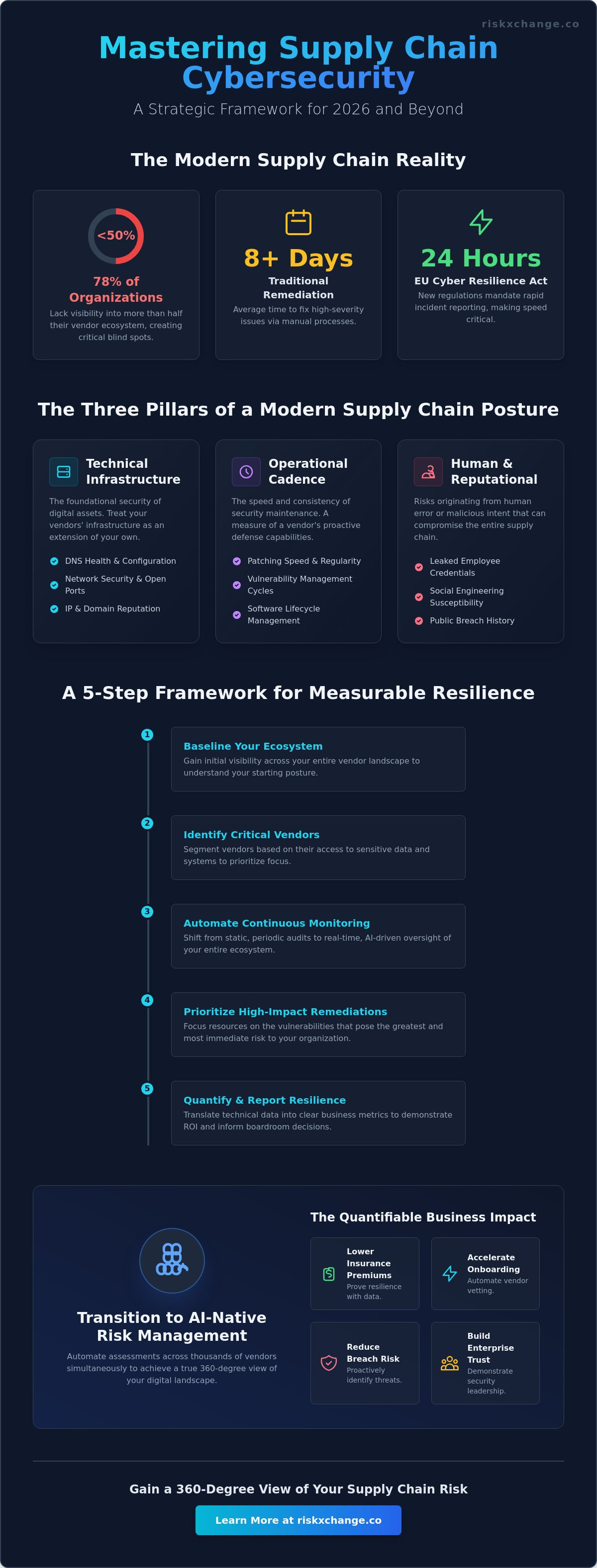
78% of organizations admit their internal cybersecurity programs cover less than 50% of their total vendor ecosystem. This visibility gap is critical when determining how to improve supply chain cybersecurity posture, especially as AI-driven threats now rank as the primary risk to global networks. You likely understand the frustration of relying on opaque vendor security practices and manual assessment processes that take eight days or more to remediate high-severity issues. With the EU Cyber Resilience Act now requiring early warnings within 24 hours of incident awareness, the traditional reliance on static audits is no longer a viable strategy.
This guide details a strategic framework for 2026 that masters a data-driven, AI-enabled approach to identifying vulnerabilities. By shifting from manual checklists to continuous, real-time oversight, you'll gain the proactive control needed to elevate your resilience and build lasting enterprise trust. We will examine how to transform your security ratings into a quantifiable benchmark that lowers insurance premiums, reduces the risk of third-party breaches, and accelerates vendor onboarding.
The Strategic Impact of Supply Chain Cybersecurity Posture in 2026
By 2026, the definition of a healthy enterprise has shifted. It's no longer enough to demonstrate internal fiscal responsibility; you must now prove the digital integrity of every partner you touch. Cybersecurity has transitioned from a back-office "nice-to-have" into a non-negotiable contractual requirement. In this environment, understanding how to improve supply chain cybersecurity posture is the difference between securing a high-value partnership and being locked out of the market entirely. Your organization's posture is now an externalized signal of reliability that investors, insurers, and partners use to judge your long-term viability.
The foundational principles of supply chain security suggest that a network is only as robust as its most vulnerable node. This reality is reflected in modern cyber insurance policies. Insurers now demand granular, real-time data on your third-party ecosystem before finalizing coverage capacity or setting premiums. If your vendors show poor infrastructure oversight, your own premiums rise. We've moved beyond the static "credit score" analogy to a model of real-time resilience, where security is a trackable, numerical benchmark that fluctuates with every new vulnerability found in your Nth-party network.
The Gatekeeper Effect: Procurement and Partnerships
Procurement teams have become the new front line of defense. In 2026, most global enterprises utilize automated procurement triggers that react instantly to a vendor’s posture drop. If a critical software provider's security rating falls below a predefined threshold, automated systems can pause contract renewals or trigger immediate audits. This creates a "gatekeeper effect" where companies with opaque security practices are systematically filtered out of the supply chain. Maintaining high visibility into your ecosystem isn't just about risk mitigation; it's a revenue protection strategy. Organizations that can't provide transparent, data-driven proof of their partners' security health face the very real consequence of lost contracts and damaged brand reputation.
Quantifying Resilience for the Boardroom
For executive leadership, the complexity of modern threat landscapes can feel overwhelming. The key to effective governance is translating technical vendor risks into a single, trackable business benchmark. When you analyze how to improve supply chain cybersecurity posture, you're essentially building a framework for boardroom clarity. These metrics allow CISOs to justify security budgets by showing a direct correlation between platform investment and risk reduction. By establishing a "Security First" culture through transparent ecosystem metrics, you move the conversation from a state of vulnerability to one of informed resilience. This quantifiable approach ensures that security is treated as a strategic asset, enabling the board to make decisions based on data-driven honesty rather than fear-based speculation.
The Three Pillars of a Modern Supply Chain Posture
Supply chain posture represents the aggregate security health of your entire digital ecosystem. It isn't a static snapshot but a living reflection of how well your partners maintain their defenses. To understand how to improve supply chain cybersecurity posture, you must treat your vendors' infrastructure as an extension of your own. This shift moves the focus from passive compliance to active attack surface oversight. By categorizing risk into three distinct pillars, you can move from obscurity to clarity.
The first pillar is Technical Infrastructure. This involves the foundational elements of digital communication, including DNS health, network security, and IP reputation. Aligning these technical checks with NIST's C-SCRM framework ensures your methodology is rooted in globally recognized standards. The second pillar is Operational Cadence, which measures the speed of patching and vulnerability management cycles. Finally, the third pillar covers Human and Reputational Factors, such as leaked credentials and social engineering susceptibility. These three pillars provide the lens through which you can evaluate your true risk exposure.
Technical Risk Factors: The Building Blocks
Effective network security starts with identifying open ports and misconfigured firewalls across your vendor base. These represent the literal doors to a partner's environment. DNS health is equally vital. The correct implementation of SPF, DKIM, and DMARC records builds ecosystem trust and prevents domain spoofing. Application security validation ensures that SSL/TLS certificates and web header configurations meet modern encryption standards. Monitoring these factors continuously allows you to visualize the true security posture of your third parties before a breach occurs.
Measuring the Patching Cadence
Time-to-remediate is arguably the most critical metric for supply chain health. A vendor's posture isn't just about their current vulnerabilities; it's about their ability to respond to new ones. You must differentiate between a "known" vulnerability and an "exploitable" attack path. Many scoring algorithms suffer from "decay," where a score remains high even as a vendor's patching speed slows down. When you evaluate how to improve supply chain cybersecurity posture, prioritize vendors who demonstrate a consistent, rapid response to high-severity issues. This operational speed is the most reliable indicator of a partner's resilience in a volatile threat landscape.
Beyond Questionnaires: Challenging the Limitations of Traditional TPRM
Self-reported security questionnaires are a relic of a slower era. In 2026, relying on a vendor's own assessment of their controls is no longer a viable strategy for those seeking how to improve supply chain cybersecurity posture. This "Inaccuracy Gap" creates a dangerous disconnect between perceived and actual risk. While a vendor might claim compliance with the NIST Cybersecurity Framework 2.0, their external digital footprint often tells a different story. Point-in-time assessments fail because threats evolve daily; a questionnaire answered in January offers zero protection against an exploit discovered in May.
Misattribution is another critical hurdle. Frequently, a vendor's risk profile is unfairly dragged down by assets they no longer own or IPs that were incorrectly mapped to their organization. This matters because their score drop can directly impact your own security rating. Managing these "Shadow Supply Chain" risks requires a move away from checkboxes and toward continuous, technical validation of every digital asset within your ecosystem. It's about moving from a world of trust to a world of verified, data-driven honesty.
The Audit Process: Verifying Your Digital Footprint
True visibility starts with a reverse lookup of every IP address associated with your partners. This technical audit identifies decommissioned assets and shadow IT that may still be broadcasting vulnerabilities. By validating the digital footprint of your vendors, you ensure that the data driving your risk decisions is accurate. Collaborating with vendors to confirm asset ownership isn't just a compliance task; it's a strategic necessity to prevent legacy infrastructure from skewing your resilience metrics. When you know exactly what's in your ecosystem, you can defend it with precision.
Strategic Communication with Rating Providers
When inaccuracies arise, speed is your primary ally. We recommend following the 48-hour rule: once a misattributed risk is identified, you must challenge it with the rating provider immediately. Effective dispute resolution requires concrete evidence, such as server logs, configuration files, and time-stamped screenshots. Utilizing RiskXchange as your "source of truth" allows you to present a data-driven case that rating providers can verify. This proactive approach ensures your organization is perceived accurately by the outside world, maintaining the trust of insurers and partners who rely on these external benchmarks. You don't just manage risk; you command the narrative of your security posture.
A 5-Step Framework for Improving Your Supply Chain Posture
Transitioning from a reactive to a proactive stance requires a methodical approach. To master how to improve supply chain cybersecurity posture, you must move beyond the "credit score" mentality and treat vendor risk as an extension of your own attack surface. This framework provides the technical roadmap to achieve quantifiable resilience.
- Step 1: Baseline and Asset Discovery. You can't manage what's invisible. Since 78% of organizations cover less than 50% of their total vendor ecosystem, the first priority is discovering every node in your digital supply chain.
- Step 2: Prioritisation. Not all risks are equal. Focus on high-impact, low-effort remediations that offer the fastest improvement in your external security profile.
- Step 3: Technical Remediation. Move from identifying vulnerabilities to fixing them. This involves direct technical engagement with partners to close exploitable paths.
- Step 4: Supply Chain Alignment. Address the "risk debt" accumulated by critical vendors whose poor security posture drags down your aggregate rating.
- Step 5: Continuous Validation. Abandon static audits in favor of AI-driven oversight that monitors your ecosystem in real-time.
Prioritising the "Low-Hanging Fruit"
The quickest path to a posture bump lies in fixing foundational technical misconfigurations. SSL/TLS certificate errors and expired web headers are often overlooked but significantly impact your external perception. Similarly, updating DNS records by implementing SPF and DMARC provides immediate reputational gains and prevents domain abuse. By closing unnecessary ports on key partner networks, you reduce the external attack surface before complex threats can take root.
Addressing the Supply Chain Drag
Critical vendors often create a "risk drag" on your organization. Addressing this drag is a core component of how to improve supply chain cybersecurity posture over the long term. To combat this, set minimum posture thresholds for every third-party partner. If a vendor's rating falls below these benchmarks, automated alerts should trigger immediate review. Implementing automated remediation workflows for tier-1 suppliers ensures that response times don't lag due to manual communication hurdles. You can automate these workflows across your entire supply chain to maintain consistent resilience levels.
Closing the Remediation Loop
Remediation often fails due to a lack of clear ownership. Assigning specific internal and external stakeholders to vendor issues is essential. Given that 60% of organizations take eight days or more to remediate high-severity issues, setting strict SLAs for patching based on criticality is vital. Use external scans to confirm remediation success in real-time, ensuring that a "fixed" issue is truly resolved and reflected in your posture metrics. This methodical closure is what separates elite organizations from those simply checking boxes.
Sustaining Resilience: The Role of AI-Native Risk Management
Achieving long-term stability in a volatile threat landscape requires more than just a periodic checkup; it demands a fundamental shift in how your organization processes risk data. When evaluating how to improve supply chain cybersecurity posture, the ultimate goal is to move from reactive remediation to predictive resilience. RiskXchange provides a 360-degree view of your digital ecosystem, moving beyond the limitations of a static letter grade. By utilizing an AI-native TPRM platform, you can automate the assessment of thousands of vendors simultaneously. This ensures that no node in your supply chain remains in the dark, regardless of its size or complexity.
Modern risk management also necessitates the integration of ESG and Data Protection metrics into a unified intelligence platform. Security doesn't exist in a vacuum; it's intrinsically linked to your organization's broader compliance and ethical standing. Seeing what hackers see before they act is the core of real-time attack surface analysis. By adopting this externalized perspective, you gain the agency to manage threats before they escalate into breaches. This proactive control is what distinguishes a mature security posture from one that is merely compliant.
The RiskXchange Advantage: AI-Driven Intelligence
Manual evidence gathering is far too slow for the 2026 threat landscape. RiskXchange replaces cumbersome human audits with automated technical validation, providing a level of thoroughness that manual processes simply cannot match. This approach utilizes predictive analytics to identify which supply chain vulnerabilities are most likely to be exploited based on current global threat patterns. For leadership, this translates into customizable reporting that clarifies risk for the boardroom. It moves the conversation from abstract technical debt to actionable business intelligence, allowing CISOs to justify their strategies with quantifiable data.
Implementing a Permanent Improvement Strategy
Sustaining a high security rating requires deep operational integration. We recommend embedding RiskXchange into your existing GRC and security workflows to ensure that risk management becomes a continuous, steady process. Setting up automated alerts for posture fluctuations allows your team to catch vendor score drops in real-time, preventing downstream impact on your own organization's reputation and insurance standing. This level of proactive control is essential for maintaining compliance with emerging regulations and protecting your enterprise trust. If you are ready to move from a state of vulnerability to one of informed resilience, Book a demo with RiskXchange to see your true security posture today.
Securing Your Enterprise Legacy Through Proactive Resilience
Building a durable digital ecosystem requires moving beyond static compliance and embracing continuous, real-time oversight. By focusing on the technical pillars of infrastructure and implementing a structured five-step framework, you gain the agency needed to master how to improve supply chain cybersecurity posture. This transition from manual questionnaires to AI-native validation ensures that your organization is perceived as a leader in security, protecting your insurance standing and contractual value.
RiskXchange provides the real-time risk intelligence and remediation capabilities needed to manage thousands of vendors simultaneously. Trusted by Fortune 500 enterprises globally, our AI-native platform is supported by dedicated teams in London, Austin, and Dubai. This global presence ensures you have the expertise required to navigate a volatile threat landscape with absolute confidence. It's time to move from a state of vulnerability to one of informed, measurable resilience.
Empower your team with a 360-degree view of risk; book your RiskXchange demo today. We look forward to helping you secure your digital supply chain's future.