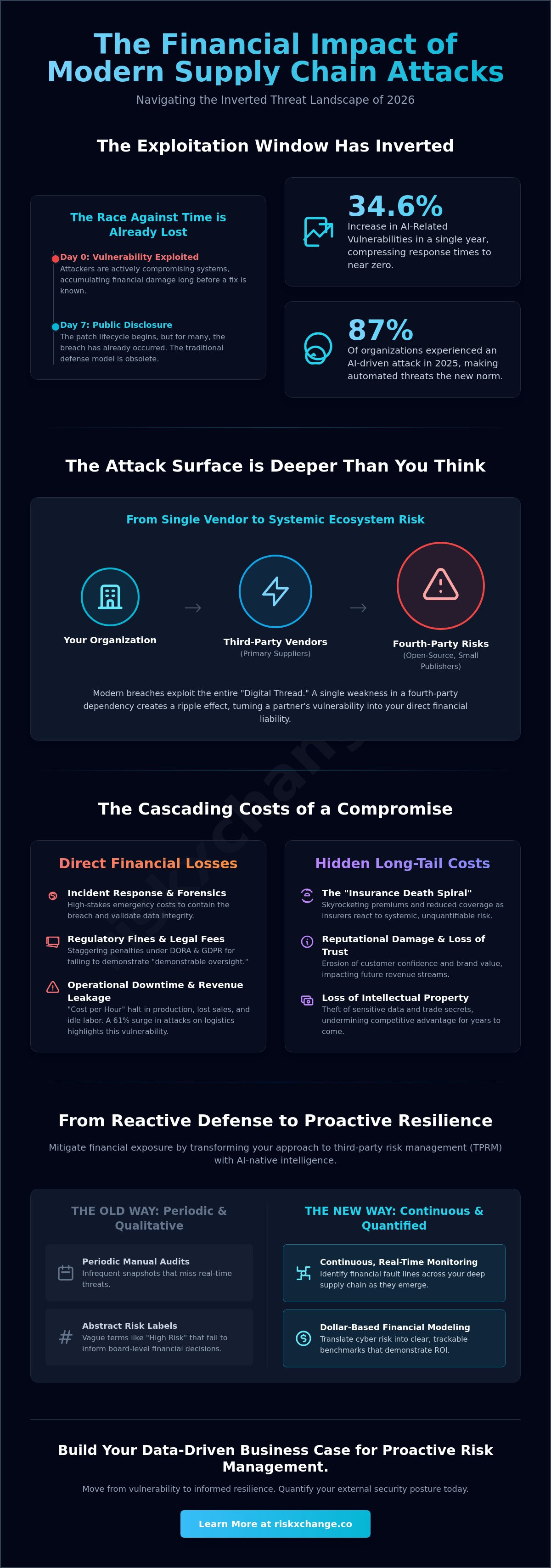
In 2025, attackers exploited vulnerabilities an average of seven days before public disclosure, effectively rendering the traditional patch lifecycle obsolete. This inversion of the exploitation window means that for many organizations, the financial impact of supply chain attack vulnerabilities is already accumulating long before a breach is even detected. It's a reality that makes quantifying abstract cyber risks into concrete dollar amounts feel nearly impossible, especially as boards demand clear ROI on every security investment.
We understand that managing an environment where AI-related vulnerabilities rose by 34.6% in a single year requires more than just reactive defense. This strategic analysis provides a clear framework for categorizing direct and hidden supply chain costs, allowing you to move from vulnerability to informed resilience. You'll discover how to use AI-native intelligence to transform these "unknown-unknowns" into trackable, numerical benchmarks that reflect your true external security posture. We'll examine the 2026 regulatory landscape's impact on fines and provide the data-backed arguments needed to secure proactive control over your entire vendor ecosystem.
The Evolving Landscape of Supply Chain Attacks in 2026
The definition of a supply chain breach has undergone a fundamental transformation. While historical discussions focused on single-point software compromises, the modern threat involves entire digital service ecosystems. Attackers no longer just target your immediate vendors; they exploit the "fourth-party" layer, where small software publishers or open-source maintainers provide the foundation for your primary suppliers. This shift has turned the financial impact of supply chain attack events into a systemic risk rather than a localized IT failure. It's a move from isolated incidents to a permanent state of external vulnerability.
In 2026, we've moved past opportunistic breaches. Threat actors now engage in strategic economic sabotage. By targeting critical maritime infrastructure or specialized logistics providers, they can disrupt global trade flows and trigger cascading financial losses that reach far beyond the initial target. Achieving 360-degree visibility into these deep-tier connections isn't just a technical goal. It's the new baseline for protecting your organization's balance sheet. Understanding what is a supply chain attack in this broader context is essential for any executive looking to maintain operational resilience. You cannot manage what you cannot see, and in a landscape where 87% of organizations experienced an AI-driven attack in 2025, visibility is your primary currency.
The Anatomy of a Modern Supply Chain Breach
Modern attackers exploit the "Digital Thread," the continuous flow of data and code between your organization and its partners. In 2026, automated vulnerability discovery tools allow threat actors to scan the entire global supply chain in real time, identifying weak points in seconds. This speed has compressed the window of response to nearly zero, often allowing exploitation to occur a full week before a patch is even available. A single vendor compromise now creates a ripple effect that can paralyze an entire sector's logistics and data integrity within hours, turning a partner's weakness into your own financial liability.
2026 Regulatory Environment and Financial Liability
Compliance requirements like DORA and evolved GDPR frameworks have turned supply chain oversight into a legal mandate. Mandatory reporting costs have spiked because regulators now demand "demonstrable oversight" as a condition of reduced liability. If you can't prove that you were continuously monitoring your third-party risks, non-compliance fines can reach staggering levels. Beyond fines, the cost of legal discovery in multi-party breaches often exceeds the immediate recovery costs. It's no longer enough to have a contract in place; you must have the data to prove you were in command of your external security posture at the moment of impact.
Direct Financial Losses: The Immediate Cost of Compromise
When a breach occurs, the clock starts ticking against your balance sheet. The first wave of the financial impact of supply chain attack incidents usually hits through forensic accounting and emergency incident response. These aren't just IT expenses; they're high-stakes financial outlays required to contain the bleed. In 2025, ransomware groups like Qilin, Akira, and Clop targeted over 2,200 victims collectively, demonstrating that the scale of these attacks is no longer a theoretical concern. While the media often focuses on the ransom demand itself, the real expense often lies in system restoration and the rigorous validation of data integrity.
Legal fees and class-action settlements add another layer of immediate financial strain. Beyond the costs of defense, organizations must prepare for direct customer compensation and the activation of service level agreement (SLA) penalties. These penalties are often triggered the moment a vendor's outage impacts a client's ability to operate, creating a cascading debt that can quickly outpace internal recovery budgets. Proactive organizations use continuous real-time risk management to identify these vulnerabilities before they manifest as balance sheet liabilities.
Operational Downtime and Revenue Leakage
Supply chain paralysis is exceptionally expensive for organizations relying on "Just-in-Time" delivery models. A single hour of downtime can halt entire manufacturing lines, leading to a "Cost per Hour" that includes lost sales, idle labor, and the premium paid for emergency logistics. During the 61% surge in cyber-attacks on logistics seen in 2025, many firms were forced into manual workarounds. These manual processes are inherently slower and more prone to error, which further leaks revenue through inefficiency and missed delivery windows.
Notification and Remediation Expenses
The logistical burden of notifying millions of affected data subjects is a hidden drain on resources. Between postage, call center scaling, and mandatory credit monitoring services, the notification phase of a breach is a significant capital drain. Remediation often requires a "rip and replace" approach for compromised hardware or software. This isn't just a simple update; it's a wholesale infrastructure overhaul that must be completed under intense time pressure to restore market confidence. Brand-stabilization marketing campaigns then follow, adding a final, costly layer to the immediate remediation phase.
The Long-Tail Impact: Hidden Costs That Cripple Resilience
Many executives operate under the dangerous assumption that cyber insurance provides a total safety net. This misconception ignores the reality of the "Insurance Death Spiral," where a single breach triggers a cycle of rising premiums and drastically reduced coverage limits. In 2026, insurers no longer just look at your internal defenses; they assess your entire ecosystem's risk posture. If your organization is perceived as a weak link, the financial impact of supply chain attack vulnerabilities manifests as prohibitive policy costs or a complete loss of insurability.
Beyond the immediate balance sheet, supply chain resilience is now a critical component of ESG (Environmental, Social, and Governance) scores. The Lehigh Business Supply Chain Risk Management Index for the first quarter of 2026 highlights cybersecurity and data risk as top-tier concerns that directly influence corporate governance ratings. Failures here lead to a downgrade in investment attractiveness. During M&A activities, a history of unmanaged third-party risk often results in significant valuation haircuts. Buyers are wary of "unknown-unknowns" lurking in the deep supply chain, frequently demanding deep discounts to account for the potential of future systemic collapses.
Erosion of Market Cap and Shareholder Value
Market cap volatility often follows the disclosure of a supply chain compromise. This isn't just a temporary dip; it represents a long-term loss of institutional trust that increases your cost of capital. When institutional investors see a pattern of reactive risk management, they reprice the risk of holding your stock. A company's external risk rating acts as a persistent signal to the market, directly influencing investor confidence and the overall liquidity of your shares.
Talent Attrition and Recruitment Costs
A high-profile security failure often triggers a "Brain Drain" that's difficult and expensive to reverse. The long-term financial impact of supply chain attack events includes the hidden cost of replacing key personnel who leave for more stable environments. Top-tier security talent rarely wants to work in a high-risk environment where they're constantly fighting fires due to poor vendor oversight. Replacing this expertise requires significantly higher salary offers and sign-on bonuses to compensate for the perceived reputational risk. You also lose years of institutional knowledge during post-incident turnover, creating a secondary wave of operational inefficiency that further stalls your recovery efforts.
Measuring the Unmeasurable: A Framework for Financial Risk Modeling
Traditional risk assessments often rely on qualitative labels like "High," "Medium," or "Low." While these categories provide a general sense of priority, they fail to answer the board's most pressing question: how much will this actually cost? To manage the financial impact of supply chain attack vulnerabilities effectively, organizations must shift to quantitative, dollar-based modeling. This transition turns cybersecurity from an abstract technical concern into a manageable financial line item. By treating risk as a trackable numerical benchmark, you move the conversation from a state of uncertainty to one of informed resilience.
Monte Carlo simulations play a vital role in this new framework. These mathematical models run thousands of "what-if" scenarios to predict the probability and magnitude of potential breach costs. They account for the 48,000+ CVEs published in 2025 and the speed of modern exploitation to provide a realistic range of financial exposure. This data allows the executive board to establish a concrete "Risk Appetite" threshold. Once you know your maximum tolerable loss, you can justify the ROI of proactive TPRM software by demonstrating how continuous oversight reduces your total risk exposure. Quantify your organization's financial exposure with a real-time risk assessment.
Key Metrics for Financial Cyber-Oversight
Effective financial oversight requires metrics that speak the language of the C-suite. Annual Loss Expectancy (ALE) is a primary anchor here, calculated by multiplying the Single Loss Expectancy by the Annual Rate of Occurrence. Another critical metric is Mean Time to Remediation (MTTR). In 2026, MTTR isn't just a technical speed test; it's a financial efficiency metric. The faster you close a vulnerability, the less revenue leaks through operational friction. The RiskXchange Score serves as the leading indicator of this volatility, providing a single, quantifiable metric that reflects your organization's external security posture in real time.
Benchmarking Against Industry Peers
Your external posture determines your competitive advantage in a volatile market. In 2025, 87% of organizations faced AI-driven attacks, making it clear that no sector is immune. Using peer data to benchmark your performance allows you to justify security budget increases by showing exactly where you lag behind industry standards. This externalized perspective is also your best tool for negotiating lower insurance premiums. When you can prove through continuous monitoring that your supply chain is more resilient than the industry average, you shift from being a high-risk gamble to a preferred, low-risk partner.
Mitigating Financial Exposure through AI-Native TPRM
Static assessments and annual audits are no longer sufficient to contain the financial impact of supply chain attack risks in a world where attackers exploit flaws a week before disclosure. Relying on point-in-time checks leaves massive blind spots between evaluations. An AI-native TPRM platform shifts the paradigm toward continuous, real-time risk management. By automating the ingestion of thousands of data points, these systems identify "Financial Fault Lines"—the specific vendor vulnerabilities most likely to trigger systemic disruption—before they can be exploited. This transition reduces the administrative overhead of manual vendor assessments, allowing your team to focus on strategic risk reduction rather than data entry.
RiskXchange provides the 360-degree lens required to navigate this volatile landscape with confidence. It moves the conversation from a state of vulnerability to one of informed resilience by treating security as a trackable, numerical benchmark. Rather than reacting to breaches after they've already crippled your operations, you gain the agency to command your external security posture. This proactive control is the only way to ensure that the increasing complexity of the 2026 digital ecosystem doesn't become a permanent drain on your organization's capital.
Real-Time Risk Ratings as a Financial Safeguard
Instant alerts act as an early warning system that prevents the accumulation of risk over time. When a new vulnerability surfaces in your deep supply chain, every hour of exposure increases the potential for a catastrophic balance sheet event. Stopping a breach at the point of entry is significantly more cost-effective than managing a full-scale recovery effort. In 2026, leading organizations use these ratings to integrate ESG and cybersecurity into a single cost-saving platform. This unified view ensures that governance standards are met while simultaneously hardening your defenses against the 61% surge in logistics-based cyber-attacks observed in 2025.
Building a Proactive Defense Strategy
Moving from a reactive to a resilient financial posture requires a methodical approach to vendor oversight. First, replace manual questionnaires with automated assessments to reduce overhead and eliminate human error. Second, utilize machine learning to prioritize remediation efforts based on the actual financial exposure each vendor represents. This automated remediation significantly lowers the total cost of ownership (TCO) by focusing resources where they provide the highest ROI. It's about creating a world where challenges are visible and manageable, ensuring your organization remains a low-risk partner in the eyes of investors and insurers alike.
Secure your supply chain's financial future with RiskXchange
Securing Your Enterprise Future Through Quantifiable Resilience
The 2026 threat landscape demands a transition from reactive defense to proactive, data-driven command. We've analyzed how the hidden costs of fourth-party vulnerabilities and the "insurance death spiral" can erode years of market growth in days. By adopting a dollar-based risk framework, you transform cybersecurity from an abstract cost center into a strategic advantage. It's about maintaining a clear, externalized perspective that reassures both shareholders and regulators of your organization's stability.
Managing the total financial impact of supply chain attack events requires a fundamental shift toward continuous, real-time intelligence. You can move from a state of obscurity to absolute clarity by leveraging metrics that track your security posture as a numerical benchmark. This level of oversight ensures your organization remains resilient, measurable, and firmly in control of its digital destiny. Challenges will always exist, but they're now visible and manageable.
Take the first step toward informed resilience today. Request a Demo of RiskXchange’s AI-Native TPRM Platform to experience AI-powered 360-degree risk intelligence. Trusted by Fortune 500 enterprises globally, our continuous real-time security ratings provide the transparency you need to thrive. Your path to proactive control starts here.