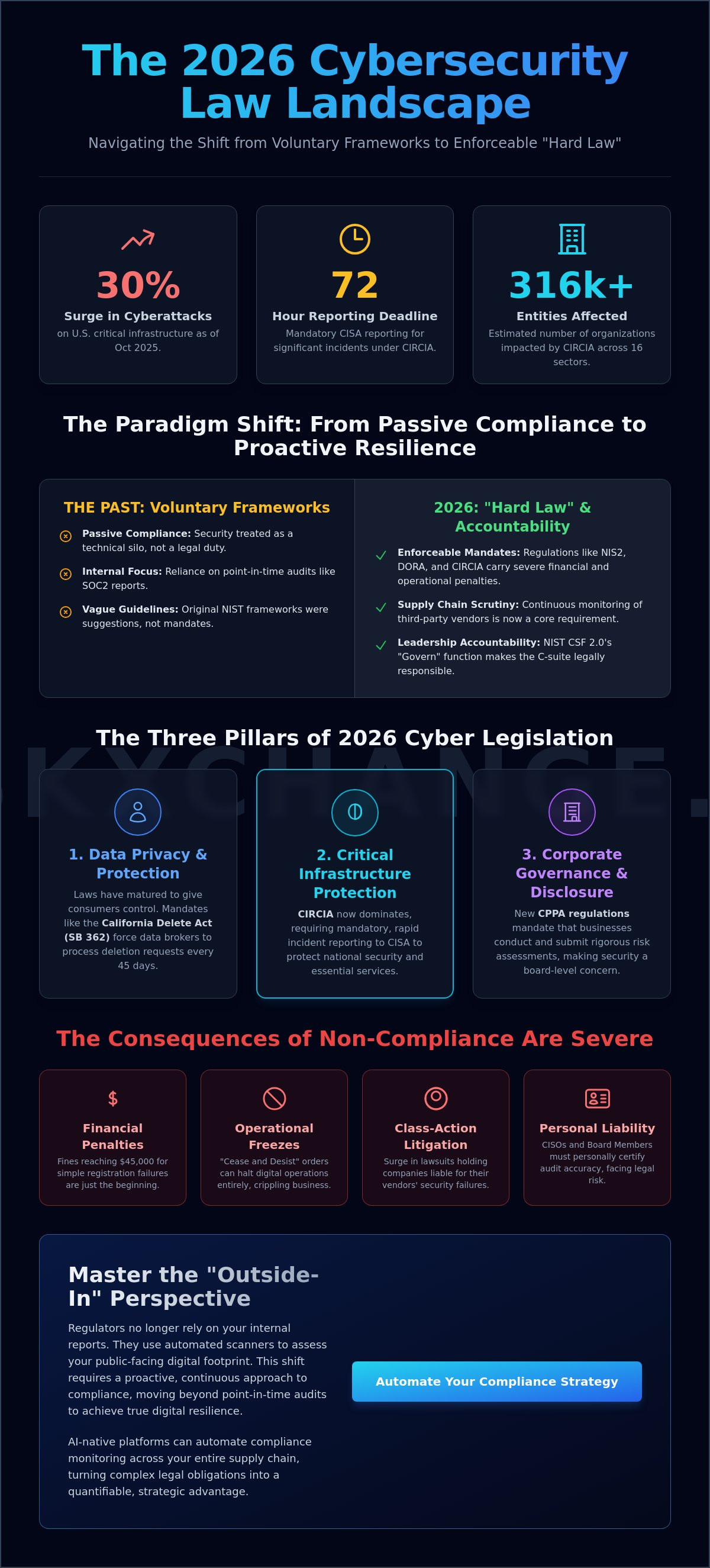
Did you know that cyberattacks on U.S. critical infrastructure surged by 30 percent as of October 2025? This data confirms that modern cybersecurity law has entered a new, aggressive era where passive compliance is no longer a viable defense. You're likely feeling the weight of regulatory fragmentation and the manual burden of mapping technical controls to mandates like the NIST CSF 2.0 "Govern" function. It's a significant challenge to manage the liability of a supply chain where a single vendor's oversight can trigger a mandatory 72 hour CISA reporting deadline under CIRCIA rules.
We're here to help you manage the California Privacy Protection Agency's new risk assessment requirements that went into effect on January 1, 2026. This guide provides a clear roadmap to help you master these 2026 regulations and move from a state of digital vulnerability to one of informed resilience. You'll learn how to automate compliance monitoring and gain a critical outside-in perspective of your organization's security posture. We'll show you how to reduce legal exposure and turn regulatory adherence into a quantifiable, strategic advantage for your entire supply chain.
What is Cybersecurity Law? Defining the 2026 Legal Architecture
By April 2026, the legal boundaries of the digital world have shifted from vague suggestions to rigid, enforceable mandates. Modern cybersecurity law represents the critical intersection of data privacy, national security, and consumer protection. It's a complex architecture that no longer treats security as a technical silo but as a core legal obligation for every enterprise. This evolution reflects a global consensus that digital systems are essential infrastructure. As a result, Cyber-security regulation has transitioned from voluntary frameworks like the original NIST guidelines into "hard law" where non-compliance carries severe financial and operational weight.
The 2026 focus has narrowed onto "digital resilience." This isn't just about preventing breaches; it's about your enterprise's legal responsibility to maintain operations and protect data across its entire footprint, including third-party vendors. The release of NIST CSF 2.0 on February 26, 2024, set this in motion by adding the "Govern" function, effectively making leadership accountable for the organization's security posture. Cybersecurity law is the legal framework governing the protection of information systems, requiring organizations to exercise a proactive duty of care in safeguarding digital assets against unauthorized access or disruption.
The Three Pillars of Modern Cyber Legislation
The current legal landscape rests on three distinct pillars. First, Data Privacy and Protection laws like the California Delete Act (SB 362) have matured. As of January 1, 2026, consumers now use the DROP system to request data deletion, forcing data brokers to process these requests every 45 days. Second, Critical Infrastructure Protection is dominated by CIRCIA, which affects an estimated 316,244 entities across 16 sectors. These entities must report significant incidents to CISA within 72 hours. Third, Corporate Governance and Disclosure mandates, such as the CPPA regulations that went into effect on January 1, 2026, require businesses to conduct and submit rigorous risk assessments.
The Consequences of Non-Compliance in 2026
The penalties for failure have moved beyond simple fines. While CalPrivacy has already levied fines reaching $45,000 for registration failures, the real threat lies in "Cease and Desist" orders that can freeze digital operations entirely. We're seeing a sharp rise in class-action litigation following third-party data breaches, where the primary company is held liable for its vendor's lack of oversight. Perhaps most significantly, the era of anonymous corporate failure is over. New transparency mandates now place personal liability on CISOs and Board members, who must certify that their cybersecurity audits are accurate and comprehensive.
Global Regulatory Fabric: Key Mandates You Must Know
Regulators in 2026 have adopted a sophisticated "outside-in" perspective. They no longer rely solely on your internal self-assessments; instead, they analyze your public digital footprint and use automated scanners to gauge your compliance. This shift means your cybersecurity law posture is visible to the world long before you file an official report. Understanding Cybersecurity Law Fundamentals is now about managing that external perception through verifiable, real-time data. You can monitor your global footprint to see exactly what regulators see before they issue a notice.
Global compliance requires balancing the European Union's "Rights-Based" approach, which prioritizes individual data sovereignty, with the United States' "Risk-Based" model, which focuses on systemic resilience. This divergence creates a complex map for global firms. Adding to this complexity is the emergence of AI-specific legislation. These laws mandate that any organization using high-risk AI systems must implement specific technical safeguards to protect the integrity of data processing pipelines against adversarial attacks.
United States: The SEC and State-Level Complexity
The United States continues to struggle with a "patchwork" problem. Organizations must navigate 50 different state breach notification laws alongside federal mandates. SEC Regulation S-P now demands strict incident reporting timelines for financial entities, while CIRCIA requires critical infrastructure sectors to report significant incidents within 72 hours. For those in the defense industrial base, CMMC 2.0 has become the definitive legal standard for protecting unclassified information, making it a prerequisite for contract eligibility in 2026.
European Union: NIS2, DORA, and the AI Act
Europe has solidified its position as a regulatory trendsetter. The NIS2 Directive has expanded its reach, classifying a wider range of organizations as "essential" or "important" entities. If you provide services within the EU, you're likely subject to these rules regardless of where your headquarters is located. Meanwhile, DORA enforces digital operational resilience specifically for the financial sector. The EU AI Act, which reached full implementation by early 2026, now imposes strict cybersecurity requirements on AI models to prevent data poisoning and model theft.
Middle East and Emerging Markets
Emerging markets are rapidly catching up to international standards. The UAE’s Data Protection Law now closely aligns with global privacy principles, while Saudi Arabia’s Essential Cybersecurity Controls (ECC) carry significant legal weight for any entity operating within the Kingdom. Managing the complexities of cybersecurity law across these regions requires a Unified Compliance Framework. This approach allows global firms to map technical controls once and apply them across multiple jurisdictions, reducing the manual burden of redundant audits.
The Supply Chain Gap: Why Internal Compliance is No Longer Enough
A common misconception persists among executives that holding a SOC2 report or a clean ISO 27001 certification equates to being legally compliant. In 2026, this logic is dangerously flawed. While these reports provide a snapshot of internal controls, modern cybersecurity law now demands proof of due diligence across your entire digital ecosystem. Regulators have moved past internal checklists; they now evaluate your "transitive liability." This means your organization is legally responsible for the security posture of your vendors, and frequently, your vendors' vendors. Relying on a point-in-time audit to manage this Nth-party risk is no longer a defensible strategy.
Legislative frameworks like NIS2 and DORA have codified the requirement for "continuous monitoring" of third-party risk. These laws recognize that a vendor's security posture can degrade in hours, not years. To bridge this gap, legal teams are increasingly adopting a quantifiable "Cybersecurity Rating." This metric provides an objective, real-time anchor for legal discussions, allowing you to move from subjective questionnaires to data-driven oversight. It transforms an abstract technical risk into a trackable business metric that leadership can act upon with confidence.
Third-Party Risk Management (TPRM) as a Legal Requirement
Recent case law in early 2026 has significantly shifted the "burden of proof" during data breach litigation. The primary organization must now demonstrate that it took active, ongoing steps to verify a supplier's security. To understand the full scope of these obligations, you should explore What is Third-Party Risk Management (TPRM)? and how it integrates with your legal strategy. In the eyes of the court, "Reasonable Security" is no longer defined by an annual assessment. It is defined by the presence of a continuous, outside-in monitoring program that identifies vulnerabilities before they are exploited.
Contractual vs. Regulatory Compliance
Your vendor contracts must evolve to meet 2026 standards. Standard "right to audit" clauses are insufficient when regulators demand near real-time incident notification. Modern Service Level Agreements (SLAs) should now include specific cybersecurity ratings as a legal benchmark. If a vendor's rating drops below a pre-defined threshold, it should trigger an immediate remediation protocol. This approach eliminates the "blind spots" that lead to regulatory enforcement actions and ensures that your supply chain remains a strategic asset rather than a hidden legal liability. By embedding real-time security data sharing into your contracts, you create a legally-defensible posture that stands up to the most rigorous regulatory scrutiny.
Building a Legally-Defensible Cybersecurity Posture
Establishing a defensible posture in 2026 requires moving beyond the "checkbox" mentality of the past decade. Legal teams and CISOs must now demonstrate "Continuous Assurance" to satisfy the rigorous demands of modern cybersecurity law. Regulators are no longer satisfied with evidence that was gathered six months ago. They want to see how you managed your risk yesterday. Proving due diligence now depends on your ability to generate a verifiable paper trail of automated risk intelligence that reflects your actual security state in real-time. You can start building your defensible record today by gaining visibility into your external attack surface.
Step 1-3: Inventory, Assessment, and Mapping
- Step 1: Map global legal obligations. Your compliance requirements are dictated by where your data flows, not just where your offices are located. If you handle data for California residents, you must account for the DROP system requirements that went into full effect on January 1, 2026.
- Step 2: Identify Shadow IT. Use an "outside-in" perspective to discover assets your IT team might have missed. Shadow IT is a primary source of legal exposure because you cannot protect or report on what you don't know exists.
- Step 3: Align with the Standard of Care. Map your technical controls directly to the "Govern" function of NIST CSF 2.0, which was released on February 26, 2024. This alignment provides a recognized legal benchmark for "Reasonable Security" during a regulatory audit or litigation.
Once your internal inventory is clear, you must apply the same rigor to your partners. Learning How to Conduct a Third-Party Risk Assessment is a critical component of this mapping phase. It ensures that your legal defensibility doesn't end at your own firewall but extends through every link in your supply chain.
Step 4-5: Automation and Continuous Oversight
Step 4 involves implementing continuous monitoring to detect compliance drifts as they happen. In a landscape where 316,244 entities are now covered by CIRCIA, manual tracking is impossible. Automated systems provide the "Actionable Intelligence" needed to identify a vulnerability and remediate it before it becomes a reportable incident. This proactive control is the difference between a routine update and a catastrophic legal failure.
Step 5 requires establishing an automated incident reporting workflow. With the CIRCIA 72-hour reporting deadline and the 24-hour ransomware payment notification rule, your legal and technical teams must be perfectly synchronized. An automated workflow ensures that the right data reaches CISA or the CPPA within the mandatory windows. This level of organization proves to regulators that your organization is not just reactive, but has achieved a state of informed resilience. By 2026, the ability to produce real-time data during an audit has become the gold standard for legal compliance.
RiskXchange: Automating Compliance Across Your Ecosystem
RiskXchange serves as the essential bridge between technical security and the complex requirements of modern cybersecurity law. By providing an AI-native TPRM platform, we enable organizations to move from reactive defense to a state of continuous, real-time risk management. This transition is vital for meeting the 2026 standards of digital resilience. Our platform doesn't just scan for vulnerabilities; it translates technical data into a Cybersecurity Rating. This metric acts as a common language, allowing IT teams to communicate risk posture to legal departments and Board members with clarity and precision.
The "outside-in" perspective is our primary rhetorical signature. It allows you to see your digital footprint exactly how a regulator or a potential attacker sees it. This visibility is a powerful tool for proactive legal defense, ensuring that no blind spots remain to trigger a notification under CIRCIA or the California Privacy Protection Agency's new rules. It's about moving the conversation from a state of digital vulnerability to one of informed resilience.
Real-Time Visibility into Regulatory Compliance
The manual burden of mapping technical controls to legal requirements is a significant pain point for the 215,000 registrants now using systems like California's DROP. RiskXchange simplifies this by automatically mapping vendor security postures to global legal frameworks. You can shift from cumbersome spreadsheets to automated risk ratings that update as the threat landscape changes. Our RiskXchange: An AI-Powered Risk Management Platform provides the comprehensive lens needed to maintain compliance without the overhead of constant manual audits.
Taking Control of Your Supply Chain Risk
Achieving 360-degree visibility across your entire ecosystem is the only way to prevent data exfiltration and mitigate legal liability for third-party breaches. With the first independent third-party compliance audits for data brokers appearing on the horizon for 2028, the data you collect today through RiskXchange provides the historical record needed for future success. Our platform helps you prepare for 2026 regulatory inquiries by providing actionable intelligence that proves your organization's commitment to "Reasonable Security."
Don't let regulatory fragmentation slow your operations. Take control of your security posture and transform compliance into a strategic advantage for your supply chain. Empower your compliance team with RiskXchange today to see how real-time monitoring can reduce your legal exposure and instill confidence in your stakeholders.
Mastering the 2026 Compliance Mandate
The shift from voluntary frameworks to enforceable mandates is now absolute. By 2026, the legal duty of care extends far beyond your own internal firewall. You've seen how global cybersecurity law now demands real-time accountability and continuous oversight of your entire third-party ecosystem. Successfully managing the 16 critical infrastructure sectors under CIRCIA or the specific data rights of 215,000 registrants in the California DROP system requires more than manual checklists. It requires a fundamental move toward automated, data-driven resilience and comprehensive supply chain visibility.
RiskXchange provides the sophisticated, AI-native TPRM platform needed to navigate this volatile landscape with quiet confidence. Trusted by Fortune 500 enterprises, our solution delivers real-time 360-degree risk intelligence that turns abstract threats into quantifiable metrics. You can see how RiskXchange automates your global compliance roadmap to ensure your organization remains resilient and legally defensible. We provide the strategic lens through which you can finally see your true security posture and take proactive control of your digital future. Your journey from vulnerability to informed resilience starts here.