What security risks do you miss with manual vendor monitoring?
Manual vendor monitoring misses any risk that appears between assessments — which is most of them. An annual questionnaire describes a supplier on one day; it cannot see a breach three weeks later, a newly exposed service, an expired certificate, a lapsed patch cycle, an acquisition that changes who holds your data, or a subcontractor added after signature. None of these generate a notification to you, and all of them change your exposure.
Specifically, the gaps a manual process leaves open are:
- Breaches at the supplier. You learn when they tell you, or when it reaches the press. Contractual notification windows help only if the supplier detects it themselves.
- Newly exposed infrastructure. A management interface, database port or staging environment that became internet-reachable after your assessment — usually by accident, and usually invisible to a questionnaire.
- Patch and support decay. Software that was current at assessment and is now unsupported or missing high-risk fixes. This is observable from outside and is a reliable proxy for whether an estate is maintained at all.
- Certificate and configuration drift. Expired certificates and weakened configurations, cheap to detect and strongly correlated with wider neglect.
- Credential and dark-web exposure. Supplier credentials appearing in breach corpora, which is often the earliest available warning.
- Corporate change. Acquisition, insolvency, restructuring or the loss of a security lead — each of which can change a supplier’s posture without changing anything you asked about.
- Fourth-party change. A supplier moving to a new hosting or identity provider, altering your concentration exposure with no notice and no contract between you and the new party.
- Answers that were never true. A manual process has no mechanism to test a claimed control against observable reality, so a questionnaire error survives until the next one.
There is also a failure mode that has nothing to do with the supplier. A manual programme is bounded by team capacity, so coverage quietly narrows to whichever suppliers escalate loudest — and because the process is still being followed and the documents still exist, nothing looks wrong. That is the risk that is hardest to see from inside: not a missed finding, but a shrinking denominator.
The rest of this article covers what closing that gap involves.
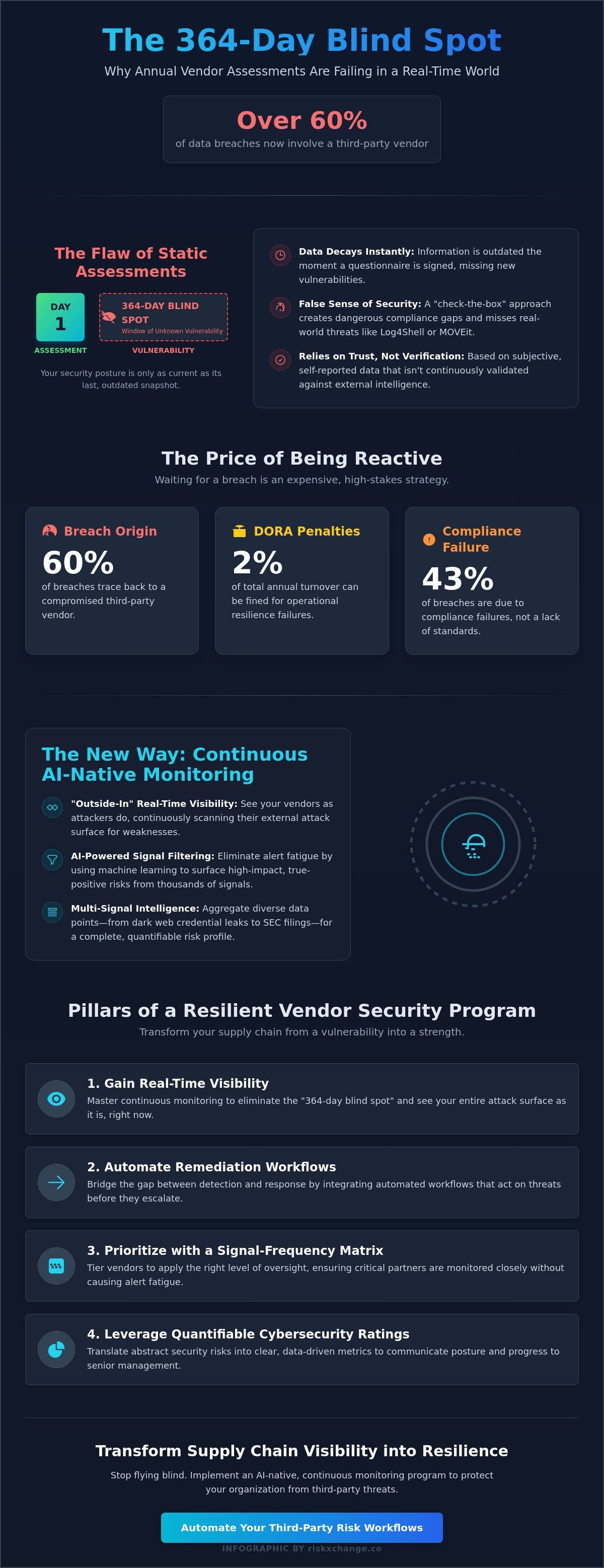
Over 60% of data breaches now involve a third-party vendor, yet most organizations still rely on a single annual questionnaire to manage that risk. If your last assessment was six months ago, you're operating with a 364-day blind spot that ignores the volatile nature of the modern attack surface. With DORA enforcement now active and carrying penalties up to 2% of annual turnover, the cost of being reactive is simply too high. You need a strategy for continuous vendor security monitoring that moves beyond static snapshots into real-time, actionable intelligence.
We understand the frustration of chasing vendors for spreadsheets only to face massive alert fatigue from low-fidelity signals. It's time to change the narrative. You'll learn how to transition from static assessments to an AI-native program that provides real-time visibility and automated remediation without manual intervention. We'll show you how to leverage a quantifiable Cybersecurity Rating for every vendor, turning your supply chain from a source of digital vulnerability into a model of informed resilience.
Beyond the Annual Questionnaire: Why Point-in-Time Assessments Fail
The moment a vendor signs a security questionnaire, the data begins to decay. In a threat landscape where new vulnerabilities emerge daily, relying on a document that's six months old is like checking a weather report from last summer to plan today's commute. This creates the 364-day blind spot; a massive window of vulnerability where your organization is flying blind between annual reviews. Traditional Third-party risk management (TPRM) was designed for a slower era, but today's digital ecosystem demands continuous vendor security monitoring to keep pace with agile attackers.
The acceleration of supply chain attacks proves that point-in-time assessments are no longer sufficient. Consider the 2021 Log4Shell vulnerability or the 2023 MOVEit exploit. These events didn't wait for your vendor's next audit cycle. They compromised thousands of organizations in a matter of days. For compliance-heavy industries, a "check-the-box" approach creates a dangerous false sense of security. It's time to move from "trust but verify" to a model of continuous validation where security is a living metric, not a static document.
The High Cost of Reactive Risk Management
A reactive stance is expensive. With 60% of data breaches now originating from third-party vendors, the financial stakes have never been higher. Under the Digital Operational Resilience Act (DORA), which became fully enforceable on January 17, 2025, financial entities face fines of up to 2% of their total annual worldwide turnover for failures in operational resilience. Compliance alone doesn't equal security; 43% of data breaches are actually attributable to compliance failures where the organization met the standard but missed the threat. When you wait for a breach to discover a vendor's weakness, you're losing more than data; you're risking the stability of your entire digital ecosystem.
The Outside-In Perspective: Seeing Your Vendors as Attackers Do
Attackers don't request permission to audit your vendors; they scan for weaknesses from the outside. By adopting continuous vendor security monitoring, you gain the same "outside-in" perspective that malicious actors use to identify targets. This means tracking the external attack surface, including unpatched servers, leaked credentials, and misconfigured cloud assets, in real time. Instead of relying on what a vendor claims they're doing, you see exactly what they're exposing to the world. This transition from internal defense to external risk intelligence allows you to identify and mitigate threats before they escalate into incidents, moving your organization from a state of vulnerability to one of proactive control.
The Mechanics of AI-Native Continuous Vendor Security Monitoring
Continuous vendor security monitoring is the real-time, automated tracking of a third party’s cybersecurity posture through external, "outside-in" signals. It replaces the manual effort of reviewing static spreadsheets with a dynamic stream of intelligence. However, the volume of data generated by modern networks can be overwhelming. This is where AI-native platforms excel. By utilizing machine learning algorithms, these systems filter thousands of low-fidelity security signals to identify the few that represent true, actionable risk. This process ensures your security team focuses on high-impact vulnerabilities rather than drowning in false positives.
Modern risk management doesn't exist in a vacuum. Effective monitoring now integrates ESG (Environmental, Social, and Governance) factors and data protection requirements into a single, unified loop. For instance, with the March 2026 deadline for DORA's second Information Register submission having just passed, financial entities must prove they have visibility into their entire ICT supply chain. AI-native platforms automate the discovery of shadow IT, identifying unauthorized or forgotten assets within your vendor’s infrastructure that they might have failed to disclose. If you're looking to automate your third-party risk workflows, moving toward an integrated AI model is the most effective path.
Multi-Signal Intelligence: Beyond Simple Scans
Effective monitoring requires more than a basic vulnerability scan. It involves aggregating diverse data points, including dark web credential leaks, SEC filings, and public breach disclosures. AI-native tools parse vendor trust centers and policy updates automatically, detecting subtle changes in a partner's security posture that would be invisible to the human eye. This outside-in approach provides a comprehensive view of the external attack surface without the need for intrusive, permission-based testing. It allows you to see exactly what an attacker sees, from misconfigured SSL certificates to exposed databases.
The Cybersecurity Rating: Making Risk Tangible
The ultimate goal of this data aggregation is to create a quantifiable Cybersecurity Rating. This score acts as a tangible anchor for all security discussions, moving the conversation away from vague "High" or "Low" labels toward data-driven benchmarks. These ratings allow for a direct comparison of vendor performance across your entire supply chain. Because they're updated in real-time, they serve as a critical KPI for board-level reporting. In an industry where the vendor risk management market is projected to reach $11.54 billion in 2026, having a clear, measurable metric is essential for demonstrating supply chain resilience to stakeholders.
The Signal-Frequency Matrix: Prioritizing Monitoring by Vendor Tier
Attempting to monitor every vendor with the same intensity is a strategic error that leads directly to alert fatigue. When your security team receives hundreds of notifications daily, the critical signals—the ones that indicate a genuine breach—are easily missed. Effective continuous vendor security monitoring requires a tiered approach that aligns oversight with risk. By implementing a Signal-Frequency Matrix, you can allocate your resources where they matter most, ensuring that your most critical partners receive the highest level of scrutiny while commodity vendors are monitored with appropriate efficiency.
Automating this tiering process is essential for scaling your program. Modern platforms use logic based on business criticality and data access to assign vendors to specific profiles. For example, a cloud hosting provider with access to your primary customer database is automatically categorized as Tier 1, while a local office supply vendor might be Tier 4. This ensures that your monitoring strategy evolves as your vendor relationships change, removing the manual burden of reassessing every partner. By May 2026, leading organizations have moved away from manual tiering, utilizing AI-driven workflows to maintain an accurate risk profile for their entire supply chain.
Tier 1: Real-Time Vigilance for Critical Partners
Vendors in Tier 1 require constant, 24/7 "outside-in" attack surface analysis. These are the partners with deep network integration or access to sensitive Personally Identifiable Information (PII). For these entities, the monitoring loop must be instantaneous. Immediate triggers are set for high-impact events such as domain hijacking, massive dark web credential dumps, or the emergence of zero-day exploits. The goal here is total visibility; any shift in their Cybersecurity Rating should trigger an immediate investigation. This level of vigilance ensures that you aren't just reacting to incidents but staying ahead of them through proactive control.
Tier 2 & 3: Balanced Oversight for the Mid-Tier
For mid-tier vendors who handle moderate-impact data, the focus shifts from immediate triggers to security posture trends. Instead of reacting to every minor certificate expiration, the system aggregates signals daily or weekly to identify patterns of neglect. This balanced oversight involves automated public record checks and financial health monitoring to provide a holistic view of the vendor's stability. By focusing on the trajectory of their Cybersecurity Rating over time, you can identify which partners are improving their defenses and which are becoming a liability. This methodical approach maintains high standards across the ecosystem without overwhelming your internal security operations center.
Closing the Response Gap: Automating Remediation Workflows
Detection is only half the battle. In a landscape where 60% of data breaches involve a third party, the true test of a security program is the speed of its response. This is known as the Detection-to-Remediation gap. While continuous vendor security monitoring identifies risks in real time, those insights must trigger immediate action to be effective. Relying on manual email chains and spreadsheets to notify a vendor of a critical vulnerability creates a delay that attackers are eager to exploit. Speed is the ultimate security metric; the longer a vulnerability remains open, the higher the probability of a successful exploit.
A sophisticated escalation playbook removes this friction. When a signal fires, the system should automatically categorize the threat and initiate the appropriate response. For critical vulnerabilities, this means immediate integration with your existing GRC and ITSM tools like ServiceNow or Jira. By pushing actionable data directly into the workflows your teams already use, you ensure that remediation becomes a seamless part of daily operations rather than a disruptive emergency. You can automate your vendor remediation workflows today to ensure no signal is left unaddressed.
Collaborative Remediation: Empowering Your Vendors
Effective risk reduction requires moving away from a culture of finger-pointing toward one of active partnership. When a vulnerability is detected, providing your vendors with the specific, "outside-in" technical data they need allows them to fix issues faster. You should track "Time-to-Remediate" as a core performance metric for every partner. This transparency builds trust and ensures that your entire supply chain is moving toward a state of informed resilience. It transforms the vendor relationship from one of simple compliance to a collaborative defense against shared threats.
Reducing Alert Fatigue with AI Filtering
Alert fatigue is the primary enemy of effective monitoring. AI plays a critical role here by distinguishing between a minor misconfiguration, such as an expiring non-critical certificate, and a high-impact breach indicator like a massive credential dump on the dark web. By setting threshold-based triggers, you prevent your team's inbox from flooding with low-fidelity noise. This ensures that when an alert does reach a human analyst, it's because the risk requires immediate, expert intervention. Managed services can further streamline this process by handling initial alert triage, allowing your internal experts to focus on strategic oversight and high-level risk management.
RiskXchange: Transforming Supply Chain Visibility into Resilience
RiskXchange provides a 360-degree, AI-native TPRM platform designed to eliminate the inherent volatility of the digital threat landscape. By moving beyond the limitations of static snapshots, our platform delivers an authoritative view of your entire ecosystem. At the heart of this approach is the Cybersecurity Rating, a quantifiable anchor that treats security as a trackable business metric. This rating allows you to see your true security posture through the same lens as a potential attacker, transforming abstract vulnerabilities into manageable data points. With continuous vendor security monitoring, you gain the clarity needed to make high-level strategic decisions with total confidence.
Our platform closes the competitive gap by integrating ESG and data protection requirements into the core monitoring loop. As of May 2026, compliance with regulations like DORA and ISO/IEC 27001:2022 is no longer a future goal but a present requirement. All organizations must now be certified to the 2022 version of ISO 27001, as older certificates expired on October 31, 2025. RiskXchange ensures your third-party risk program remains aligned with these evolving standards, providing seamless oversight that satisfies both technical CISOs and business-focused executives. We move the conversation from a state of digital vulnerability to one of informed resilience.
Actionable Intelligence for the Modern Enterprise
Fortune 500 companies trust RiskXchange to power their real-time risk management strategies. Our "Zero-Lag Defense" model ensures that the time between threat detection and actionable intelligence is virtually non-existent. This is achieved through sophisticated AI that filters noise and prioritizes signals based on actual business impact. Whether you're managing a handful of critical partners or a global supply chain of thousands, our platform scales with you. We provide custom API integrations and dedicated implementation support to ensure our intelligence flows directly into your existing security stack, creating a unified front against supply chain attacks.
Take Control of Your Third-Party Risk Today
Transitioning to an AI-native monitoring program allows organizations to reduce their manual assessment overhead by up to 80%. This efficiency doesn't just save time; it allows your security team to focus on proactive risk mitigation rather than administrative paperwork. By replacing the 364-day blind spot with real-time visibility, you take control of your digital footprint and build a more resilient organization. It's time to stop reacting to the threat landscape and start managing it with precision. Request a demo of RiskXchange’s continuous monitoring platform to see how we can help you secure your supply chain.
Take Control of Your Digital Resilience
The 364-day blind spot is no longer a manageable risk in a landscape where supply chain threats evolve in hours. You've seen how continuous vendor security monitoring moves your organization from a reactive posture into a state of proactive control. By leveraging a Signal-Frequency Matrix and automating remediation workflows, your team can finally focus on high-fidelity, actionable intelligence instead of decaying static data.
RiskXchange provides the clarity needed to navigate this volatile environment with calm confidence. Named a top cybersecurity risk rating platform for 2026, our AI-native TPRM platform is trusted by Fortune 500 enterprises to track risks across 20+ critical categories in real time. We replace abstract vulnerability with a quantifiable Cybersecurity Rating, allowing you to see your external attack surface exactly as an attacker does.
It's time to move beyond the limitations of the annual questionnaire and embrace a future of informed resilience. Book a demo to see how RiskXchange provides 360-degree visibility into your supply chain. You have the power to secure your ecosystem; we provide the lens to make it happen.