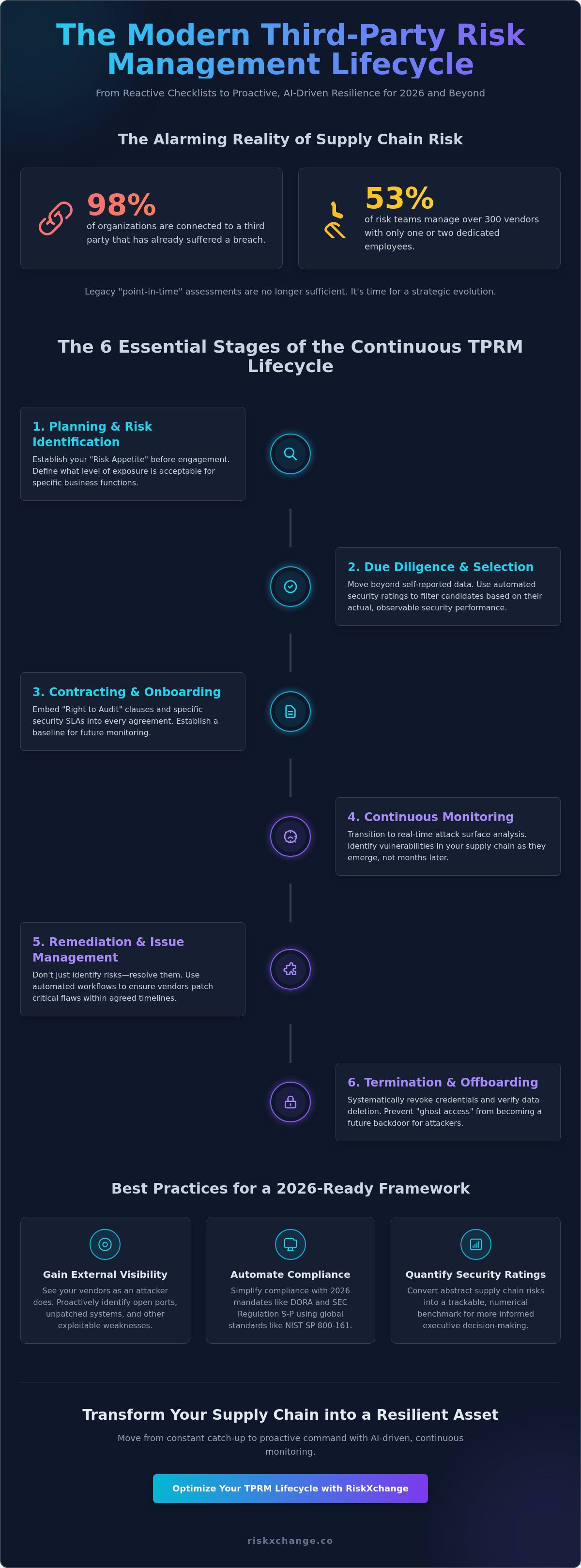
Did you know that 98% of organizations are currently connected to a third party that has already experienced a breach? Despite this staggering reality, 53% of risk teams are still attempting to manage upwards of 300 vendors with only one or two dedicated employees. It's a precarious position that leaves you drowning in manual questionnaires and "point-in-time" assessments that are obsolete the moment they're completed. You've likely realized that a lack of visibility into fourth-party risks is no longer just a technical gap; it's a fundamental business vulnerability.
We're here to help you move from a state of constant catch-up to proactive command. By modernizing your third-party risk management lifecycle with AI-driven, continuous monitoring, you can transform supply chain uncertainty into a trackable, numerical benchmark of resilience. This article provides a clear roadmap for vendor oversight that automates compliance with critical 2026 deadlines for DORA and SEC Regulation S-P. You'll discover how to build a strategic framework that reduces breach probability and provides the granular technical oversight required to secure your entire digital ecosystem.
What is the Third-Party Risk Management Lifecycle?
The third-party risk management lifecycle is the end-to-end strategic framework used to identify, evaluate, and mitigate the digital and operational risks posed by external entities. In a highly interconnected 2026 ecosystem, this process is no longer a linear checklist that begins with onboarding and ends with a contract termination. Instead, it's a continuous loop of intelligence and remediation. This circular approach ensures that your organization maintains perpetual resilience, even as your vendors' security postures fluctuate in real time. Effective third-party management now requires a move away from manual, spreadsheet-based tracking toward AI-native risk intelligence platforms. These systems provide a 360-degree view of your supply chain, merging cybersecurity metrics with ESG scores and data protection compliance into a single, actionable lens.
The Evolution of Vendor Oversight
Legacy vendor oversight relied on "point-in-time" assessments, which were often outdated before the ink dried. In 2026, the industry has shifted toward real-time security ratings that offer immediate visibility into a vendor's vulnerabilities. This evolution is driven by intense regulatory pressure. For instance, the 2026 reporting cycle for the DORA Register of Information requires financial entities in the Netherlands, Ireland, and Malta to submit detailed contractual documentation by March 2026. Similarly, the SEC’s Regulation S-P amendments mandate written incident response programs by June 2026. These aren't just compliance hurdles; they're catalysts for building true supply chain resilience. The goal is to transform your vendor network from a source of hidden vulnerability into a transparent, managed asset that supports your broader business objectives.
Why a Structured Lifecycle Matters
A failed lifecycle approach carries a heavy price tag; breaches involving a third party increased to 30% in Verizon's 2025 DBIR, doubling from the previous year. When you don't have a structured third-party risk management lifecycle, your risk data becomes siloed. Procurement might see a vendor's financial health, while IT remains unaware of their critical software vulnerabilities. A unified lifecycle eliminates these blind spots by centralizing data and providing "External Visibility." This perspective allows you to see your vendors exactly as an attacker does, identifying open ports or unpatched systems before they can be exploited. By treating security as a trackable, numerical benchmark throughout the entire relationship, you gain the command and agency needed to protect your organization from the outside in.
The 6 Essential Stages of the TPRM Lifecycle
Mastering the third-party risk management lifecycle requires a shift from passive checking to active, intelligence-led oversight. While legacy models often stopped at onboarding, the 2026 framework operates as a continuous loop. This circularity ensures that your defense posture remains robust despite the volatility of the modern threat landscape. While some frameworks, such as The Five Stages Of Third-Party Risk Management, provide a strong foundation for financial entities, a comprehensive 2026 strategy must include a sixth phase: secure termination and offboarding. This final step is critical for revoking digital access and ensuring data deletion, preventing "ghost" access from becoming a backdoor for attackers.
- Phase 1: Planning and Risk Identification – Establish your "Risk Appetite" before engaging. Define what level of exposure is acceptable for specific business functions.
- Phase 2: Due Diligence and Selection – Move beyond self-reported data. Use automated security ratings to filter candidates based on their actual, observable security performance.
- Phase 3: Contracting and Onboarding – Embed "Right to Audit" clauses and specific security SLAs into every agreement. Establish a baseline for future monitoring.
- Phase 4: Continuous Monitoring – Transition to real-time attack surface analysis. This identifies vulnerabilities in your supply chain as they emerge, not months later.
- Phase 5: Remediation and Issue Management – Don't just identify risks; resolve them. Use automated workflows to ensure vendors patch critical flaws within agreed timelines.
- Phase 6: Termination and Offboarding – Systematically revoke credentials and verify the return or destruction of sensitive data to close the lifecycle loop.
Initial Assessment and Due Diligence
The procurement funnel is often where risk management fails first. By using AI-native tools to pre-screen vendors, you can identify red flags before a single contract is signed. Rather than relying solely on manual questionnaires, which 12% of organizations still manage via spreadsheets, you should prioritize independent security telemetry. This data provides an objective view of a vendor's hygiene. Categorizing vendors by criticality is equally vital. Tier 1 vendors with direct access to your core infrastructure require deeper, more frequent scrutiny than Tier 3 service providers with no data access. Implementing a real-time risk management platform allows you to automate this tiering, ensuring your limited resources are always focused on the highest-impact threats.
Onboarding and Continuous Oversight
Onboarding is the most effective time to establish technical benchmarks. Use this phase to set a quantifiable security score that the vendor must maintain throughout the relationship. Once the contract is active, the focus must shift to "Always-On" monitoring. This is essential for catching zero-day vulnerabilities that appear between annual assessments. In 2026, oversight also means merging silos. Your monitoring loop should integrate cybersecurity data with ESG metrics and financial health indicators. This holistic view ensures that a vendor's operational instability doesn't become your next security breach.
Beyond Questionnaires: The Role of Continuous Monitoring
The biggest hurdle to a robust third-party risk management lifecycle is the perceived lack of bandwidth. Risk teams often feel they must choose between thoroughness and speed. If you're managing 300 or more vendors with a skeleton crew, 24/7 monitoring sounds like an impossible dream. However, AI-native platforms have changed the math. These systems provide "Autonomous Oversight" by scanning the digital horizon for threats without requiring additional headcount. They act as a persistent guardian, shifting your posture from reactive fire-fighting to proactive command.
This transition relies on Attack Surface Management (ASM) as the primary lens for visibility. By viewing your vendors' external infrastructure as an attacker would, you gain immediate clarity on their vulnerabilities. This clarity must extend beyond your direct partners. The "Fourth-Party" problem is a significant blind spot in 2026; currently, 79% of organizations report that less than half of their nth-party suppliers are covered by a cybersecurity program. A modern lifecycle must account for these hidden dependencies to prevent a breach from cascading through your broader supply chain.
Real-Time Security Ratings vs. Annual Audits
Static audits are fundamentally flawed because they capture a single moment in time. In the volatile threat landscape of 2026, the "decay rate" of a traditional audit is nearly instantaneous; a clean report today is often obsolete within 24 hours. While Federal Reserve TPRM lifecycle guidance emphasizes the need for regular review, relying on self-reported questionnaires is no longer sufficient. Visibility is the prerequisite for control. You can't manage what you can't see, and you can't see the truth through a vendor's curated answers alone. Objective security ratings provide the data-driven honesty required for an elite security posture.
Automating the Remediation Loop
Identifying a risk is only half the battle. The second half is resolution. When a vendor's security rating drops below your established threshold, your platform should trigger automated alerts. This allows for "Collaborative Remediation." Instead of sending an accusatory email, you provide the vendor with the specific data they need to fix the gap. Using quantifiable metrics as a tangible anchor ensures that these discussions are based on facts, not interpretations. It turns security into a trackable benchmark that holds vendors accountable to the high standards defined in your initial contract. This steady, methodical approach ensures that vulnerabilities are not just identified, but systematically closed.
Implementing a TPRM Framework: Best Practices for 2026
Implementing a robust third-party risk management lifecycle requires more than just software; it demands a cultural shift toward structured accountability. In 2026, the benchmark for excellence is alignment with global standards like NIST SP 800-161 or ISO 27001. These frameworks provide a methodical path for managing complex supply chain risks, ensuring that security is woven into the fabric of every vendor relationship. Successful implementation also hinges on the creation of a cross-functional Risk Committee. By bringing together leaders from Legal, IT, and Procurement, you ensure that risk is evaluated from every angle. This prevents the silos that often lead to oversight failures.
Prioritization is the next pillar of a mature framework. You must develop a Tiering Logic that separates your high-impact partners from low-risk service providers. This logic should be based on quantifiable data, such as the volume of sensitive data handled or the criticality of the vendor to your business continuity. This allows your team to focus their energy where it matters most, moving from a state of general concern to one of targeted, proactive control. To see how your organization can automate your TPRM framework and maintain this level of precision, consider an AI-native platform designed for continuous oversight.
Governance and Stakeholder Alignment
Board members and executives don't need technical jargon; they need clarity. Presenting third-party risk data using clear, numerical ratings transforms abstract threats into a trackable, business-centric benchmark. This transparency builds confidence and ensures that security investments are data-driven. Ownership is equally critical. Every stage of the lifecycle must have a designated owner who is accountable for specific outcomes. Finally, you should integrate this risk data directly into your existing ERP and ITSM workflows. This ensures that security intelligence is available at the point of decision-making, whether you're approving a new purchase or responding to a service ticket.
Termination and Secure Offboarding
The "Ghost Vendor" remains one of the most significant yet overlooked risks in the 2026 landscape. Inactive accounts and forgotten access points are prime targets for attackers looking for a quiet path to exfiltration. A "Clean Exit" strategy is just as vital as the onboarding process. Your offboarding checklist must include the immediate revocation of all digital credentials, the verified return or destruction of sensitive data, and a final audit to ensure no remnants of the partnership remain. Adhering to these data destruction clauses is not just a best practice; it's a regulatory necessity under GDPR and DORA. By closing the loop with the same rigor you used to open it, you maintain the permanence and stability of your security posture.
Optimizing the Lifecycle with RiskXchange
RiskXchange serves as the technical engine that powers a modern, resilient third-party risk management lifecycle. By deploying an AI-native platform, organizations can move away from the fragmented, manual processes of the past and embrace a unified system of record. This platform automates the entire 360-degree lifecycle, from initial risk identification to secure offboarding. It transforms security from an abstract, shifting concept into a trackable, numerical benchmark. This transition allows decision-makers to manage their supply chains with the quiet confidence of a seasoned expert, ensuring that every vendor relationship is visible, measurable, and manageable.
The core of this optimization lies in the integration of real-time security ratings. These ratings provide the data-driven honesty required during both the due diligence and continuous monitoring phases. Instead of waiting for a vendor to respond to a questionnaire, you gain immediate, objective insights into their actual security performance. This immediacy is vital for streamlining compliance with the 2026 regulatory environment. By automating evidence collection for mandates like DORA and ESG, RiskXchange removes the administrative friction that typically slows down risk teams. It moves your organization from a state of vulnerability to one of informed empowerment, where risk intelligence becomes a strategic asset rather than a compliance burden.
The 360-Degree Visibility Advantage
A unique advantage of the RiskXchange platform is its ability to provide an externalized perspective of your entire attack surface. This lens allows you to evaluate your vendors exactly as an attacker would, identifying vulnerabilities before they can be exploited. This level of technical oversight is achieved without increasing headcount. In fact, by replacing manual workflows with AI-driven automation, organizations can reduce their assessment time by up to 80%. This efficiency was demonstrated when a global leader in the financial sector used the platform to secure a supply chain of over 1,000 vendors, successfully identifying and remediating critical fourth-party risks that had previously remained obscured.
Get Started: From Obscurity to Clarity
Transitioning from obscurity to clarity begins with a single, quantifiable metric. We invite you to view your own organization's security rating to understand how you are perceived by the outside world. RiskXchange is designed for seamless integration with your existing security stack, ensuring that risk data flows directly into your established workflows. This stability and permanence of oversight are what distinguish a sophisticated third-party risk management lifecycle from a mere checklist. If you are ready to take proactive command of your supply chain resilience, book a demo to see the RiskXchange platform in action and discover how to simplify the complexity of the modern threat landscape.
Secure Your Supply Chain for 2026 and Beyond
Navigating the 2026 threat landscape requires a fundamental shift from a reactive posture to proactive command. As we've explored, the traditional reliance on static, point-in-time assessments is insufficient for modern resilience. By implementing a circular third-party risk management lifecycle, you replace obscurity with clarity; ensuring that every external dependency is visible and measurable. This structured approach allows your organization to meet rigorous regulatory deadlines for DORA and the SEC while simultaneously reducing the probability of a supply chain breach.
The transition to autonomous oversight doesn't have to be overwhelming. With AI-native real-time security ratings and 360-degree supply chain visibility, you can manage complex risks with precision and ease. Our teams in London, Austin, and Dubai are ready to help you transform your security posture into a trackable, numerical benchmark of success. Take the next step toward informed resilience today. Request a Free Demo of the RiskXchange AI-Native TPRM Platform and see how we simplify the complexity of the modern threat landscape. You'll gain the agency needed to protect your digital ecosystem with confidence.