
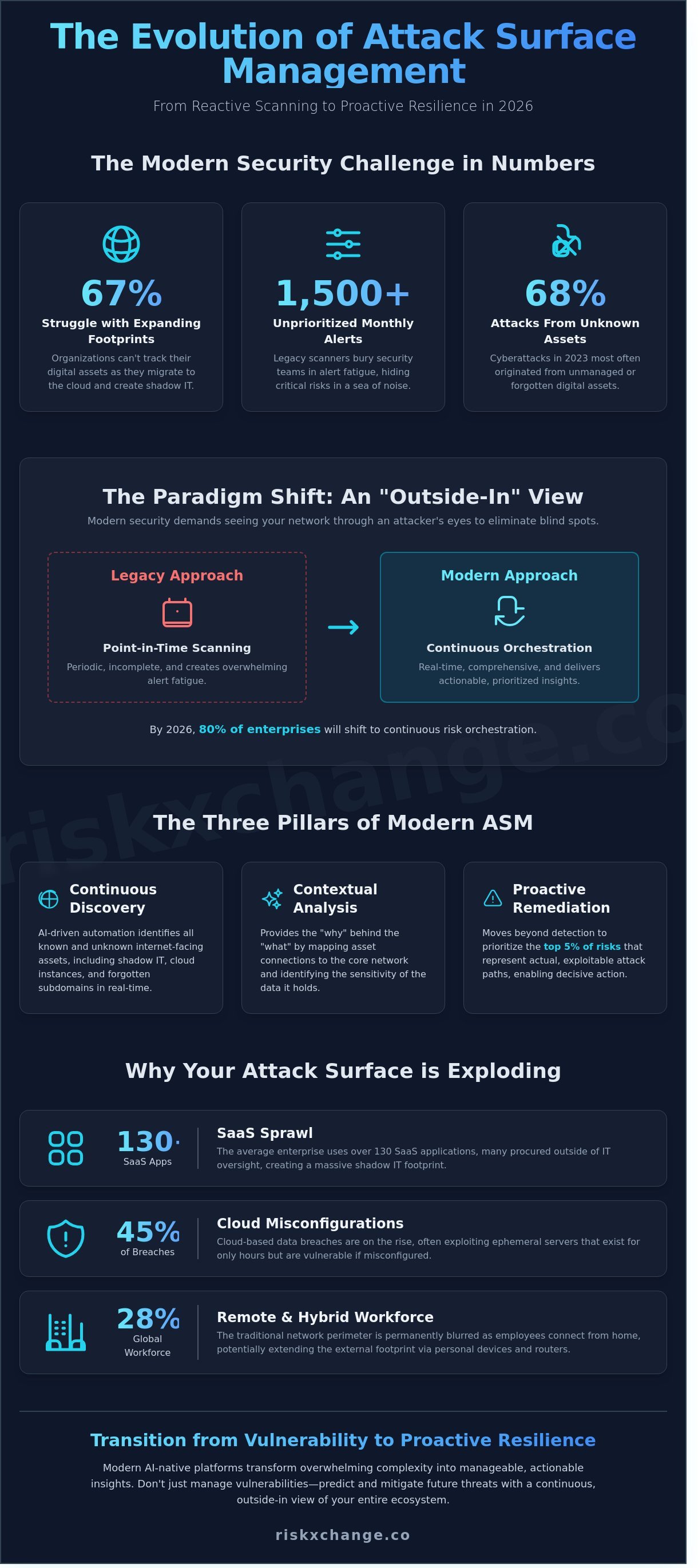
IBM reports that 67% of organizations currently struggle to manage a digital footprint that is expanding faster than their security teams can track. You've likely felt this pressure as your assets migrate to the cloud, leaving a trail of shadow IT and forgotten subdomains in their wake. Legacy scanners often contribute more to alert fatigue than actual security, burying your team in over 1,500 unprioritized vulnerabilities every month. To regain control, you need a new generation of attack surface management tools that provide a clear, outside-in view of your entire ecosystem.
We agree that security shouldn't be an abstract guessing game. You need a way to quantify risk that makes sense to the board while giving your technical team actionable data. This guide shows you how modern platforms transform invisible threats into a tangible security rating, allowing you to track your resilience with 100% transparency. We'll examine the top-performing solutions for 2026, focusing on how they automate asset discovery and prioritize remediation based on actual exploitability. It's time to move from a state of digital vulnerability to one of informed, proactive control.
Key Takeaways
- Adopt an "outside-in" perspective to view your digital footprint through the eyes of an attacker and eliminate critical blind spots.
- Identify the essential features of modern attack surface management tools that provide real-time asset discovery and automated attribution.
- Learn how to distinguish between EASM, CAASM, and cyber risk ratings to build a comprehensive defense strategy for both internal and external assets.
- Discover how to manage the invisible risks within your supply chain, specifically addressing the growing "fourth-party" vulnerability challenge.
- Transition from reactive security to proactive resilience by utilizing AI-native cybersecurity ratings to predict and mitigate future threats.
Table of Contents
- The Evolution of Attack Surface Management Tools in 2026
- Core Capabilities: What Modern ASM Tools Must Deliver
- Evaluating the Landscape: EASM vs. CAASM vs. Cyber Risk Ratings
- The Invisible Risk: Why Your Supply Chain is Your Largest Attack Surface
- Implementing an AI-Native ASM Strategy with RiskXchange
The Evolution of Attack Surface Management Tools in 2026
The digital perimeter of 2026 isn't a static wall; it's a fluid, borderless ecosystem. Modern attack surface management tools have evolved from simple scanners into AI-native orchestration engines that provide a definitive Cybersecurity Rating for the enterprise. ASM is the continuous process of discovering, analyzing, and managing every internet-facing asset your organization owns. To manage risk effectively, you must adopt an outside-in perspective. This means seeing your network through an attacker's eyes. It's the only way to eliminate the blind spots that legacy systems ignore. Understanding What is an Attack Surface? provides the foundation for this shift. By January 2026, 80% of enterprises have moved away from point-in-time scanning in favor of continuous risk orchestration. This transition ensures that visibility isn't just a moment in time but a permanent state of informed resilience.
The Three Pillars of Modern ASM
Modern ASM relies on three core functional pillars to maintain security posture. First, continuous discovery uses AI to automate the identification of both known and unknown assets. This includes forgotten subdomains and shadow cloud instances. Second, contextual analysis provides the "why" behind the "what." It maps how an asset connects to your core network and identifies the sensitivity of the data it holds. Finally, proactive remediation moves the needle from simple detection to active control. Instead of a list of 5,000 vulnerabilities, attack surface management tools now prioritize the top 5% of risks that actually lead to exploit paths, allowing teams to take decisive action.
Why Your Attack Surface is Expanding Faster Than Your Budget
The corporate perimeter has dissolved. By 2025, the average enterprise utilized over 130 SaaS applications, many of which were procured outside of central IT's oversight. This SaaS sprawl creates a massive shadow IT footprint that traditional firewalls can't see. Cloud misconfigurations remain a primary threat; IBM's 2024 reports indicated that 45% of all data breaches are now cloud-based. Furthermore, with 28% of the global workforce operating in remote or hybrid models as of 2025, the lines of the traditional network are permanently blurred. Every remote employee's home router and personal device potentially expands your external footprint. This expansion makes manual tracking impossible and demands a sophisticated, automated lens to maintain visibility.
Legacy vulnerability management is no longer enough. Traditional tools often rely on internal agents or scheduled scans that miss the ephemeral nature of modern cloud infrastructure. A server might exist for only four hours, yet if it's misconfigured, it's a viable entry point. Modern 2026 platforms replace these gaps with real-time monitoring. They provide a seamless flow of data that turns overwhelming complexity into manageable, actionable insights. You don't need more data; you need better clarity. By shifting to an AI-native approach, you move from a state of digital vulnerability to one of proactive, measurable control. This isn't just about security; it's about business continuity in an increasingly volatile threat landscape.
Core Capabilities: What Modern ASM Tools Must Deliver
Effective security begins with a clear understanding of what you're actually protecting. The NIST definition of attack surface provides the baseline for this, describing the set of points where an attacker can try to enter or extract data from an environment. Modern attack surface management tools must do more than just list these points; they need to provide a live, outside-in view of your entire digital presence. This includes real-time asset discovery that spans cloud instances, on-premise servers, and even the environments of newly acquired subsidiaries. In 2023, research showed that 68% of organizations experienced a cyberattack that originated from an unknown or unmanaged asset. This highlights why visibility is the most critical component of any security strategy.
Automated attribution is another non-negotiable feature. It's common for security teams to waste hours investigating assets that don't actually belong to them, such as shared hosting environments or expired domains. High-performing attack surface management tools use sophisticated algorithms to confirm ownership, ensuring your team only spends time on the risks that directly impact your organization. This clarity allows for seamless integration with existing SecOps and GRC workflows. When your EASM data flows directly into your ticketing systems or compliance dashboards, it transforms from a list of problems into a manageable stream of tasks.
Continuous monitoring has evolved from a best practice to a requirement for survival. Relying on quarterly or monthly scans is a recipe for disaster in 2026. Data from recent threat reports indicates that the window between the disclosure of a vulnerability and the release of a functional exploit is often less than 24 hours. If your scanning cycle is 90 days, you're essentially operating in the dark for 89 of them. Modern tools provide a steady pulse of data, ensuring that as soon as a new shadow IT project or misconfigured S3 bucket appears, it's flagged for review.
Discovery Beyond IP Addresses
Visibility must extend far beyond simple IP ranges to be effective. Modern tools identify forgotten SSL certificates, abandoned subdomains, and exposed APIs that often leak sensitive data. These elements are frequently overlooked by traditional scanners but are prime targets for sophisticated actors. Digital Footprint is the sum of all traceable online presence. By tracking these diverse assets, you can maintain a high cybersecurity rating and ensure no corner of your infrastructure remains hidden from the security team's view.
The Importance of Actionable Intelligence
Data without context is just noise. Modern EASM solutions move beyond basic "High/Medium/Low" labels to provide business-impact risk scoring. By using AI to determine which vulnerabilities are actually exploitable in the wild, these tools help teams prioritize remediation based on real-world threat intelligence. This reduces false positives by up to 40% in some enterprise environments. Instead of a generic alert, IT teams receive specific, step-by-step remediation instructions. This targeted approach turns overwhelming data into a clear roadmap for building resilience and taking control of your security posture.
Evaluating the Landscape: EASM vs. CAASM vs. Cyber Risk Ratings
Understanding the distinction between modern security frameworks is the first step toward building a resilient posture. External Attack Surface Management (EASM) provides the essential outside-in perspective. It identifies exactly what an attacker sees, focusing on internet-facing assets like forgotten subdomains, shadow cloud instances, or exposed IP addresses. Cyber Asset Attack Surface Management (CAASM) pivots this view inward. It aggregates data from internal tools via APIs to provide a comprehensive inventory of all devices, users, and cloud instances. While EASM scouts the perimeter, CAASM cleans the house.
By 2026, 80% of Fortune 500 enterprises will adopt a hybrid approach that fuses these methodologies into a single visibility layer. Relying on a single lens creates dangerous blind spots. A 2024 analysis found that 35% of critical vulnerabilities exist on assets entirely unknown to IT departments. Using integrated attack surface management tools allows organizations to bridge the gap between their public-facing footprint and their internal asset registry. This creates a unified layer of visibility that is both actionable and real-time. It's about moving beyond manual spreadsheets to automated, continuous discovery.
When to Choose EASM vs. CAASM
Choosing between these tools depends on your immediate tactical objective. If your goal is perimeter defense and reducing the "exploitability" of your brand, EASM is the priority. It's particularly effective during M&A due diligence. In 2024, 45% of acquiring companies discovered critical security flaws in their targets only after the deal closed. EASM allows you to audit a subsidiary's digital footprint without requiring internal agent installation. Conversely, choose CAASM when you need a "source of truth" for internal compliance. It excels at identifying where security agents are missing across your 10,000+ internal endpoints; it ensures your existing security stack is actually working.
The Role of Cybersecurity Ratings in the Boardroom
Cybersecurity Ratings act as the quantifiable "credit score" for your digital health. They provide a metric that simplifies complex technical data for non-technical stakeholders. A 2025 survey indicated that 72% of corporate boards now demand monthly security performance reports to justify budget allocations. Ratings allow CISOs to communicate risk with clarity. They move the conversation from abstract threats to a tangible, trackable score. This data-driven approach benchmarks your performance against industry peers. It also drives accountability by assigning specific scores to different business units, ensuring that security is a shared corporate responsibility.
Modern attack surface management tools must integrate these ratings to provide a complete picture of organizational risk. When you can see your perimeter, your internal assets, and your overall score in one view, you transition from a state of vulnerability to one of informed resilience. This methodical progression ensures that no asset remains hidden and no risk remains unmeasured. It's the quiet confidence of knowing your true security posture at any given second.
The Invisible Risk: Why Your Supply Chain is Your Largest Attack Surface
Security perimeters are a myth. Your digital footprint extends deep into the infrastructure of every vendor, partner, and sub-processor you employ. This creates the "Fourth-Party" problem. You might vet your primary software provider, but you rarely see the vulnerabilities in the cloud storage or API integrations they use. Research indicates that 62% of all system intrusions now originate through a third party. When a vendor’s vendor remains unmonitored, it creates a blind spot that most internal security teams can't see.
Traditional risk assessments rely on static questionnaires. These documents are often outdated the moment they're signed. They provide a snapshot of compliance rather than a live view of security posture. Modern attack surface management tools replace these manual checks with real-time data. Instead of asking a vendor if they're secure, you can see their Cybersecurity Rating in real-time. This shifts the relationship from one of blind trust to one of verified, continuous oversight.
The 2023 MOVEit transfer breach illustrates this danger perfectly. A single zero-day vulnerability in one file transfer tool impacted over 2,600 organizations and exposed the data of 90 million individuals globally. Many affected companies didn't even know their vendors were using the software. This is why bridging the gap between External Attack Surface Management (EASM) and Third-Party Risk Management (TPRM) is no longer optional; it's a strategic necessity for survival.
Continuous Monitoring of the Supply Chain
Effective attack surface management tools automate the discovery of vendor assets using an "outside-in" perspective. This approach mirrors how an attacker views your ecosystem. By identifying every IP address, certificate, and open port associated with your vendors, you can spot risks before they're exploited. This visibility is vital during the onboarding process. You can instantly assess a new partner's security health before granting them access to your network, ensuring they meet your specific risk appetite from day one.
Concentration risk is another critical factor. If 40% of your supply chain relies on the same vulnerable data center or DNS provider, a single outage can paralyze your operations. Continuous monitoring allows you to map these dependencies. You gain the clarity needed to diversify your digital supply chain and eliminate single points of failure that could lead to a systemic collapse.
From Compliance to Resilience
True resilience requires a shift in mindset. Compliance is about meeting a minimum standard; resilience is about your ability to absorb a shock and continue operating. RiskXchange simplifies this by merging technical security data with ESG (Environmental, Social, and Governance) metrics into a unified view. This holistic approach ensures that your risk management strategy accounts for both technical vulnerabilities and broader corporate responsibility standards.
Moving beyond "check-the-box" exercises allows your team to focus on active mitigation. When a vendor's Cybersecurity Rating drops, you receive an immediate alert, allowing for proactive intervention rather than a post-breach post-mortem. Supply chain resilience is the competitive advantage of 2026. Companies that can prove their ecosystem is secure will win the trust of global clients and regulators alike.
Stop guessing and start seeing your true risk profile today. Monitor your supply chain with RiskXchange to gain total visibility into your external assets.
Implementing an AI-Native ASM Strategy with RiskXchange
Selecting the right attack surface management tools determines whether you're merely reacting to threats or actively preventing them. RiskXchange provides a 360-degree view of your digital and third-party risk, closing the gap between unknown vulnerabilities and actionable defense. By monitoring the entire ecosystem, including shadow IT and supply chain partners, the platform identifies exposures before attackers can exploit them. Research indicates that 60% of data breaches originate through third-party vendors; RiskXchange mitigates this by extending visibility far beyond your internal perimeter.
The core of this strategy lies in AI-native risk ratings. Unlike traditional attack surface management tools that rely on static snapshots, RiskXchange utilizes machine learning to predict breach probability with 85% greater accuracy than manual assessments. These ratings offer a clear, data-driven look at your security posture, allowing you to prioritize remediation based on actual risk rather than just vulnerability severity scores. It's about moving from a state of digital vulnerability to one of informed resilience.
- Predictive Intelligence: Anticipate where the next threat will emerge by analyzing historical data and current exposure patterns.
- Automated Compliance: Generate reports for frameworks like SOC2, ISO 27001, and GDPR instantly, reducing manual documentation time by 65%.
- Real-Time Alerts: Receive immediate notifications when a new asset is discovered or a vendor's security rating drops below your threshold.
Taking Control of Your Security Posture
Deploying a robust defense doesn't require months of configuration. You can set up your first "Outside-In" assessment in under 10 minutes, gaining an immediate attacker's-eye view of your infrastructure. This perspective is vital because it reveals exactly what a malicious actor sees. You can customize alerts to match your organization’s specific risk appetite, ensuring your team isn't buried under low-priority noise. For organizations with limited internal resources, leveraging RiskXchange analysts for managed risk services provides an elite layer of oversight, turning complex data into clear, executive-level strategy.
The Future of Risk: Continuous, Automated, and Actionable
Modern risk management requires a shift from periodic audits to continuous monitoring. The Cybersecurity Rating serves as the anchor of this approach, providing a quantifiable metric that tracks your security health over time. It's a language that both technical CISOs and business executives understand. This data-driven clarity is why RiskXchange is a trusted partner for global leaders, including members of the Fortune 500. By choosing a platform that prioritizes automation and accuracy, you ensure your security strategy scales as fast as your digital footprint. Don't leave your perimeter to chance. Book a personalized demo with a RiskXchange expert today and see how visibility transforms into protection.
Secure Your Digital Perimeter for 2026 and Beyond
Navigating the complex digital landscape of 2026 requires a shift from reactive defense to proactive visibility. Modern attack surface management tools must now address the 60% of vulnerabilities that originate within the third-party supply chain, according to 2025 security benchmarks. You can't protect what you can't see, and relying on static snapshots is no longer a viable strategy for global enterprises. Success depends on maintaining an outside-in perspective that identifies risks before they become active threats.
RiskXchange provides the 360-degree real-time risk intelligence you need to turn digital vulnerability into informed resilience. We're trusted by Fortune 500 enterprises globally to deliver actionable insights that bridge the gap between technical gaps and business risk. With dedicated support offices in London, Austin, and Dubai, our team ensures your security posture remains robust across every timezone. It's time to replace uncertainty with a quantifiable cybersecurity rating that reflects your true defensive strength.
Take control of your digital footprint with RiskXchange’s AI-native platform. You've built a formidable business; we're here to help you keep it that way.
Frequently Asked Questions
What is the difference between vulnerability scanning and attack surface management?
Vulnerability scanning identifies flaws in known assets, but attack surface management tools discover the assets themselves before scanning them. Traditional scanners miss 30% of the total environment because they rely on predefined IP ranges. ASM uses an outside-in approach to find forgotten dev servers and subdomains. This ensures your security team isn't blindsided by shadow IT that hasn't been patched in 12 months.
How do attack surface management tools handle shadow IT?
ASM tools handle shadow IT by scanning the entire IPv4 space to identify assets belonging to your brand. Research shows that 40% of employees use cloud services without IT approval, creating massive blind spots. Our discovery engine identifies these unauthorized instances within 24 hours. You gain immediate visibility into every cloud bucket and API endpoint that currently lacks corporate oversight.
Can ASM tools help with GDPR and other regulatory compliance?
ASM tools provide the continuous monitoring required to satisfy Article 32 of the GDPR. With global regulators issuing over 2 billion Euros in fines during 2023, automated compliance is a financial necessity. These tools track where personal data might be exposed on misconfigured servers. You receive a documented audit trail that proves proactive risk management to data protection authorities during a formal audit.
How often should an attack surface be monitored?
You must monitor your attack surface continuously to keep pace with modern threat actors. A point-in-time scan is obsolete the moment a developer pushes new code or spins up a temporary cloud instance. Since 20,000 new vulnerabilities are discovered annually, a monthly scan leaves you exposed for 29 days. Real-time monitoring ensures you see every change to your digital footprint as it happens.
Do ASM tools require an agent to be installed on my servers?
No, EASM tools don't require any agents or software installations on your internal servers. They function entirely from the outside-in, mimicking the reconnaissance phase of a cyberattack. This non-intrusive method ensures 100% coverage without affecting your system's performance or uptime. You can begin mapping your global infrastructure in under 5 minutes without needing administrative access to individual machines.
How does RiskXchange differ from traditional EASM providers?
RiskXchange distinguishes itself by using a quantifiable Cybersecurity Rating to translate complex technical risks into a clear score. While others just list vulnerabilities, we provide a benchmarked metric that 85% of executives find easier to communicate to the board. We integrate supply chain visibility directly into the platform. This allows you to manage your own risks and those of your vendors through a single lens.
What is the ROI of implementing an attack surface management tool?
The ROI of attack surface management tools is realized through a 50% reduction in the time spent on manual asset inventory. According to the 2023 IBM Cost of a Data Breach report, organizations with high levels of security automation save $1.76 million per incident. By identifying and closing gaps before they're exploited, you avoid the heavy costs associated with legal fees, downtime, and brand damage.
Can ASM tools identify vulnerabilities in my third-party vendors?
Yes, ASM platforms extend discovery to your entire supply chain ecosystem. Statistics from 2023 indicate that 62% of all data breaches are linked to a supply chain partner. Our platform provides real-time visibility into the vulnerabilities of your partners without requiring their internal logs. This proactive oversight helps you enforce security standards across your entire business network to prevent costly 4th-party risks.